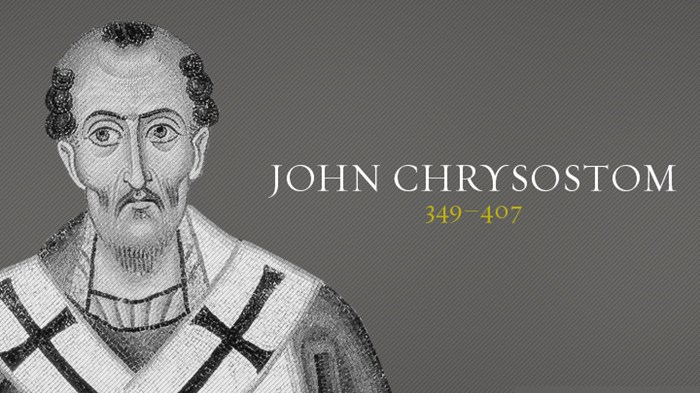
John Chrysostom


"Preaching improves me. When I begin to speak, weariness disappears; when I begin to teach, fatigue too disappears."
"It is foolishness and a public madness to fill the cupboards with clothing," John of Antioch exhorted the congregation, "and allow men who are created in God's image and likeness to stand naked and trembling with the cold so that they can hardly hold themselves upright."
Eloquent and uncompromising preaching was typical of John and earned him the name history would remember him by: Chrysostomos—"golden mouth." But his preaching, though considered the best in the early church, was what got him into trouble and led to his untimely death.
Affair of the statues
John was raised in Antioch, a leading intellectual center of late antiquity, by his widowed mother, Anthusa, a pious Christian woman. His tutor was Libanius, the famous pagan rhetorician who had been a professor in both Athens and Constantinople.
After his education, like many devout men of his day, the spidery John (he was short, thin, and long-limbed) entered monastic seclusion. But his ascetic rigors were so strenuous, they damaged his health (the effects would last his whole life), and he was forced to return to public life. He quickly went from lector to deacon to priest at the church in Antioch.
Timeline |
|
|
323 |
Eusebius completes Ecclesiastical History |
|
325 |
First Council of Nicea |
|
341 |
Ulphilas, translator of Gothic Bible, becomes bishop |
|
349 |
John Chrysostom born |
|
407 |
John Chrysostom dies |
|
410 |
Rome sacked by Visigoths |
During this time, he penned On the Priesthood, a justification for his own delay in entering the priesthood but also a mature look at the perils and possibilities of ministry: "I do not know whether anyone has ever succeeded in not enjoying praise," he wrote in one passage. "And if he enjoys it, he naturally wants to receive it. And if he wants to receive it, he cannot help being pained and distraught at losing it."
It was in Antioch where Chrysostom's preaching began to be noticed, especially after what has been called the "Affair of the Statues."
In the spring of 388, a rebellion erupted in Antioch over the announcement of increased taxes. Statues of the emperor and his family were desecrated. Imperial officials responded by punishing city leaders, killing some; Archbishop Flavian rushed to the capital in Constantinople, some 800 miles away, to beg the emperor for clemency.
In Flavian's absence, John preached to the terrified city: "Improve yourselves now truly, not as when during one of the numerous earthquakes or in famine or drought or in similar visitations you leave off your sinning for three or four days and then begin the old life again." When eight weeks later, Flavian returned with the good news of the emperor's pardon, John's reputation soared.
From then on, he was in demand as a preacher. He preached through many books of the Bible, though he had his favorites: "I like all the saints," he said, "but St. Paul the most of all—that vessel of election, the trumpet of heaven." In his sermons, he denounced abortion, prostitution, gluttony, the theater, and swearing. About the love of horse racing, he complained, "My sermons are applauded merely from custom, then everyone runs off to [horse racing] again and gives much more applause to the jockeys, showing indeed unrestrained passion for them! There they put their heads together with great attention, and say with mutual rivalry, 'This horse did not run well, this one stumbled,' and one holds to this jockey and another to that. No one thinks any more of my sermons, nor of the holy and awesome mysteries that are accomplished here."
His large bald head, deeply set eyes, and sunken cheeks reminded people of Elisha the prophet. Though his sermons (which lasted between 30 minutes and two hours) were well attended, he sometimes became discouraged: "My work is like that of a man who is trying to clean a piece of ground into which a muddy stream is constantly flowing."
At the same time, he said, "Preaching improves me. When I begin to speak, weariness disappears; when I begin to teach, fatigue too disappears."
Kidnapped to Constantinople
In early 398, John was seized by soldiers and transported to the capital, where he was forcibly consecrated as archbishop of Constantinople. His kidnapping was arranged by a government official who wanted to adorn the church in the capital city with the best orator in Christianity. Rather than rebelling against the injustice, John accepted it as God's providence.
And rather than soften his words for his new and prestigious audience—which now included many from the imperial household—John continued themes he preached in Antioch. He railed against abuses of wealth and power. Even his lifestyle itself was a scandal: he lived an ascetic life, used his considerable household budget to care for the poor, and built hospitals.
He continued preaching against the great public sins. In a sermon against the theater, for example, he said, "Long after the theater is closed and everyone is gone away, those images [of "shameful women" actresses] still float before your soul, their words, their conduct, their glances, their walk, their positions, their excitation, their unchaste limbs … And there within you she kindles the Babylonian furnace in which the peace of your home, the purity of your heart, the happiness of your marriage will be burnt up!"
His lack of tact and political skill made him too many enemies—in the imperial family and among fellow bishops. For reasons too complex to elaborate, Theophilus, the archbishop of Alexandria, was able to call a council outside of Constantinople and, trumping up charges of heresy, had John deposed from office. John was sent into exile by Empress Eudoxia and Emperor Arcadius.
John was transported across the plains of Asia Minor in the heat of summer, and almost immediately his health began to fail him. He was visited by loyal followers, and wrote letters of encouragement to others: "When you see the church scattered, suffering the most terrible trials, her most illustrious members persecuted and flogged, her leader carried away into exile, don't only consider these events, but also the things that have resulted: the rewards, the recompense, the awards for the athlete who wins in the games and the prizes won in the contest."
On the eastern shore of the Black Sea, at the edges of the empire, his body gave out and he died.
Thirty-four years later, after John's chief enemies had died, his relics were brought back in triumph to the capital. Emperor Theodosius II, son of Arcadius and Eudoxia, publicly asked forgiveness for the sins of his parents.
He was later given the caption of "Doctor of the Church" because of the value of his writings (600 sermons and 200 letters survive). Along with Basil the Great, Gregory of Nazianzus, and Athanasius, he is considered one of the greatest of the early Eastern church fathers.

Support Our Work
Subscribe to CT for less than $4.25/month