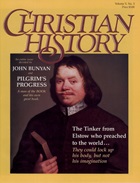
The Pilgrim's Progress: A Dream That Endures


As I walked through the wilderness of this world, I lighted on a certain place where was a den; and I layed me down in the place to sleep: and as I slept, I dreamed a dream.
This great and simple opening of The Pilgrim’s Progress may remind us that in 1678 Bunyan’s dream was delivered to a reading public ready to receive it. For not only the British but Europeans generally had become all too familiar with the moral complexity of the natural world and the hardness of its going; their every path was a perplexity, their wandering footsteps stumbled in a maze, a labyrinth, a wilderness. Already John Amos Comenius, that great educational reformer of international renown, had published his Labyrinth of the World and the Paradise of the Heart (1631), in which he hoped to show “both the vanity of the world and the glory, happiness and pleasure of the chosen hearts that are united with God,” while a host of other hortatory works in English with titles suggestive of Bunyan’s were in widespread circulation during the first half of the seventeenth century.
It is consequently hardly surprising that The Pilgrim’s Progress should have met so early with “good acceptation among the people,” as publisher Nathaniel Ponder happily observed in an appendix to the fourth edition of 1680. Furnishing as it did much counsel, caution and consolation amid the toilsome traffic of daily life, it bore a message that was at once both useful and agreeable. What is more remarkable is the degree of its success as a best-seller. Bunyan’s first editor, Charles Doe, noted in 1692 that about one hundred thousand copies were at that time in print in England alone and that the book had already appeared “in France, Holland, New England and in Welch”, a phenomenon suggesting to Doe how Bunyan’s fame might yet “be the cause of spreading his other Gospel-Books over the European and American world, and in process of time may be so to the whole Universe.” So overwhelming indeed was the continuing popularity of the book that even learned critics of the eighteenth century, like Samuel Johnson and Jonathan Swift, could not forbear to cheer.
Nevertheless, the Age of Reason generally found Bunyan lacking in finesse, and it was left to the Romantics to uphold this very absence of refinement as a peculiar virtue. If Bunyan was an unlettered tinker out of Bedford, his allegory must be the untutored work of one who was truly a “natural” genius; his pilgrim, after all, had power enough to affect the businesses and bosoms of all sorts and conditions of men. William Blake was sufficiently moved by Christian’s adventures to create his twenty-nine incomparable water-color illustrations, while Samuel Taylor Coleridge thought the allegory “the best Summa Theologiae Evangelicae ever produced by a writer not miraculously inspired.” Adulation continued unabated throughout the nineteenth century and reached a peak in the evangelical fervor of the Victorian era.
American interest in The Pilgrim’s Progress was initially fostered and later sustained by the prevalence of an apocalyptic view which anticipated the establishment of the New Jerusalem in the new world as the climactic event of history. The parallel between the vision of Christian’s journey through a harsh and hostile world to a shining city on a hill and their own utopian dream and millenarian hope was too sharp for most Americans to miss. Accordingly, the influence of Bunyan’s allegory in America was pervasive; it is indicated not only by the astonishing number of American adaptations produced in the nineteenth century, of which Hawthorne’s The Celestial Railroad is no doubt the best known, but also by the inspiration the allegory provided for authors as disparate as Hawthorne, Louisa May Alcott, Mark Twain, and E. E. Cummings.
Despite the current status of The Pilgrim’s Progress as a world’s classic, there is no question that in the twentieth century, with the general decline in piety, popular interest in the book on both sides of the Atlantic has waned enormously. Interestingly enough, however, there has been a compensatory attachment to the work at the academic level, for within the last twenty-five years Bunyan has been taken up by the universities. In what is surely a major irony The Pilgrim’s Progress is now subjected to the most rigorous critical analysis by such leading scholars as Stanley Fish and Wolfgang Iser, who regard the allegory as an object of sophisticated art from which we can learn much about the capacity of literature to engage the reader’s mind; it is likewise appreciated by other students who have mined its resources for numerous doctoral dissertations. Today, the appearance of the allegory in the fine collected edition being published by the Oxford University Press bears eloquent testimony both to its durability and to the permanent validity of what it has to say.
Given these vagaries of the book’s cultural history, can we explain why the dream has lasted? The main reasons are the nature of its message and the archetypal imagery which conveys it. While the image of life as a journey actually pre-dated the Christian era, it was from the start adopted to become one of the most potent metaphors in Christian thought, especially when wayfaring is combined, as here, with its cognate image of warfaring. For its use Bunyan was actually indebted to the popular culture of his time, because many English Puritan preachers had given precedent and sanction to the “similitude” in writing their own accounts of the spiritual life. It is, then, to the interplay of tradition and the individual talent that we owe the metaphoric structure of The Pilgrim’s Progress, a heterocosm of romance and adventure in which the Calvinist scheme of salvation is set forth as a progress from one discernible city to another and a process which has a definable beginning, a middle, and an end.
The initial scene is magnificent in its evocation of the solitariness of the long-distance runner. The picture of a man reading his Bible and experiencing a conviction of sin is the first indication of conversion: his anguished cry, “What shall I do to be saved?” opens the story with a query about individual responsibility, and the episodes that follow are so arranged as to demonstrate divine initiative and intervention in the course of salvation. As a general rule it may be said that the events that happen (such as the capture of Christian and Hopeful by Giant Despair) and the places visited (for instance, the Delectable Mountains) represent states of mind experienced during the progress. To read the book is thus to observe the elected soul negotiating the tricky and treacherous currents between the Scylla of over-confidence and the Charybdis of despair. Or it is to recognize that Christian’s world is the world of Humpty Dumpty, but with this significant difference, that whereas not all the king’s men could put Humpty Dumpty together again, Christian falls to rise, is baffled only to fight better. From this perspective The Pilgrim’s Progress is largely a pictorial representation of the doctrine of sanctification, a fact which helps us to understand why the crucial scene at the Cross comes so early in the book after less than one third of the story has been told. It also goes a long way towards explaining why this beautiful scene, in which Christian loses his burden of sin in the imputed righteousness of Christ and receives a token of his election from the Three Shining Ones, is so economically if deftly sketched. Bunyan’s especial allegorical interest in sanctification is no more than the artistic correlative of that development of Calvinist theology which seventeenth-century English Puritans had made specifically their own and for which they had become famous throughout Europe.
Yet the concentration on sanctification is by no means exclusive; all other steps in the plan of salvation find their place in the design of the whole. Following the scene at the outset comes the masterly episode of Mr. Worldy Wiseman which describes the period of formal or legal Christianity preceding effectual calling. The pilgrim is thereafter pressed onward to the Cross where his justification is made plain by his change of raiment, the mark on his forehead and the receipt of his roll. Now that the bargain has been sealed, the sequel deals with the pilgrim’s growth in grace; but every in his vicissitudes we are made to feel the binding nature of the covenant entered into at the Cross. That is why, for example, the debate with Apollyon concerns its contractual basis, the argument turning on the relationship between master and servant. And since the pilgrim does continue to follow his Master, the bond is ultimately ratified when sanctified Christian passes to the glory of the New Jerusalem.
Election, vocation, justification, sanctification, glorification: such are the stages Bunyan maps out as the progress of the elect soul. Christian is therefore not Everyman, but he is every man’s paradigm, and his application is universal. Nowhere, it seems, has the scheme of salvation been set forth more attractively and with such force and clarity. In its lack of moral ambiguity the allegory highlights a peculiar beauty of Calvinist theology as Bunyan represents “the Way” with a definitiveness one would have to go back to the first-century Didache to match. It is this concrete quality of the work, founded as it is upon the bedrock of human need and aspiration, that grounds our experience of it in reality and accounts in large measure for its permanence.
The same unabashed moral frankness, the same refusal to shrink from the disagreeable aspects of life, so reminiscent of the Shakespeare of King Lear or the Milton of Lycidas, are apparent also in the memorable characters that inhabit the allegory. Since The Pilgrim ’s Progress is a drama of predestination, all the characters met with are either doomed and damned or enskied or sainted. This sharp demarcation is evident throughout the allegory, so that Bunyan, in writing his Apology about how he quickly had his thoughts “in the black and white,” speaks no less than the figurative truth. It is not that he is insensitive to nuances of character or subtleties of behavior, but rather that he consistently expresses a moral position based on assurance; and such an attitude determines his character delineation. If Faithful be truly the type of Christian martyr, he must stand fixed in a self-denying humility as constant as the Northern Star. If Lord Hate-good condemn him, he must display peacock pomposity and bluster in braggadocio. There is nothing crude about such character-drawing; indeed, it is motivated by a desire for artistic integrity.
Within these limits Bunyan characteristically proceeds to create personae of great individuality. His creatures are not mere types or pale ghosts tagged with allegorical labels, but men and women of flesh and blood. Even the best souls are not without their shortcomings, as Christian sometimes appears too self-centered for our liking, too intent on winning his own felicity; nor are Faithful and Hopeful easily acquitted of superciliousness from time to time.
The portrait of Ignorance is the richest painting of a villain in the whole book, and he is realized economically at the outset by a phrase, “a very brisk lad,” which places him as one concerned with only the externals of religion. On the other hand, By-ends is categorized by a skillful handling of context: he is from the town of Fairspeech yet will not speak his name; but he does name all his kindred until he stands exposed as a fair-weather supporter (“most zealous when religion goes in his silver slippers”) whose motive is self-interest. Like so may other characters, By-ends is etched indelibly on the reader’s mind and he exemplifies but another aspect of Bunyan’s art that sustains continuing interest in the allegory.
These separate excellencies of structure, theme and characterization still might not move us were they not fused by a style which is rightly praised for its simplicity, directness, economy and vigor. George Bernard Shaw was even prepared (with typical Shavian extravagance) to award the palm to Bunyan against Shakespeare for the brilliance of Apollyon’s speech. Certainly much of the narrator’s persuasive power derives from Bunyan’s manipulation of language, which is often homely and colloquial in dialogue yet opulent and expansive in its range of biblical imagery and reference (particularly apocalyptic), to focus our attention where he wishes, all with the object of involving us in the action. And the case remains true whether we are trapped in Doubting Castle, restoring ourselves after the struggle with Apollyon, fearfully picking our way through the Valley of the Shadow of Death or solacing ourselves upon the Delectable Mountains.
Such are the qualities that have enabled Bunyan’s dream to endure and to confront the challenge of time and circumstance. What of the future? There is some hope that Bunyan’s little book may once again be returned to its original ownership, the common people, for while it has suffered from the disrepute into which many Puritan works have fallen, there are within it some identifiable elements far less dated than we often find it convenient to admit. Like all classics, The Pilgrim’s Progress asserts values that are of a timeless validity, and what remains from our experience of it is a vision of human life and destiny which far transcends any other consideration. Through its emphasis on the worth of the individual soul, its forceful expression of a life beyond the present and the meaning this gives to the here-and-now, the dream can yet deliver a message supremely relevant to our nuclear age. For still the cry remains: “What shall I do to be saved?”
James F. Forrest, Ph.D. is Professor of English at the University of Alberta, Edmonton, Canada
Copyright © 1986 by the author or Christianity Today/Christian History magazine.
Click here for reprint information on Christian History.

Support Our Work
Subscribe to CT for less than $4.25/month