The Piety of the Persecutors


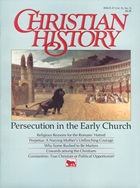
Persecutors seldom get good press. Whether the reporting is done by the journalist or the historian, it is always easier to side with the victims. The courage and fortitude of martyrs holds greater appeal than the haughty rationalizations of their judges and executors. Thus, the persecutors are seen as cruel and capricious tyrants, sybarites, inattentive to the needs of their subjects and indifferent to the ways of God.
In the writing of Christian history, the emperors most closely identified with the persecution of Christians—Domitian, Decius, and Diocletian—have long been the object of obloquy and abuse. One early Christian writer, Lactantius, even wrote a book entitled On the Death of the Persecutors. Its purpose was to describe in lurid detail the torturous end of the “enemies of God.”
Humane Roman Officials
Yet the writing of history is more than the celebration of the deeds of noble and virtuous men and women; it is also the challenge to understand what offends and disturbs our moral sensibilities.
The earliest document on Christianity written by a Roman official bears no marks of cruel indifference; its author, Pliny (governor of the province of Bithynia in Asia Minor), is humane, cautious, prudent, fair, and pious.
Pliny had been sent (c. 111) by the emperor Trajan to tour the cities of Bithynia and to oversee the social and economic affairs of the region. At one of these cities, located on the southern shore of the Black Sea, the local citizens lodged a complaint against Christians living in the region. What prompted the petition is not known, but it may have had to do with the refusal of Christians to participate in the public cult.
When Pliny looked into the matter, he discovered that the “sum total of their guilt or error amounted to no more than this: [the Christians] had met regularly before dawn on a fixed day to chant verses alternately among themselves in honor of Christ as if to a god, and also to bind themselves by oath.… After this ceremony it had been their custom to disperse and reassemble later to take food of an ordinary, harmless kind.”
In his investigation, Pliny is not being cruel; he is simply conscientiously fulfilling his duty to maintain public order.
Halting a Degenerate Cult
To what, then, does Pliny object?
In his letter Pliny calls Christianity a “degenerate sort of cult carried to extravagant lengths.” The term he uses for a degenerate cult is superstitio. (This same word is used by two contemporaries, the historians Tacitus and Suetonius, to designate Christianity. Tacitus terms Christianity a “deadly superstition,” and Suetonius calls Christians a “class of persons given to a new and mischievous superstition.”)
The Latin word superstitio has somewhat different overtones than our English superstition; in its most common sense it designates practices and beliefs associated with foreign peoples—for example, the Germanic tribes in northern Europe or the Egyptians. Jews, too, were thought to be tainted with superstition: they worshiped a single supreme deity, refrained from work on the Sabbath, refused to eat pork (a meat Romans loved), and circumcised their male children.
To say that a group was “superstitious” meant that its rites and customs set the people apart from the rest of society. The superstitious did not conform their lives to the traditions of most citizens. They were “other,” just as the saffron-robed Hare Krishna monks are to most Americans. Their otherness was, however, not simply social; it was also religious. What set them apart were not only national customs and familial traditions but also religious rituals and beliefs. In saying that Christians were “superstitious,” the Romans were making a religious judgment about their way of life.
The Romans’ Public Piety
To understand why the Romans persecuted Christians and sought to exclude them from society, we have to look at the way Romans viewed religion.
In most history books and courses on ancient civilization, little is said about Roman religion. What are celebrated and admired are Roman law, politics, road building, architecture, and administration. When religion is discussed, it is portrayed as cold and unfeeling, the perfunctory performance of lifeless ritual. Although the poems of Virgil are filled with the names of Roman gods and goddesses, and public monuments depict religious scenes, only a few specialists give much attention to Roman religion.
Traditional Roman religion emphasized the utilitas (usefulness) of religious belief for the well-being of the commonwealth, the res publica. Hence, it has been easy, especially for a civilization nurtured on the “personal” religion of Christianity, to assume that the Romans did not actually believe in the gods, but rather deemed belief in the gods merely advantageous to the life of society and to the state.
The term used most frequently to designate the religious attitudes of people such as Pliny and Tacitus was piety (pietas in Latin, eusebeia is Greek). When the Capitol—the temple of Jupiter, Juno, and Minerva in Rome—was rebuilt after the civil wars of 68–69, Tacitus described the public ceremony of dedication as an act of piety. Its rebuilding was at once a religious rite and a civic festival. It was religious in that it was an act of piety toward the gods, and civic in that it was a public occasion involving the populace. The dedication ceremony was presided over by religious as well as civic officials. In American society, it would be more like a Memorial Day celebration than a religious service of a church or synagogue. In short, piety designated loyalty and obedience to the customs and traditions of Rome, as well as reverence for the gods and respect for the rituals by which the gods were honored.
In the cities of the Roman Empire, religion was inextricably intertwined with social and political life. Piety toward the gods was thought to insure the well-being of the city, to promote a spirit of kinship and mutual responsibility, to bind together the citizenry. “In all probability,” wrote Cicero, “disappearance of piety toward the gods will entail the disappearance of loyalty and social union among men as well, and of justice itself, the queen of all the virtues.” In the most profound sense, then, impiety toward the gods disrupted society, and when piety disappears, said Cicero, “life soon becomes a welter of disorder and confusion.”
By the standards of the individual and personal religion familiar to most Westerners, it is difficult for us to appreciate the social and public character of Roman religion. But “separation of the concept of piety into a familiar and a cultic half is clearly a product of modern sensibilities; in antiquity piety formed a unity.” For the Romans, religion sustained the life of the state. The new Christian superstition undermined it.
Impious Christians
In this view of religion, tradition and custom are the final arbiters. For the Romans, the ultimate legitimation of religious beliefs did not rest on philosophical arguments about the nature of the gods but on rites that had been passed from generation to generation. Religion was also tied to place and to people. Because Christianity had no homeland and did not constitute a people or nation, and was not the bearer of an ancient tradition, its way of life could make no claim on religious truth. Hence, Christians were considered impious.
When the Romans called Christianity a superstition they meant that it promoted impiety. Superstitious practices did not contribute to the public good. In Tacitus’s phrase, Christians were hostile to humankind. By saying this, he did not mean simply that he did not like Christians and found them a nuisance (though that was certainly true), but that they were an affront to his social and religious world. There were, then, “spiritual” reasons for the persecution of Christians.
For 200 years Roman writers charged the Christians with impiety and superstition. When Porphyry wrote a book against the Christians in the mid third century, he used language reminiscent of Pliny and Tactitus. “How can people not be in every way impious and atheistic who have apostatized from the customs of our ancestors through which every nation and city is sustained? … What else are they than fighters against God?”
During the final persecution of Christians at the beginning of the fourth century, the emperor Maximinus Daia (310–313) restated this traditional Roman belief. The Christians, he wrote to a city in Asia Minor, should be “driven from your city . . . so that it may be purged of all contamination and impiety, and in pursuit of its set purpose may with due reverence give itself to the regular worship of the immortal gods.”
Superstition’s New Meaning
By the beginning of the fourth century Christianity was a large and influential social and religious force within Roman society, no longer a tiny, unknown foreign sect. Yet from the perspective of Roman officials Christians remained a people apart. They contributed little to the public life of society, and by their devotion to their own deity, Jesus of Nazareth, they undermined the religious foundations of the cities in which they lived.
With the advent of a Christian emperor, Constantine the Great, in the next decade, and the gradual transformation of the Roman Empire into a Christian Empire, the impiety of the Christians became the new “piety” of the Roman world. When Christianity became the religion of society, the term once applied to the Christians, “superstition,” took on a new meaning: Pliny and Tacitus and the emperors who had persecuted the Christians were said to be captive to deadly superstition.
Dr. Robert L. Wilken is the William R. Kenan, Jr., Professor of the History of Christianity at the University of Virginia. He is author of The Christians as the Romans Saw Them (Yale University Press, paper edition, 1985).
Copyright © 1990 by the author or Christianity Today/Christian History magazine.
Click here for reprint information on Christian History.

Support Our Work
Subscribe to CT for less than $4.25/month