Radical Resistance


Most Germans welcomed Adolf Hitler’s appointment as German chancellor (prime minister) on January 30, 1933. Few were more jubilant than Protestant church leaders. They welcomed the possibility of a national regeneration.
The dean of the Magdeburg Cathedral exulted in the Nazi flags prominently displayed in his church. “Whoever reviles this symbol of ours is reviling our Germany,” he declared. “The swastika flags around the altar radiate hope—hope that the day is at last about to dawn.”
Some churchmen even referred to the “turning point in history” where “through God’s providence our beloved fatherland has experienced a mighty exaltation.” Pastor Siegfried Leffler declared that “in the pitch-black night of church history, Hitler became, as it were, the wonderful transparency for our time, the window of our age, through which light fell on the history of Christianity. Through him we were able to see the Savior in the history of the Germans.” Pastor Julius Leutheuser added that “Christ has come to us through Adolf Hitler.”
Welcoming Hitler: Why?
The Protestant press in 1933 was full of editorials affirming that Germany’s honor would be vindicated. The humiliation of the lost world war would be left behind. Old moral values of authority, family, home, and church would be restored. The stagnant economy would move once again.
These editorials reflected the reality that the church had long held strong ties to German monarchs. Church leaders looked upon the “November Revolution” in 1918, which forced the abdication of the Kaiser (Emperor William II), as an unparalleled disaster.
Socialists had been leaders in that revolution, and they had helped form the subsequent liberal democratic Weimar Republic. Most Protestant clergy were anti-Marxist and feared communism. To them, the hated Weimar Republic had “casually” accepted the humiliating peace terms following World War I. The republic allegedly was dominated by liberals and Jews who were leading the country to destruction.
Jews, who composed only 1 percent of the German population, were accused of fostering materialism, secularism, pacifism, anti-patriotism, and moral degeneracy. The clergy also bitterly hated the Western Allies for imposing the harsh Versailles peace treaty upon Germany.
These factors insured that Protestant leaders would be solidly in the conservative camp in the 1920s. They called for a synthesis of Volkstum (German national identity) and Christianity.
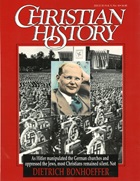
Although many German Protestants bought into this anti-democratic moral myopia, Dietrich Bonhoeffer was not one of them. Two days after Hitler’s appointment, he delivered a radio address. In it, he warned that if a leader (Führer) should succumb to the wishes of his followers and become their idol, then he would be a “misleader” who “makes an idol of himself and his office, and who thus mocks God.” The microphone was mysteriously shut off before Bonhoeffer could utter the last sentences.
Brewing Controversy in the Church
In the flush of enthusiasm following Hitler’s appointment, some Protestants set out to achieve their long-desired hope: replacing their scattered regional churches with one centralized national church (“Reich Church”).
Others wanted to revise the churches’ creeds to bring them into line with National Socialism. These churchmen were known collectively as the “German Christians.” They planned to appoint a single national “Reich Bishop.”
More ominously, they wanted to apply within the church the “Aryan Paragraph” of the new Nazi civil-service law. This clause, passed on April 7, 1933, prohibited Jews (or those of Jewish ancestry) from being appointed to any civil-service or government positions. Applied to the church, the Aryan Paragraph would have barred any Jewish Christian from holding ministerial office, or ultimately, from being part of the church at all.
In his first essay on the “Jewish question,” written in April, the young pastor and university lecturer Dietrich Bonhoeffer challenged the Nazi world view. He rejected the exclusion of Jewish Christians from the church as schismatic and heretical.
In early May, Bonhoeffer became involved in the Young Reformer group. The group formed to counter the German-Christian effort to take power in the church. The German Christians sought to elect their own Reich Bishop, Ludwig Müller, a colorless former army chaplain and ardent Nazi. Bonhoeffer and others wanted the church to maintain its integrity against efforts to Nazify it.
But their resistance was not intended as resistance to the state as such. The Lutheran theology of the German churches held that there are “two kingdoms” of church and state, both ordained by God, but with separate spheres of responsibility. The church is responsible only for the inward, or spiritual, sphere. This belief destined that the struggle would be for the “inner freedom” of the church and not a challenge to the National Socialist order per se. However, the totalistic claims of the Third Reich made a political confrontation inevitable.
Linking Christianity and Nazism
Elections for the new national German Evangelical (Protestant) Church were scheduled for July 23, 1933. With the other Young Reformers, Bonhoeffer threw himself into the campaign to counter the German Christians, who had official support and even the personal endorsement of Hitler. But they could not stop the steamroller. The “leadership principle” (allegiance to the Führer) and “racial conformity” (restrictions on Jews) were quickly introduced into the church. The Nazi Müller was easily elected Reich Bishop at the national synod (assembly) on September 27.
The Young Reformers, led by Martin Niemüller, recognized that the matter of power in the church had been resolved. Now they decided to focus on the question of truth. Utilizing the opportunity afforded by the new church constitution, they emphasized the need to develop a confession of faith—one that would counter the false doctrines of the German Christians. In August, Bonhoeffer and a colleague were sent to a retreat center at Bethel, in Westphalia, to draft a confession that could be presented at the national synod in September. However, when the text of this Bethel Confession was reviewed by others, they watered it down so much that Bonhoeffer refused to sign the final version.
Another critical event occurred on September 5. At the Prussian General Synod, the hard-liners set out to ram through the Aryan Paragraph. (This meeting is often referred to as the “Brown Synod” because the German Christian representatives, who were in the majority, appeared in brown Nazi uniforms. The other ministers wore clerical gowns.)
The Aryan Paragraph disqualified all clergy or church officials of “non-Aryan extraction” (i.e., those who had a Jewish grandparent, or who were married to such a person). When it became apparent the racist provision would be adopted, the opposition walked out. For all practical purposes this split the church.
Forming a Breakaway Church
The following day the opposition met to discuss the situation. Bonhoeffer, whose thinking on the “Jewish question” was more advanced than that of anyone else in the group, showed that the Aryan Paragraph was “a false doctrine” that “destroys the basic nature of the church.” He favored formally withdrawing and founding a free church. The majority, however, agreed to stay in and hold fast to the claim that they were the true Evangelical Church in Germany.
Immediately afterward, the Pastors’ Emergency League was formed under the leadership of Martin Niemoller. For this group, the Aryan Paragraph was a status confessionis, an issue on which the church must take a stand. By January, seven thousand (out of a total of eighteen thousand pastors) had joined the league.
Ultimately, on April 22, 1934, five thousand pastors and laypeople gathered in Ulm and created the “Confessing Church.” (The name referred to their reliance on the Reformation confessions in interpreting Scripture.) The Council of Brethren, which led the new group, convened a synod at Wuppertal-Barmen on May 29–31 to draft a confession. The resulting Barmen Declaration proved to be the most significant theological statement of the church struggle.
In many ways, however, the Confessing Church was a “reluctant resistance.” Its goal was to preserve the church, not to topple the Hitler regime. The great majority of Christians supported the Führer, even when he led them into war. With its idealistic view of the state as being always God’s agent, the Confessing Church was slow to recognize how perverted the political order had become.
Still, Article 5 of the Barmen Declaration spoke against the theological exaltation of the state and its supreme head. In 1936 the Confessing Church sent a letter to Hitler protesting the deChristianization of the people. The letter further warned the regime that its human presumption was in revolt against God. In 1938, on the eve of the expected attack on Czechoslovakia, the Confessing Church adopted a prayer of atonement. And in 1943 it produced a statement affirming human life as sacred to God and condemning the annihilation of those who were mentally ill or who belonged to another race (including the people of Israel). These actions reveal that the Confessing Church had indeed ventured on the totally new and risky path of political resistance.
Leading An “Illegal” Seminary
In 1933, Bonhoeffer had accepted a call to pastor two German congregations in London. Thus, he was not directly involved in the crucial events of 1934. But he kept in close touch with matters back home by telephone, telegraph, messenger, and personal visits. Also, he continued to expand his ties within the ecumenical movement. These contacts would prove invaluable during his later involvement in the active resistance.
As Confessing Church students were excluded from the universities, the group set up alternate seminaries to train its clergy. In March 1935, Bonhoeffer came back from London to lead one such theological school, held primarily at Finkenwalde in Pomerania. When he took his students to an ecumenical gathering in Sweden the following year, his lectureship at Berlin University was abruptly canceled. In September 1937 the Gestapo closed the Finkenwalde seminary. For the next two years Bonhoeffer trained students secretly in “collective pastorals.”
As his position deteriorated, Bonhoeffer was invited to America by theologian Reinhold Niebuhr. However, as soon as Bonhoeffer arrived in the safety of the United States (in June 1939), he began to feel pangs of conscience. He concluded he would have no right to participate in the reconstruction of Christian life in Germany after the war if he did not share the current trials with his people. After a month he returned home.
Willing His Country’s Defeat
Now Bonhoeffer had reached a crucial turning point. In the letter to Niebuhr explaining his decision, he acknowledged, “Christians in Germany will face the terrible alternative of either willing the defeat of their nation in order that Christian civilization may survive, or willing the victory of their nation and thereby destroying our civilization. I know which of these alternatives I must choose; but I cannot make that choice in security.” He had made the final break with traditional Lutheran views about unconditional obedience to civil authority.
As he wrote in his work Ethics, this was the “exceptional necessity” in which lay the “freedom of responsibility.” There was no law that compelled responsible action; the individual must take the risk to do what was in accordance with the divine guidance of history. The effort to remove Hitler, even if it meant tyrannicide, was in fact a matter of religious obedience; the new methods of oppression by the Nazis justified new types of disobedience.
Thus Bonhoeffer could say in 1941: “I pray for the defeat of my country, for I think that is the only possibility of paying for all the suffering that my country has caused in the world.” On another occasion he declared, “If we claim to be Christians, there is no room for expediency. Hitler is anti-Christ. Therefore we must go on with our work and eliminate him whether he is successful or not.”
Actually, those who desired Hitler’s ouster faced problems of such magnitude that an effective resistance became virtually impossible. For example, enormous ideological differences existed among them. Meanwhile, the ever-watchful and utterly ruthless secret police ferreted out and crushed any indication of opposition. Abroad, the Allies were suspicious of, or at best, dubious about, a German resistance. The Allies’ stated objective was “unconditional surrender.” So it was questionable whether they would accept a new German regime that resulted from a military coup.
Becoming a Double Agent
Bonhoeffer’s position further deteriorated in 1940. Increasing pressure forced his collective pastorate to be dissolved in March. Then he traveled for the Confessing Church as a pastor-at-large. In September the Gestapo prohibited him from speaking publicly because of his “subversive activity.”
But in the following month, his lawyer brother-in-law, Hans Dohnanyi, got Bonhoeffer a position as a “confidential agent” in the Abwehr (military intelligence). This protected him from being called up for military service.
Dohnanyi was a deputy to Hans Oster, an Abwehr department head. Both Oster and Dohnanyi were deeply involved in the resistance movement, so Bonhoeffer quickly was drawn in as well. The pretext for Bonhoeffer’s Abwehr membership was that he could use his ecumenical contacts to help the unit assess the political situation in Switzerland, Britain, America, and Scandinavia. In fact, Bonhoeffer would use these contacts to increase communication between the resistance movement and the Allies.
Bonhoeffer made three visits to Switzerland, where messages about resistance activities were passed to London through ecumenical channels. He also made noteworthy trips to Norway and Italy. Most important was his journey to Sweden in spring 1942. There he gave English bishop George Bell vital information about figures in the resistance. He expressed the movement’s willingness to negotiate a compromise peace following the overthrow of Hitler. Bell took this to British Foreign Secretary Anthony Eden, but Eden did nothing with it. Bonhoeffer utilized his position also to smuggle Jews into Switzerland as alleged Abwehr agents.
Facing Prison and Execution
The Gestapo began closing in on the Abwehr. Bonhoeffer was arrested in April 1943, even though it was not clear that he was involved in a conspiracy.
Bonhoeffer was lodged at Tegel Prison in Berlin. He effectively disguised the true nature of his Abwehr activities, and he was even allowed to write and to receive visitors. Because of his imprisonment, he was not directly involved in the July 20, 1944, assassination attempt on Hitler.
He might have been charged only with draft-dodging and survived the war. But certain secret papers were discovered at the military-high-command headquarters in Zossen. The papers, which had been kept by the resistance for use in a possible trial of Hitler, implicated Bonhoeffer and other Abwehr figures. Bonhoeffer was then moved downtown to the main security office for interrogation.
In February 1945 he was taken to Buchenwald concentration camp and then in April was transferred to the Flossenburg camp. On Hitler’s orders he was given a summary court-martial and hanged on April 9. In a farewell message to Bishop Bell, Bonhoeffer said: “This is the end—for me, the beginning of life.”
Dietrich Bonhoeffer’s life and death left a clear legacy for subsequent generations of Christians. From his shining example we learn that spiritual power will surely prevail over the forces of evil—but we must take an active part in that struggle.
Dr. Richard V. Pierard is professor of history at Indiana State University in Terre Haute, Indiana. He has twice held Fulbright professorships in Germany.
Copyright © 1991 by the author or Christianity Today/Christian History magazine.
Click here for reprint information on Christian History.

Support Our Work
Subscribe to CT for less than $4.25/month