The Crusades: Did You Know?
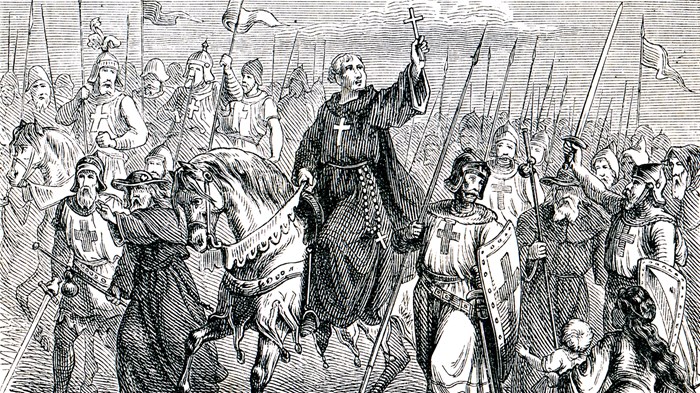


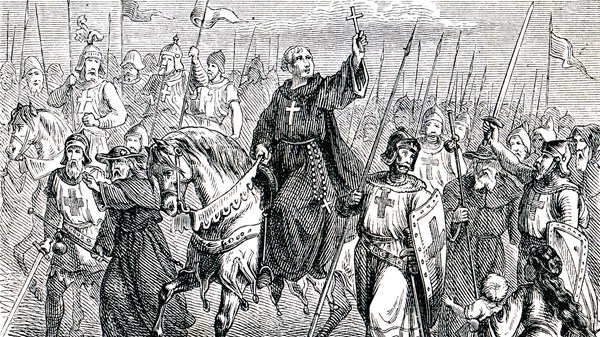
There were literally hundreds of crusades. In some periods, armed religious expeditions set forth almost every year.
Many crusades did not fight against Muslims or go near the Holy Land. The church marched against European pagans (such as the Slavs) or heretics (such as the Albigensians).
Women participated actively in the Crusades, with a few on the front lines. Arab historian Imad al-Din noted, “Among the Franks there were indeed women who rode into battle dressed in men’s clothes; who rode out into the thick of the fray.”
The Crusades were supported by such Christian saints as Bernard of Clairvaux, Catherine of Siena, and Thomas Aquinas.
Ironically, the council that launched the First Crusade also renewed the Truce of God, which limited military bloodshed. Under the Truce of God, knights were forbidden to feud from Wednesday evening to Monday morning, and on holy days. The Crusades were likewise seen as a way to bring peace, because they redirected knights’ aggression away from Europe.
The Tafurs, a group of wild peasants on the fringe of the First Crusade, would sometimes lead the charge into battle armed only with sticks! Reportedly, they sometimes cooked and ate dead Muslims in a sacred cannibalism.
During the Fourth Crusade (1202–1204), Christians attacked other Christians. The crusaders intended to fight Muslims in Egypt but got sidetracked and destroyed the great Eastern Christian capital of Constantinople.
Muslims conquered far larger territories of Christians than vice-versa. As late as 1683, Muslim forces had pushed into central Europe.
Several crusades were led by children or peasants. These groups believed God would use them, the poor and humble, to free Jerusalem. But none made it to the Holy Land.
Crusades were outrageously expensive. King Louis IX spent more than six times his annual income to finance one crusade.
Peace-loving Francis of Assisi joined the Fifth Crusade in Egypt, though he did not fight. He risked his life crossing enemy lines to preach to Muslim sultan Malik-al-Kamil. The sultan did not convert, but he offered Francis riches (declined) and had him escorted back to the Christian camp.
During the eleventh and twelfth centuries, crusading fervor broke out into savage persecutions of Jews. Although some bishops tried to stop them, Christians in the First Crusade slaughtered entire villages of Jews along the Rhine River.
In Spain and Portugal, crusade-like wars against the Muslims continued for nearly 800 years. This “perpetual crusade,” known as the Reconquest, did not end until 1492 under Isabella and Ferdinand.
Crusades were waged in almost every country in Europe and the Near East.
In military terms, crusades to the Holy Land utterly failed. Only the First Crusade reached its objective of capturing Jerusalem.
Dr. Caroline T. Marshall is professor of history at James Madison University in Harrisonburg, Virginia, and a contributor to The History of Christianity (Lion, 1977).
Copyright © 1993 by the author or Christianity Today/Christian History magazine.
Click here for reprint information on Christian History.

Support Our Work
Subscribe to CT for less than $4.25/month