A Time to Be Poor


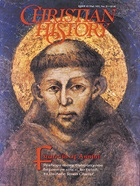
Although Francis and his Order of Friars Minor celebrated poverty with a new intensity, voluntary poverty was hardly new in Christian tradition. Luke’s Gospel emphasized Jesus’ call to renunciation, and his Acts of the Apostles idealized the Jerusalem community in which “none claimed private ownership of any possessions, but everything they owned was held in common” (Acts 4:32).
In the third century, hermits like Antony began selling all their possessions and regarded money as a demonic snare. The monastic Christianity that soon followed was likewise founded on vowed poverty.
By the eleventh and twelfth centuries, new tides of devotion led Christians to yearn for the “perfect life”—a life that would mirror Christ’s and not compromise God’s perfect will. Bernard of Clairvaux, for example, considered possessions an intolerable distraction from the love of God.
The Gross Gap
As Duane V. Lapsanski, in Evangelical Perfection, has shown, the century before Francis, monastic writers and wandering preachers increasingly focused on “evangelical poverty,” the life of poverty modeled by Christ and the apostles.
In the newly burgeoning towns, the townsfolk who prospered did so mostly by trade or usury, both of which were, at best, morally ambiguous. In the view of moralist preachers, the wealth of the towns was the result of greed and exploitation, the gap between rich and poor was gross, and there was no way the judgment of God could be evaded. It was no accident that Francis was the son of an urban merchant or that money caused him spiritual nausea. Evangelical poverty explicitly presented itself as an act of penitence and as the divine verdict against the neglect of Christ’s poor.
Radical preachers’ vigorous support of evangelical poverty did not go unchallenged. Not all tradition-minded (and comfortable) bishops and abbots were pleased with claims that they were inadequately Christ-like. As members of mendicant orders (Franciscans and Dominicans) began to attend universities, their theologians came to debate the claims of apostolic poverty with great acuity and considerable heat. Thomas Aquinas, a Dominican, argued that love, not poverty, was the measure of perfection. The Franciscans responded by forbidding members of their order to read Thomas’s works!
It was in such a time, a time passionate about poverty, that Francis formulated his views.
Dr. William S. Stafford is professor of church history at Virginia Theological Seminary in Alexandria, Virginia. He is author of Domesticating the Clergy: The Inception of the Reformation in Strasburg, 1522–1524 (Scholar's Press, 1994).
Copyright © 1994 by the author or Christianity Today/Christian History magazine.
Click here for reprint information on Christian History.

Support Our Work
Subscribe to CT for less than $4.25/month