Holy Passion for Liberty


At a safe distance of over 200 years, it’s easy to intellectualize the revolution, to debate the wisdom and folly of each political move, to discuss the various ideologies that influenced events. But for colonists, more than politics or philosophy was at stake.
These excerpts from contemporary speeches, diaries, and letters show Americans passionate for liberty and captivated by a movement they believed was blessed by God.
Prayer to Melt a Quaker
The political situation was more tense than ever when the Continental Congress met for the first time on September 5, 1774. In a letter to his wife, John Adams described the powerful religious sentiments that hung in the air as the 56 delegates gathered.
When the Congress met, Mr. Cushing made a motion that it should be opened with prayer. It was opposed by Mr. Jay of New York and Mr. Rutledge of South Carolina because we were so divided in religious sentiments—some Episcopalians, some Quakers, some Anabaptists, some Presbyterians, and some Congregationalists—that we could not join in the same act of worship.
Mr. Samuel Adams arose and said that he was no bigot and could hear a prayer from any gentleman of piety and virtue who was at the same time a friend to his country. He was a stranger in Philadelphia but had heard that Dr. Duche deserved that character, and therefore he moved that Mr. Duche, an Episcopal clergyman, might be desired to read prayers to Congress tomorrow morning. The motion was seconded and passed in the affirmative.…
Accordingly next morning he appeared with his clerk and his pontificals [vestments], and read the Psalter for the seventh day of September, which was the 85th Psalm. You must remember this was the next morning after we had heard the rumor of the horrible cannonade of Boston. I never saw a greater effect produced upon an audience. It seemed as if Heaven had ordained that Psalm to be read on that morning. After this, Mr. Duche, unexpectedly to everybody, struck out into extemporary prayer, which filled the bosom of every man present:
“Be Thou present, O God of Wisdom, and direct the counsel of this honorable assembly. Enable them to settle all things on the best and surest foundations, that the scene of blood may be speedily closed, that order, harmony, and peace may be effectually restored, and truth and justice, religion and piety, prevail and flourish among the people. Preserve the health of their bodies and the vigor of them in this world, and crown them with everlasting glory in the world to come. All this we ask in the name and through the merits of Jesus Christ, thy Son and our Savior, Amen.”
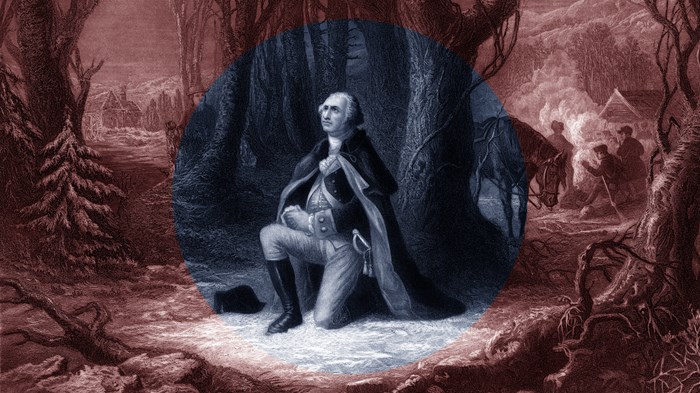
Washington was kneeling there, and Henry, Randolph, Rutledge, Lee, and Jay, and by their side there stood, bowed in reverence, the Puritan patriots of New England, who at that moment had reason to believe that an armed soldiery was wasting their humble households.… They prayed fervently for America, for Congress, for the Province of Massachusetts Bay, and especially for the town of Boston [whose port had been closed and in which British troops were being quartered].
And who can realize the emotions with which they turned imploringly to Heaven for divine interposition. It was enough to melt a heart of stone. I saw the tears gush into the eyes of the old, grave, pacifist Quakers of Philadelphia.
Liberty or Death!
On March 23, 1775, before the Virginia Convention, in one of the most moving speeches in American history, Patrick Henry prodded colonists toward independence by appealing to their indignation and their passion for liberty. He concluded:
Sir, we have done everything that could be done to avert the storm which is now coming on. We have petitioned; we have remonstrated; we have supplicated; we have prostrated ourselves before the throne and have implored its interposition to arrest the tyrannical hands of the ministry and Parliament. Our petitions have been slighted; our remonstrances have produced additional violence and insult; our supplications have been disregarded, and we have been spurned, with contempt, from the foot of the throne. In vain after these things may we indulge the fond hope of peace and reconciliation. There is no longer any room for hope.
If we wish to be free, if we mean to preserve inviolate those inestimable privileges for which we have been so long contending, if we mean not basely to abandon the noble struggle in which we have been so long engaged and which we have pledged ourselves never to abandon until the glorious object of our contest shall be obtained—we must fight! I repeat it, sir, we must fight! An appeal to arms and to the God of Hosts is all that is left us!
They tell us, sir, that we are weak, unable to cope with so formidable an adversary. But when shall we be stronger? Will it be the next week or the next year? Will it be when we are totally disarmed and when a British guard shall be stationed in every house? Shall we gather strength by irresolution and inaction? Shall we acquire the means of effectual resistance by lying supinely on our backs and hugging the delusive phantom of hope until our enemies shall have bound us hand and foot?
Sir, we are not weak if we make a proper use of those means which the God of nature hath placed in our power. Three millions of people, armed in the holy cause of liberty and in such a country as that which we possess, are invincible by any force which our enemy can send against us.
Besides, sir, we shall not fight our battles alone. There is a just God who presides over the destinies of nations, and who will raise up friends to fight our battles for us. The battle, sir, is not to the strong alone; it is to the vigilant, the active, the brave.
Besides, sir, we have no election [choice]. If we were base enough to desire it, it is now too late to retire from the contest. There is no retreat but in submission and slavery! Our chains are forged. Their clanking may be heard on the plains of Boston! The war is inevitable—and let it come! I repeat it, sir, let it come!
It is in vain, sir, to extenuate the matter. Gentlemen may cry, “Peace! Peace!” but there is no peace. The war is actually begun! The next gale that sweeps from the north will bring to our ears the clash of resounding arms! Our brethren are already in the field! Why stand we here idle? What is it that gentlemen wish? What would they have? Is life so dear or peace so sweet as to be purchased at the price of chains and slavery? Forbid it, Almighty God! I know not what course others may take, but as for me, give me liberty or give me death!
Balls Flew Like Hailstones
The American Revolution was a war, entailing suffering, bloodshed, and much grief. But at the beginning, war seemed glorious, even in defeat. In a letter to his father, patriot Peter Brown described the Battle of Bunker Hill, June 17, 1775.
About half after five in the morn, we not having above half the fort done, they [the British] began to fire, I suppose as soon as they had orders, pretty briskly a few minutes, and then stopped, and then again to the number of about 20 or more. They killed one of us, and then they ceased till about eleven o’clock, and then they began pretty brisk again, and that caused some of our young country people to desert, apprehending the danger in a clearer manner than the rest, who were more diligent in digging and fortifying ourselves against them. We began to be almost beat out, being tired by our labor and having no sleep the night before, but little victuals, no drink but rum.…
It being about three o’clock, there was a little cessation of the cannons roaring. Come to look, there was a matter of 40 barges full of regulars coming over to us; it is supposed there were about 3,000 of them and about 700 of us left … besides 500 reinforcements that could not get so [nigh] to us as to do any good hardly till they saw that we must all be cut off.…
But the enemy landed and fronted before us and formed themselves in an oblong square, so as to surround us, which they did in part. And after they were well formed, they advanced towards us in order to swallow us up, but they found a choky mouthful of us, tho’ we could do nothing with our small arms as yet for distance, and had but two cannon and nary [a] gunner.
And they, from Boston and from the ships, a-firing and throwing bombs, [kept] us down till they got almost round us. But God in mercy to us fought our battle for us, and altho’ we were but few and so were suffered to be defeated by them, we were preserved in a most wonderful manner far beyond expectation, to admiration, for out of our regiment there was about 37 killed, four or five taken captive, and about 47 wounded.…
If we should be called into action again, I hope to have courage and strength to act my part valiantly in defense of our liberties and our country, trusting in him who hath yet kept me and hath covered my head in the day of battle.
And tho’ we have lost five of our company, and our Lieutenant’s thigh broke and he taken captive by the cruel enemies of America, I was not suffered to be touched, altho’ I was in the fort till the regulars came in—and I jumped over the walls and ran for about half a mile, where balls flew like hailstones and cannons roared like thunder.
Offerings to Liberty
The Reverend Samuel Langdon, president of Harvard and pastor of a Congregational church in Portsmouth, New Hampshire, helped defend Bunker Hill. Afterward he returned to his church to announce he was devoting himself full-time as chaplain to patriot troops. He recorded the scene in his diary entry for July 20, 1775.
This has been one of the most important and trying days of my life. I have taken leave of my people for the present and shall at once proceed to the American camp at Boston and offer my services as chaplain in the army. Ever since the battle of Bunker Hill, my mind has been turned to this subject. God’s servants are needed in the army to pray with it and for it. This is God’s work, and his ministers should set an example that will convince the people that they believe it to be such.
But the scene in the house of God today has tried me sorely. How silent, how solemn, was the congregation, and when they sang the 61st Psalm—commencing, “When overwhelm’d with grief, / My heart within me dies”—sobs were heard in every part of the building.
At the close, I was astonished to see Deacon S., now nearly 60 years of age, arise and address the congregation. “Brethren,” said he, “our minister has acted right. This is God’s cause, and as in days of old, the priests bore the ark into the midst of the battle, so much they do it now. We should be unworthy of the fathers and mothers who landed on Plymouth Rock if we do not cheerfully bear what Providence shall put upon us in the great conflict now before us. I had two sons at Bunker Hill, and one of them, you know, was slain. The other did his duty, and for the future, God must do with him what seemeth him best. I offer him to liberty. I had thought that I would stay here with the church. But my minister is going, and I will shoulder my musket and go, too.”
In this strain, he continued for some time till the whole congregation was bathed in tears. Oh, God must be with this people in the unequal struggle, or else how could they enter upon it with such solemnity and prayer, with such strong reliance on his assistance, and such a profound sense of their need of it?
Submitting to Providence
As the finishing touches were being put on the Declaration of Independence, John Adams reflected on the events of recent years. On July 3, 1776, he wrote to his wife, Abigail:
When I look back to the year 1761 … and run through the whole period from that time to this, and recollect the series of political events, the chain of causes and effects, I am surprised at the suddenness as well as greatness of this revolution. Britain has been filled with folly, and America with wisdom. At least, this is my judgment. Time must determine.
It is the will of Heaven that the two countries should be sundered forever. It may be the will of Heaven that America shall suffer calamities still more wasting and distress yet more dreadful. If this is to be the case, it will have this good effect at least: It will inspire us with many virtues which we have not, and correct many errors, follies, and vices which threaten to disturb, dishonor and destroy us. The furnace of affliction produces refinement, in states as well as individuals.
And the new governments we are assuming in every part will require a purification from our vices and an augmentation of our virtues, or they will be no blessings. The people will have unbounded power, and the people are extremely addicted to corruption and venality, as [are] the great. But I must submit all my hopes and fears to an overruling Providence, in which, unfashionable as the faith may be, I firmly believe.
Praising God with Every Chord
This solemn hymn, by William Billings, was one of the most popular revolutionary songs. Three verses go:
Let tyrants shake their iron rod,
And slavery clank her galling chains;
We fear them not, we trust in God—
New England’s God for ever reigns.
When God inspired us for the fight,
Their ranks were broke, their lines were forced;
Their ships were shattered in our sight,
Or swiftly driven from our coast.
What grateful offering shall we bring?
What shall we render to the Lord?
Loud hallelujahs let us sing,
And praise his name on every chord.
Copyright © 1996 by the author or Christianity Today/Christian History magazine.
Click here for reprint information on Christian History.

Support Our Work
Subscribe to CT for less than $4.25/month