Live Longer, Healthier, & Better
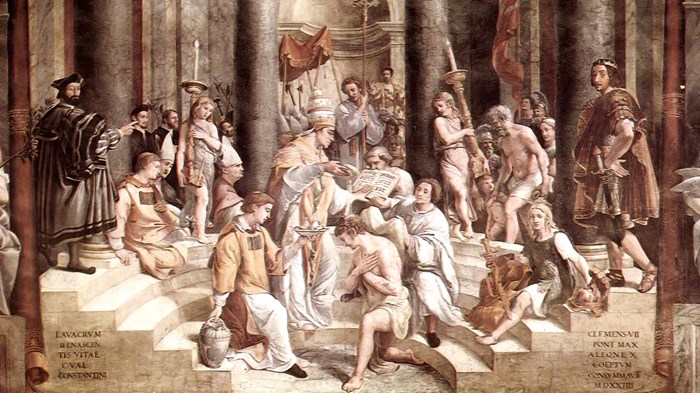


Constantine, the first Christian to rule Rome, governed for 31 years and died in bed of natural causes at a time when the average imperial reign was short and emperors' lives usually came to violent ends.
That he lived to old age illustrates a more general, if not widely known, early Christian achievement: Christians in the ancient world had longer life expectancies than did their pagan neighbors.
Modern demographers regard life expectancy as the best indicator of quality of life, so in all likelihood, Christians simply lived better lives than just about everyone else.
In fact, many pagans were attracted to the Christian faith because the church produced tangible (not only "spiritual") blessings for its adherents.
Why Christians lived longer
Chief among these tangibles was that, in a world entirely lacking social services, Christians were their brothers' keepers. At the end of the second century, Tertullian wrote that while pagan temples spent their donations "on feasts and drinking bouts," Christians spent theirs "to support and bury poor people, to supply the wants of boys and girls destitute of means and parents, and of old persons confined to the house."
Similarly, in a letter to the bishop of Antioch in 251, the bishop of Rome mentioned that "more than 1,500 widows and distressed persons" were in the care of his congregation. These claims concerning Christian charity were confirmed by pagan observers.
"The impious Galileans support not only their poor," complained pagan emperor Julian, "but ours as well."
The willingness of Christians to care for others was put on dramatic public display when two great plagues swept the empire, one beginning in 165 and the second in 251. Mortality rates climbed higher than 30 percent. Pagans tried to avoid all contact with the afflicted, often casting the still living into the gutters. Christians, on the other hand, nursed the sick even though some believers died doing so.
The results of these efforts were dramatic. We now know that elementary nursing—simply giving victims food and water without any drugs—will reduce mortality in epidemics by as much as two-thirds. Consequently Christians were more likely than pagans to recover—a visible benefit. Christian social services also were visible and valuable during the frequent natural and social disasters afflicting the Greco-Roman world: earthquakes, famines, floods, riots, civil wars, and invasions.
Girl power
Women greatly outnumbered men among early converts. However, in the empire as a whole, men vastly outnumbered women. There were an estimated 131 men for every 100 women in Rome. The disparity was even greater elsewhere and greater still among the elite.
Widespread female infanticide had reduced the number of women in society. "If you are delivered of a child," wrote a man named Hilarion to his pregnant wife, "if it is a boy, keep it, if it is a girl discard it." Frequent abortions "entailing great risk" (in the words of Celsus) killed many women and left even more barren.
The Christian community, however, practiced neither abortion nor infanticide and thus drew to itself women.
More importantly, within the Christian community women enjoyed higher status and security than they did among their pagan neighbors. Pagan women typically were married at a young age (often before puberty) to much older men. But Christian women were older when they married and had more choice in whom, and even if, they would marry.
In addition, Christian men could not easily divorce their wives, and both genders were subject to strongly enforced rules against extramarital sex.
To cities filled with the homeless and impoverished, Christianity offered charity and hope. To cities filled with newcomers and strangers, Christianity offered immediate fellowship. To cities filled with orphans and widows, Christianity provided a new and expanded sense of family.. Christian women benefitted further from their considerable status within the church. We have it from the apostle Paul that women held positions of leadership, as was confirmed by Pliny the Younger, who reported to Emperor Trajan that he had tortured two young Christian women "who were called deaconesses."
Urban sanctuary
Yet the early church attracted and held members of both sexes, and not just because it offered longer life and raised social standing. Christianity also offered a strong community in a disorganized, chaotic world.
Greco-Roman cities were terribly overpopulated. Antioch, for example, had a population density of about 117 inhabitants per acre—more than three times that of New York City today.
Tenement cubicles were smoky, dark, often damp, and always dirty. The smell of sweat, urine, feces, and decay permeated everything. Outside on the street, mud, open sewers, and manure lay everywhere, and even human corpses were found in the gutters. Newcomers and strangers, divided into many ethnic groups, harbored bitter antagonism that often erupted into violent riots.
For these ills, Christianity offered a unifying subculture, bridging these divisions and providing a strong sense of common identity.
To cities filled with the homeless and impoverished, Christianity offered charity and hope. To cities filled with newcomers and strangers, Christianity offered an immediate fellowship. To cities filled with orphans and widows, Christianity provided a new and expanded sense of family.
In short, Christianity offered a longer, more secure, and happier life.
The emotional benefits of martyrdom
It seems obvious that in periods of persecution, church membership would decrease dramatically. In fact, persecutions rarely occurred, and only a tiny number of Christians were ever martyred—only "hundreds, not thousands" according to historian William H. C. Frend. Usually only bishops and other prominent figures were singled out for martyrdom. The actual threat to rank-and-file Christians was quite small.
However, the martyrdoms played a crucial role in cementing the faith of early believers. Persecution eliminated the "free-rider" problem common to many new religions. Those who stayed in the church believed strongly in the tenets of the faith because it was "expensive" to do so.
Anyone who has participated in a cause that demands great sacrifice will understand that services conducted in those early house churches must have yielded an intense, shared emotional satisfaction. Shared risk usually brings people together in powerful ways.
Compassion equation
It was not simply the promise of salvation that motivated Christians, but the fact that they were greatly rewarded in the here and now for belonging. Thus while membership was "expensive," it was, in fact, "a bargain." Because the church asked much of its members, it followed that it gave much.
For example, because Christians were expected to aid the less fortunate, they could expect to receive such aid, and all could feel greater security against bad times. Because they were asked to nurse the sick and dying, they too would receive such nursing. Because they were asked to love others, they in turn would be loved.
In similar fashion, Christianity mitigated relations among social classes, and at the very time when the gap between rich and poor was growing. It did not preach that everyone could or should be socially or politically equal, but it did preach that all were equal in the eyes of God and that the more fortunate had a responsibility to help those in need.
Good theological news
Converts not only had to learn to act like Christians but to understand why Christians acted as they did. They had to learn that God commanded them to love one another, to be merciful, to be their brother's keeper. Indeed, they had to understand the idea of "divinity" in an entirely new way.
The simple phrase "For God so loved the world … " puzzled educated pagans, who believed, as Aristotle taught, that the gods could feel no love for mere humans. Moreover, a god of mercy was unthinkable, since classical philosophers taught that mercy was a pathological emotion, a defect of character to be outgrown and overcome.
The notion that the gods care how we treat one another would also have been dismissed as patently absurd by all sophisticated pagans.
When we examine the gods accepted by these same sophisticates, they seem trivial in contrast with "God the Father," and wicked incompetents compared to "His Son." Yet to many pagans, this new teaching was more than absurd. It was also good news.
Behind all these tangible, sociological, and intellectual motives, of course, Christians believe the Holy Spirit prodded and persuaded pagans to believe. Christian conversion, after all, is ultimately a spiritual affair. But is it too much to imagine that God perhaps used the tangible to influence the spiritual?
Rodney Stark is professor of sociology and comparative religion at the University of Washington, and author of The Rise of Christianity: A Sociologist Reconsiders History (Princeton University Press, 1996).
Copyright © 1998 by the author or Christianity Today/Christian History magazine.
Click here for reprint information on Christian History.

Support Our Work
Subscribe to CT for less than $4.25/month