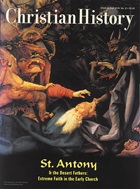




Antony and the Desert Fathers: Recommended Resources


The topic of this issue confronted us with three major problems, each of which we tackled, as we are wont, by examining books.
Ancient documents
The first problem had to do with the veracity of the fantastic stories told about the desert monks. Many modern historians are automatically cynical about any extraordinary event recorded in ancient documents. We tend to view these stories on a case-by-case basis, making judgments at least partly by a careful reading of the earliest accounts. Sometimes a miracle that sounds crazy in summary form (someone rising from the dead, e.g.), actually sounds credible when you read the original sources (the Gospels, e.g.).
Five key primary source documents for the desert fathers are these:
(1) Athanasius's Life of Antony,
(2) The History of the Monks of Egypt (a.k.a, Historia Monachorum en Aegypto),
(3) The Sayings of the Desert Fathers,
(4) Cyril of Scythopolis's The Lives of the Monks of Palestine, and
(5) John Cassian's Conferences.
You'll find portions of (2) and (3), as well as other ancient histories, in Helen Waddell's The Desert Fathers (Vintage, 1998); Owen Chadwick's, Western Asceticism (Westminster, 1958) contains translations of (3) and (5).
Benedicta Ward's The Lives of the Desert Fathers (Cistercian, 1980) is a full translation of (2) and R. M. Price's Cyril of Scythopolis: The Lives of the Monks of Palestine (Cistercian, 1991) is what it says it is, as is Robert C. Gregg's translation of Athanasius: The Life of Antony (Paulist, 1980).
Fortunately, all these are modern, accessible translations and fascinating reads.
In addition, you can find older translations of these documents on the Internet. The Christian Classics Ethereal Library (www.ccel.org) has Cassian's Conferences (www.ccel.org/fathers/NPNF2-11/jcassian/conferen/), and The Ecole Initiative (www2.evansville.edu/ecoleweb/) has the Life of Antony, as well as many other minor works (e.g., lives of Paul of Thebes or Mary of Egypt).
Ancient context
The problem with reading only primary sources, of course, is that it's difficult to get perspective. The ancient writers were not interested in social or political context, and they write as if monks lived their lives, for the most part, independent of the world.
The book that best helped us understand the movement as a whole was Jacques Lacarriere's Men Possessed by God (Doubleday, 1964). It's out of print but still available in used book stores (try www.abebooks.com for a start). Lacarrier's book is the most accessible. We found Derwas J. Chitty's The Desert a City (St. Vladimir's Seminary, 1995) a mighty difficult read, but pretty thorough. James E. Goehring's Ascetics, Society, and The Desert (Trinity, 1999) is more scholarly than his article in this issue but also full of fresh insights into the desert fathers: e.g., they weren't so divorced from larger society as we thought.
Probably the most significant single work on the desert fathers has been an essay by Princeton historian Peter Brown: "The Rise and Function of the Holy Man in Late Antiquity." He argues that these men were key figures in the transition from pagan antiquity to the Christian Middle Ages. The essay is reprinted in his Society and the Holy in Late Antiquity (University of California, 1982), and a revised assessment can be found in Authority and the Sacred (Cambridge, 1995).
Other accounts that we found useful and readable were Douglas Burton-Christie's The Word in The Desert: Scripture and the Quest for Holiness in Early Christian Monasticism (Oxford University, 1993) and John Binns's Ascetics and Ambassadors of Christ: The Monasteries of Palestine, 314-631 (Clarendon, 1994).
Lasting meaning
What does it all mean for today? That's the final issue that concerned us. We found Belden C. Lane's The Solace of Fierce Landscapes: Exploring Desert and Mountain Spirituality (Oxford, 1998) supplied a lot of the answers. If you enjoyed his insights in the Link Interview ("Discovering the Desert Paradox"), you'll find more in this book.
Copyright © 1999 by the author or Christianity Today/Christian History magazine.
Click here for reprint information on Christian History.

Support Our Work
Subscribe to CT for less than $4.25/month