


Ministries of Mercy: Mother Teresa
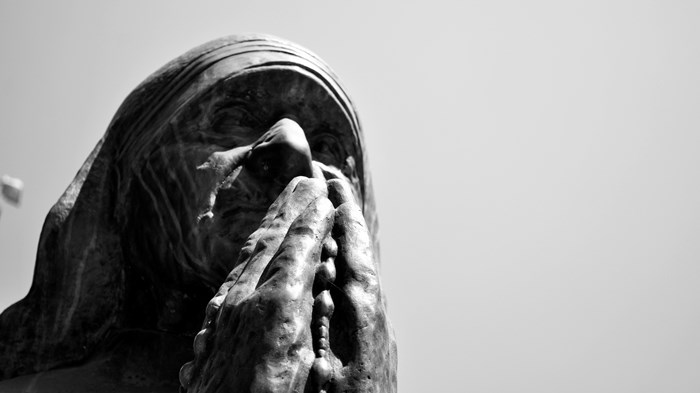

Mother Teresa belongs to the whole world—not to Roman Catholics only, not to Christians only. Indeed, she is the first religious figure in history to be revered during her lifetime by adherents of all religions and Christians of all denominations. And when she died in 1997, there was a universal outpouring of heartfelt appreciation and reverence for her long life of service.
Humility, simplicity, and sacrifice are the terms most often associated with Mother Teresa and her work—though many who encountered her personally would quickly add tenacity. And this tenacity was often accompanied by a stern, uncompromising demeanor. She was driven by an unswerving conviction that she was called by God to reach out to the poorest of the poor, and this conviction left little room to entertain the objections of government officials, church authorities, or even military leaders.
In a famous televised scene from 1985, she insisted that a government minister from Ethiopia give her Missionaries of Charity two unused buildings to be made into orphanages. With cameras rolling, the minister balked but finally had no choice but to capitulate. Pop singer Bob Geldorf, in Ethiopia as part of his Band Aid campaign, witnessed this exchange in the Addis Ababa airport and remarked, "There was a certainty of purpose which left her little patience. But she was totally selfless; every moment her aim seemed to be, how can I use this or that situation to help others?"
Mother Teresa of Calcutta was born Agnes Gonxha Bojaxhiu in Albania in 1910. Her father was a businessman whose death when she was 9 years old left the family in difficult financial circumstances. But their faith sustained them. With her mother and brother and sister, Agnes attended church every day, and she sang in the church choir. Her widowed mother, though nearly destitute herself, volunteered in the neighborhood, caring for an invalid alcoholic woman and later taking six orphaned children into her own home. It was a model of servanthood that did not go unnoticed by young Agnes.
At age 12, Agnes sensed God calling her to his service, but she struggled with how she could know for certain. She prayed and talked with her mother and sister, but she had no real peace. Then she talked with her Father confessor. "How can I be sure?" she asked. He answered, "Through your joy. If you feel really happy by the idea that God might call you to serve him, then this is the evidence that you have a call. The deep inner joy that you feel is the compass that indicates your direction in life."
As to my calling, I belong to the whole world. As to my heart, I belong entirely to Jesus."
—Mother Teresa
The joy of serving God stayed with her, and in 1929, at age 19, she was in Calcutta preparing to become a teacher and a nun. From the beginning, she was concerned for the poor, but for two decades, her assigned ministry was in the classroom—primarily at the Loreto Convent, where she taught geography to schoolgirls. She loved her students and they loved her, and soon they were joining her on weekends as she went into the streets to care for the sick and the hungry.
Mother Teresa's call to devote herself entirely to serving the poor came suddenly. It was a clear call from God, she insisted, not pity for the poor. And it was a call that was not easily answered in the affirmative: "To leave Loreto was my greatest sacrifice, the most difficult thing I have ever done," she later reflected. "It was much more difficult than to leave my family and country to enter religious life. Loreto meant everything to me."
She experienced the call in 1946 while traveling to a Himalayan retreat:
"It was on that train that I heard the call to give up all and follow him into the slums—to serve him in the poorest of the poor. … I was to leave the convent and work with the poor while living among them. It was an order. I knew where I belonged, but I did not know how to get there."
At 38 Mother Teresa left the security of the Loreto community and exchanged her black and white nun's habit for garb of the street—a white and blue sari. With permission from the pope a year later, a new religious order was born. All of the members were required to take the three basic vows of poverty, chastity, and obedience, as well as an additional a vow of pledging service to the poor, whom Mother Teresa spoke of as the embodiment of Christ. The nuns were not cloistered, and there was no vow of silence. They lived simply, shared work equally (Mother Teresa helped with the daily washing until she was too feeble to do so), and served the dying and destitute with food, medical supplies, and companionship—whatever they needed most.
Mother Teresa was sometimes challenged about the long-term effects of her humanitarian ministry. For example, she was asked, why give people fish to eat instead of teaching them how to fish? She had a quick response: "But my people can't even stand. They're sick, crippled, demented. When I have given them fish to eat and they can stand, I'll turn them over and you give them the rod to catch the fish."
She was quick to emphasize, however, that she gave people more than "fish." Equally important was that which came from the heart—love and joy. The poor, she insisted, deserve more than just service and dedication: "If our actions are just useful actions that give no joy to the people, our poor people would never be able to rise up to the call which we want them to hear, the call to come closer to God. We want to make them feel that they are loved."
In 1952, four years after she left Loreto community, she opened Nirmal Hriday ("Pure Heart"), a home for dying and destitute people in Calcutta. In the decades that followed, she extended her work to five continents. The first 20 years of the ministry passed essentially unnoticed, but that changed quickly in 1969, when she was interviewed by Malcolm Muggeridge for the BBC. A film and a book (both called Something Beautiful for God) by Muggeridge followed, and soon she was on her way to becoming an international celebrity. Special recognition came from Queen Elizabeth and from the U. S. Congress, and even from Harvard University, which granted her an honorary doctorate. In 1979 she was awarded the Nobel Peace Prize. But she was never fully comfortable in the limelight. "For me," she confessed, "it is more difficult than bathing a leper."
Bathing a leper would be her lasting legacy. Of course, she will also be remembered for the international recognition she received, the thousands of nuns who followed her, and the hundreds of homes established around the world. But the image imprinted on the global psyche would be that of a tiny wrinkled old woman reaching out and touching those consigned to the trash heap of humanity.
Ruth A. Tucker is the author of 13 books, including From Jerusalem to Irian Jaya: A Biographical History of Christian Missions.
Timeline
1901 Jean Henri Dunant, founder (in 1863) of the Red Cross, wins the inaugural Nobel Peace Prize
1910 Agnes Gonxha Bojaxhiu born in Skopje, Macedonia (Albania)
1913 Acclaimed theologian and organist Albert Schweitzer begins medical missionary work in Africa
1929 Sister Teresa arrives in Calcutta
1944 National Association of Evangelicals establishes the War Relief Commission (renamed World Relief in 1950)
1946 United Nations Children's Fund (UNICEF) established
1947 India gains independence from Great Britain
1950 Order of the Missionaries of Charity approved by Pope Pius XII; Bob Pierce founds World Vision
1952 Mother Teresa establishes Nirmal Hriday, her first Home for Dying Destitutes
1961 Peace Corps launched; Amnesty International founded
1966 Brother Andrew takes charge of the Missionary Brothers of Charity, the order's male branch
1969 Malcolm Muggeridge's BBC film Something Beautiful for God brings Mother Teresa worldwide recognition
1979 Mother Teresa wins the Nobel Peace Prize
1985 Band Aid, a charity effort of several popular music groups, raises money for famine in Ethiopia
1997 Mother Teresa dies
You Are There
In my television interview with Mother Teresa, I raised the point as to whether, in view of the commonly held opinion that there are too many people in India, it was really worth while trying to salvage a few abandoned children who might otherwise be expected to die of neglect, malnutrition, or some related illness. It was a point, as I was to discover subsequently, so remote from her whole way of looking at life that she had difficulty in grasping it. The notion that there could in any circumstances be too many children was, to her, as inconceivable as suggesting that there are too many bluebells in the woods or stars in the sky. In the film we made in Calcutta, there is a shot of Mother Teresa holding a tiny baby girl in her hands; so minute that her very existence seemed like a miracle. As she holds this child, she says in a voice, and with an expression, of exaltation most wonderful and moving: "See! there's life in her!" Her face is glowing and triumphant; as it might be the mother of us all glorying in what we all possess—this life in us, in our world, in the universe, which, however low it flickers or fiercely burns, is still a divine flame which no man dare presume to put out, be his motives never so humane and enlightened.
— BBC journalist Malcolm Muggeridge in Something Beautiful for God
Click here for reprint information on Christian History.

Support Our Work
Subscribe to CT for less than $4.25/month