A Church of Their Own


As immigration boomed between 1840 and 1920, the central plains attracted Europeans from agrarian backgrounds, while the West Coast and the Rockies lured Europeans and Asians seeking opportunity. By 1870, nearly three in ten westerners were foreign-born—and many of these newcomers had strong religious ties.
Not unexpectedly, then, ethnic churches became the cornerstones of many immigrant communities. Traditional worship reminded newcomers of home and helped them reaffirm their cultural identity. More importantly, ethnic churches evoked a profound sense of spiritual fulfillment that other American churches could not provide. As an 1887 German Lutheran sermon from Missouri confidently affirmed: "Dear God, grant that the Word may also be preached pure and unadulterated among those who speak English, as it is among us."
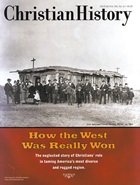
As immigrants settled across the trans-Mississippi West, religious leaders attempted to keep pace by creating new parishes, dioceses, and districts. German Methodists, Dutch Reformed, Eastern Orthodox, and Icelandic Lutherans, among others, could be found from the Midwest to the Pacific Coast. Chinese and Japanese Christian churches dotted parts of the Mountain West and the Pacific Coast, notably California. Growing ethnic populations often retained their identity even within denominations. The Lutheran Church in America was not a singular institutional body but a composite of many ethnic synods, including Danish, Norwegian, Finnish, and Slovakian.
Ethnic clergy who had been hindered by state churches in Europe readily found an outlet for their evangelical energies in America. Fratisek Kun, a Protestant Czech minister, served rural communities in Iowa, Wisconsin, Minnesota, Nebraska, and the Dakotas. Before coming to America, he was warned that the country offered "no promising opportunities whatsoever for a Czech preacher," but Kun proved his critics wrong and spread the gospel among his fellow Czech immigrants.
Distances between congregations, internal divisions, and insufficient funds unnerved many pastors but didn't necessarily dissuade them. Rev. Christian Scriver Thorpe, a German Lutheran minister in eastern Montana and western North Dakota in 1906, found his assignment troubling at first. He was "filled with foreboding" about his work on the frontier. "But I also felt," he recalled, "that God, who had called me to serve Him, would not let me down."
Carl V. Hallberg is senior historian at the Wyoming State Archives.
Copyright © 2000 by the author or Christianity Today/Christian History magazine.
Click here for reprint information on Christian History.

Support Our Work
Subscribe to CT for less than $4.25/month