No Rest for the Weary


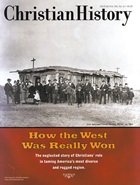
When William Clark of Freeport, Illinois, and his party participated in the westward movement that carried thousands of American to the Pacific Coast during the mid-nineteenth century, they demonstrated remarkable fidelity to a Christian institution. Leaving Leavenworth in 1857, Clark and three others joined up with a firm that was to haul freight to army posts in Utah. The four man contracted "with the express understanding that we should not be asked to drive Sundays, unless for the want of grass or water." The men pledged to each other to stand by their bargain.
Shortly after setting out, on a Sunday when the bullwhackers were resting after a hard week's work, Chatham Rennick, the train boss, directed the four to hitch up their cattle in order to drive the remainder of the day. The men refused. Rennick did not press the point. When this experience was repeated on the next Sabbath, the man declared, "drive Sunday we would not."
After another such encounter, Rennick discharged the four and refused to let them take their guns. A tense confrontation with guns drawn followed. Clark and his companions feared for their lives. Rennick had "men enough to massacre us," Clark retaliated, "but not enough … to make us drive a single rod." Rennick pleaded with the men, who remained adamant. Never again were they asked to drive on the Sabbath.
This encounter might have been exceptional, but it illustrates that Sabbath observance was still important when Americans set out on the Overland Trail for the Pacific Coast. "He who starts across the continent," wrote one overland diarist in 1852, "is most sure to leave his religion on the east side of the Missouri river." This notion entered the history books. But first-hand accounts of the westward movement reveal a more complex reality.
Leaving faith in the East
Crossing the plains, the desert, and the mountains was a serious undertaking, and in 1849 and 1850 most emigrants traveled in organized wagon trains for mutual assistance and protection. Before jumping off, some companies drafted a constitution stipulating that the Sabbath was to be a day of rest except in cases of absolute necessity. The reasons for Sabbath observance were practical as well as religious. "Never travel on the Sabbath," advised Joseph E. Ware in The Emigrant's Guide to California (1849). "Those who lay by on the Sabbath, resting themselves and their teams," Ware added, "would get to California 20 days sooner that those who traveled seven days a week.
Sabbath observance was generally best during the early weeks on the trail, but even people reared under religious influences often lost their moral bearings once they entered a land where neither law nor common practice restrained. The issue caused dissension and split otherwise harmonious parties. In addition, the passion for speed fed on itself, fracturing companies into even smaller units that treated all days alike. Necessity ruled with an iron hand. Trains depended on campsites with water, grass, and wood. Each train competed with hundreds of others for these essentials.
Sixty-five diaries and reminiscences for the gold-rush years of 1849 and 1850 reveal diverse patterns of Sabbath observance on the Overland Trail. Eighteen diarists simply disregard the Lord's Day, while 23 described companies that traveled as readily on the Sabbath as on other days. George W.B. Evans, a devoted Presbyterian from Defiance, Ohio, characterized Sunday as "the day of rest, set apart for the good of mankind." Yet his company usually traveled on Sundays. Members did celebrate the Fourth of July, which Evans called the "great National Sabbath."
Charles C. Gray of New York describes his company's Sabbath observance with mocking irreverence. One Sunday the party stopped "out of respect for the Sabbath (thereby meaning we had some clothes to wash and some wagon repairs to do)." Charles R. Parke of Como, Ilinois, crossed the plains with a party of nine men and three wagons. They drove on all or part of 13 Sundays, remaining in camp on four. Parke's company marched on the Sabbath immediately before and after the Fourth of July but remained in camp near South Pass on "the Nation's birthday." With plenty of milk and snow available, Parke made ice cream on "this Sacred day of the year."
Sabbatarian minority
A second pattern was that of travelers who desired to observe the Sabbath but found impediments in their way. Some Sabbatarians went along with a non-Sabbath-keeping majority out of expediency. James Abbey of New Albany, Indiana, was in a company that normally traveled on Sunday. Yet his journal stresses the holiness of the Sabbath and its sweet memories of home and family. The Sabbath was "the day our mothers charged us never to forget."
Solomon Gorgas left Ohio with a band that frequently traveled on the Sabbath. Gorgas denounced the practice as a desecration of the day, remembering the Sabbath as "the blessed day of rest and quiet." But on the trail there was no rest for man or beast: no preaching, no praying. "All respect for the sabbath of the Lord is here forgotten."
Some companies set out intending to observe the holy day but found it hard to do so. Ansel J. McCall of Bath, New York, who joined the Robidoux company west of St. Joseph's, proposed that the company rest on the Sabbath except in case of necessity. His motion failed, and at Salt Lake the assembly fell apart. McCall's group remained in camp on 11 of 17 Sabbaths on the trail.
Elisha D. Perkins, an Ohio journalist, left for California with the Marietta Gold Hunters. Members agreed to rest on the Sabbath, "an arrangement the policy of which is evident to those who know anything of frontier travelling, & very gratifying to those who have been taught to reverence the day at home." The company planned its Saturday travel with a view to camping on the Sabbath for the rest that the day afforded man and beast. In time, however, necessity obliged the ensemble to travel on the Sabbath. Members split into smaller groups so as to travel faster.
Catherine M. Haun of Clinton, Iowa, and her husband joined a caravan consisting of 120 persons and 70 wagons bound for California. "When the camp ground was desirable enough to warrant it," Haun wrote, "we did not travel on the Sabbath." The men spent the day mending wagons and the like, the women cooked and washed clothes and "all felt somewhat rested on Monday morning."
Divided camps
A third pattern of Sabbath observance was that of emigrant groups with a strong commitment to the Fourth Commandment. These companies generally set out by observing the Sabbath according to a written rule or a tacit agreement but found it difficult to realize their ideal. They divided over Sunday travel.
Elisha B. Lewis of Rock County, Wisconsin, went west with an outfit whose written rules prohibited Sunday travel. When the company made good distance all one week, Lewis thought it only reasonable that their teams and the men should rest on the holy day. But the majority ruled, "so there was no other way but to go in contradiction to the constitution by which we professed to be governed and also to transgress the laws of God which some of us still hold more sacred."
Charles E. Pancoast, a Quaker druggist from St. Louis, went to California with a company of 200 that passed a resolution not to travel on the Sunday when it could be avoided. They lay over every Sabbath except two, when, because of necessity, they moved.
Augustus R. Burbank of Naples, Illinois, and his wife were staunch Sabbatarians. Their group was organized "expressly was a Sabbath observing company & all joined as such with this understanding." Soon, however, some members favored moving on the Sabbath. "There is but few men that will keep the Sabbath, " Burbank lamented, "where there is sacrifice to be made." Burbank's party, which split from the rest of the company over the issue of Sunday travel, achieved a nearly perfect record of Sabbath-keeping en route to Sacramento.
Samuel Rutherford Dundass, a deeply religious Presbyterian, joined an Ohio company whose members adopted a resolution to lie by on the Sabbath. After two weeks on the plains, the 60 men divided into several companies of ten in order to travel faster. Dundass's group, which struck out alone, soon teamed up with other pioneers. Through it all, Dundass faithfully observed the Sabbath, although on three occasions necessity compelled short moves to provide for the oxen. Dundass justified his observance on religious grounds. "This is the holy Sabbath," he wrote, "and in accordance with our custom we observe the day." A week later he vowed, "We wish to do as the Israelites did in the wilderness of Sinai, to keep the Sabbath as a day of rest, holy unto the Lord." The Sabbath was a day of rest, a time to read the Bible and engage in private religious exercises. "Welcome, even here in the wilderness, welcome sweet day of rest that saw the Lord arise!"
Ideally, the Sabbath was a day of rest for both humans and animals. When Joseph Warren Wood of Walworth, Wisconsin, and his company of 60 men rested one Sunday, a blast of the horn summoned members to hear a sermon by an old preacher. For some Argonauts a minister pro tem stood in the center of a corral, conducting a devotional service while everyone continued with his or her work. The rest day was not typically one of leisure. Routine chores that were regarded as unchristian at home—making repairs, rearranging loads, cooking, and washing clothes—had to be done.
A new Sabbath view
These accounts of Sabbath observance on the Overland Trail illuminate important aspects of American religious development. The trek westward was a mirror reflecting the character of the emigrants and the quality of the society from which they came. Almost certainly men and women who participated in this movement viewed the Sabbath in a new light when they reached the Pacific Coast.
Perhaps the larger significance of the events described here is their bearing on Sabbath-observance in later American life. In all likelihood, Americans who went overland to California in the years described never again viewed the Sabbath as they had before leaving home. Thus the experience of crossing the plains may be seen as a preview of the economic, social, demographic and secular forces that would contribute to transforming the place of the Sabbath in later American culture.
Winton U. Solberg is professor emeritus of history, University of Illinois, Urbana-Champaign.).
Related Links:
The creators of the PBS documentary on the Oregon Trail present some of their findings here:
www.isu.edu/~trinmich/Oregontrail.html
More from PBS here:
www.pbs.org/opb/oregontrail/.
And from the End of the Oregon Trail History Library:
www.teleport.com/~eotic/histhome.html.
Copyright © 2000 by the author or Christianity Today/Christian History magazine.
Click here for reprint information on Christian History.

Support Our Work
Subscribe to CT for less than $4.25/month