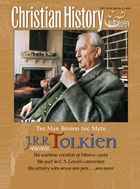



Tolkien: Man Behind the Myth


On January 3, 2003, J.R.R. Tolkien would have celebrated his eleventy-first birthday, a most momentous occasion, the same birthday on which Bilbo departed the Shire for Rivendell.
What would this venerable Oxford don have thought about his position in western culture at the age of 111, almost a half-century after he initially published his trilogy?
He would have seen reason enough for distress, chilling marks of the modern secular-scientific ideal. In the East: the killing fields, the gulags, and the holocaust camps. In the West: materialism, invasive corporate capitalism, and softly tyrannical bureaucracies. An anti-modern conservative, Tolkien often fell into despair, especially toward the end of his life, as he took account of the world situation.
"The spirit of wickedness in high places is now so powerful and so many-headed in its incarnations," Tolkien wrote in 1969, "that there seems nothing more to do than personally to refuse to worship any of the hydra's heads." The world, he thought, seemed little better than a new Tower of Babel, "all noise and confusion."
Yet, this most devout Christian would also see signs of immense hope, knowing well that St. Paul accorded it the second highest place among the virtues. Karol Wojtyla, pope, poet, playwright, and philosopher, had told Tolkien's beloved Roman Catholic Church, "Be not afraid," quoting Christ. Emboldened by this message, millions between 1989 and 1991 peaceably tore down the misanthropic Marxist-Leninist regimes.
On Tolkien's 111st birthday, he would also be especially surprised to note that for fifty years, his myth—a myth he felt he had recorded rather than invented—had dramatically affected and shaped people all over the world. In it, they found depth, inspiration, and guidance; not the mere entertainment or escapism his detractors claimed. In The Lord of the Rings, they found models of Christian virtue, true heroism, and timeless Truth.
Indeed, since the trilogy's initial publication in the mid-1950s, Tolkien's popularity has waxed less and waxed more, but it has never waned. Poll after poll at the turn of the century declared The Lord of the Rings the book of the twentieth century, with a readership, by one estimate, of over 150,000,000 persons worldwide. He would also see prominent academics at prestigious schools labeling him "The Author of the Century."
Out of Africa
John Ronald Reuel Tolkien was born in Bloemfontein, South Africa, on January 3, 1892. Attempting to control the fraud that seemed rampant in the diamond trade, a British bank had relocated his father, Arthur Tolkien, there.
"My parents both came from Birmingham in England. I happened to be born [in South Africa] by accident. But it had this effect; my earliest memories are of Africa, but it was alien to me, and when I came home, I had for the countryside of England both … native feeling and … personal wonder." His own Middle-earth reflects what he called his "wonder and delight in the earth"—especially his life-long love of trees.
Two years later, his mother, Mabel, gave birth to Tolkien's only sibling, his brother Hilary. In 1895, Mabel returned to England with the two boys because of Ronald's health, and Arthur remained behind in South Africa, only to die a year later. Tolkien was particularly close to his mother after his father's death. She home-schooled the two boys during their first school-age years.
Even as a young boy, Tolkien loved languages. He invented his own, but his mother viewed them as a waste of his time. "As a child, I was always inventing languages. But that was naughty," Tolkien recalled wryly. "Poor boys must concentrate on getting scholarships. When I was supposed to be studying Latin and Greek, I studied Welsh and English. When I was supposed to be concentrating on English, I took up Finnish."
Through the door of language Tolkien entered the world of myth. "The seed [of the myth] is linguistic, of course. I'm a linguist and everything is linguistic—that's why I take such pains with names." A language, he believed, could not remain abstract. It must arise within a history and a culture—or, if lacking that, a mythology. Soon he would create for his own languages a most elaborate world indeed.
Son of persecution
In 1900, much to the dismay of her family, Mabel was confirmed in the Roman Catholic Church. Her family strongly disapproved of her decision—though they tended to be only nominally Protestant—and they cut her off from all family money. Four years later, Mabel died of diabetes, which might have been treated with sufficient finances. In his adulthood, Tolkien remembered his mother as "a gifted lady of great beauty and wit, greatly stricken by God with grief and suffering, who died in youth (at 34) of a disease hastened by the persecution of her faith."
It would be impossible to stress too much the influence her death had on Tolkien. He was almost thirteen when she died, and she had served, effectively, as his only parental figure to this point. She had influenced him in everything, and Ronald would attempt to live up to her memory for the rest of his life. This was especially true in his religious devotions. "I witnessed (half-comprehending) the heroic sufferings and early death in extreme poverty of my mother who brought me into the Church," he reflected in 1963.
Mabel left Ronald and Hilary to the care of Father Francis Morgan, a Roman Catholic priest at John Henry Cardinal Newman's Birmingham Oratory. Half Welsh and half Anglo-Spanish, Morgan is described by Tolkien's biographer as "a very noisy man, loud and affectionate, embarrassing to small children at first but hugely lovable when they got to know him." Ronald struggled with Father Morgan at times, especially over dating his future wife Edith, but he considered the priest his true father. Indeed, Tolkien credited Father Morgan with solidifying the faith into which his mother brought him. "I first learned charity and forgiveness from him," Tolkien wrote in 1965.
At the Oratory, Tolkien absorbed the lingering, profound presence of Newman, the founder. Newman was a devout follower of St. Augustine, another significant influence on Tolkien. In his Apologia, Newman recorded having been deeply influenced by the Catholic doctrine of the warfare between the City of God and the powers of darkness. He believed this battle was about to intensify, as nineteenth-century liberalism was poised to usher in a secular, modern City of Man.
"A confederacy of evil, marshaling its hosts from all parts of the world, organizing itself, taking its measures, enclosing the Church of Christ as in a net, [was] preparing the way for a general Apostasy from it," Newman feared in 1838. Tolkien saw his world devastated by the forces that Newman had believed imminent.
A wartime awakening
After a highly successful college career at Exeter College, Oxford, Tolkien became an officer in the British military. He experienced first-hand the horrors of mechanized warfare in World War I. He was a member of the 11th Lancashire Fusiliers, one of the most decorated regiments of the war, and also a unit that suffered devastating casualties.
It was in the trenches that Tolkien first conceived the Middle-earth mythology. His son Christopher later found some of the first lines of verse containing "Seven names of Gondolin" "scribbled on the back of a paper setting out the chain of responsibility in a battalion."
He began writing in earnest during his sick leave in 1916 and 1917, "in army huts, crowded, filled with the noise of gramophones." As Tolkien admitted in his famous academic essay "On Fairy Stories," "a real taste for fairy-stories was wakened by philology on the threshold of manhood, and quickened to full life [by] war."
In the filth of northern France, Tolkien longed for beauty. Frodo's passage through the Dead Marshes in The Two Towers, said the author, consciously echoed the "miles and miles of seething, tortured earth" he had seen on the war's battlegrounds:
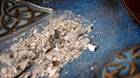
"More loathsome far was the country that the crawling day now slowly unveiled to his shrinking eyes. … Here nothing lived, not even the leprous growths that feed on rottenness. The gasping pools were choked with ash and crawling muds, sickly white and grey, as if the mountains had vomited the filth of their entrails upon the lands about. High mounds of crushed and powdered rock, great cones of earth fire-blasted and poison-stained, stood like an obscene graveyard in endless rows, slowly revealed in the reluctant light."
Doting father, Oxford "great"
In 1916, Tolkien began his own family when he married Edith Bratt, a woman he loved passionately and who served as the inspiration for the beautiful elven maiden, Luthien. Together, the two had four children: John (1917-2003); Michael (1920-84); Christopher (b. 1924); and Priscilla (b. 1929). Priscilla recalled:
"He was always there, at lunch and at tea. We children were allowed to run in and out of his study at any time, so long as he wasn't actually teaching. He was very much involved with family life and, since we were often hard up, he had to write and work far into the night just to make extra money."
Priscilla's reminiscences are typical. Tolkien's son Michael noted that he always took "my childish comments and questions with complete seriousness." And Tolkien's grandson Simon remembered his grandfather as "incredibly nice," with a deep voice, a laugh that "seemed full and his eyes. … bright and full of life."
Indeed, there were few children that Tolkien seemed not to love. The last time his friend George Sayer saw him, Tolkien was with a number of children "playing trains: 'I'm Thomas the Tank Engine. Puff. Puff. Puff.'"
His children also served as the first audience for significant parts of his mythology. The Hobbit, which Tolkien had read at least in part to his children, "got dragged against my original will," as he put it, into the legendarium.
Tolkien had a full academic career, first at Leeds University from 1920-1925 and then at Oxford from 1925 until his retirement in 1959. He was regarded by Oxford students as one of the "greats" in both scholarship and personality. Few, though, thought well of him as a lecturer. So muffled and incoherent were many of his lectures, in fact, that one former student remembered him as having a "speech impediment." Tolkien himself was the first to admit his failings as a lecturer.
The exception to Tolkien's poor lecturing was his recitation of Beowulf, much of which he had memorized. When discussing that old English tale, he became a bard, and the lecture room a mead hall. One student wrote of these performances:
"He came in lightly and gracefully, I always remember that, his gown flowing, his fair hair shining, and he read Beowulf aloud. We did not know the language he was reading, yet the sound of Tolkien made sense of the unknown tongue, and the terrors and the dangers that he recounted—how I do not know—made our hair stand on end. He read like no one else I have ever heard. The lecture room was crowded—it was in the Examination Halls, and he was a young man then, for his position, long before The Hobbit or the Trilogy were to make him famous."
In the Atlantic Monthly, the poet W. H. Auden confided: "I do not remember a single word he said, but at a certain point he recited, and magnificently, a long passage of Beowulf. I was spellbound."
Yet, this was a man who also loved the Marx Brothers and boyish pranks. He once appeared at a formal party for Oxford dons dressed in "an Icelandic sheepskin hearthrug" and white face paint. At a lecture in the 1930s, Tolkien told his audience that leprechauns really existed—then, to prove it, pulled from the pocket of his old tweed coat a four-inch green shoe.
From myth to Messiah
Tolkien published a number of critical articles during his academic career, including numerous translations of Anglo-Saxon and Middle English works as well as the essays "Beowulf: The Monsters and the Critics" (1936) and "On Fairy-Stories" (1939).
In the latter essay, Tolkien describes how the perilous realm of Faerie reveals truth and beauty beyond normal comprehension; the true and the beautiful lead one to the Good and the One. Indeed, Tolkien saw the gospel standing behind and patterning all fairy stories.
Tolkien began writing—he preferred to call it "recording"—his mythology in 1916. Even at his death, he had failed to complete it, and his son Christopher has spent much of his adult life editing and completing what his father could not in one lifetime. The two most famous of Tolkien's stories, The Hobbit (1938) and The Lord of the Rings (1954-1956), are profound manifestations of the larger mythology, which the author referred to as his legendarium. Since his father's death, Christopher has completed The Silmarillion (1977), Unfinished Tales of Númenor and Middle-earth (1980), and the twelve-volume History of Middle-earth (1983-1996), each of which is indispensable to understanding the myth as a whole.
A double-edged fame
By the mid-1960s, Tolkien had reached the status of a popular icon. In the first ten months after The Lord of the Rings appeared in paperback in the U.S. in 1965, stores sold over 250,000 copies (see p. 42).
The 1960s brought not only fame but cultural change, invading even the great bulwark of traditionalism, the Roman Catholic Church. At one Vatican II-inspired Mass, Tolkien found the innovations too much for him. Disappointed by changes in the Mass's language and the informality of the ritual, he rose from his seat, made his way laboriously to the aisle, made three low bows and stomped out.
Much to the conservative Tolkien's chagrin, in the mid- to late 1960s the drug and political Left especially embraced his mythology. Afraid that such readers might create a sort of "new paganism" around his legendarium, Tolkien spent much of the last decade of his life clarifying its theological and philosophical positions in the work that became The Silmarillion.
The burden of the philosophical and theological intricacies of the mythology, his wife's deteriorating health in the mid-1960s resulting in her death in 1971, and his own natural aging proved too difficult for Tolkien, and he died before finishing The Silmarillion. Still, the accolades poured in. In 1972, Oxford awarded Tolkien an honorary doctorate and the Queen named him a "Commander of the Order," a rank just below knighthood.
On September 2, 1973, Tolkien left the City of Man and became a permanent resident of the City of God.
To the last, critics continued to describe his works as trivial and escapist. But Tolkien was content to rest his case in a higher court.
"The only just literary critic," he concluded, "is Christ, who admires more than does any man the gifts He Himself has bestowed."
Bradley Birzer is an assistant professor of history at Hillsdale College, Michigan and author of J. R. R. Tolkien's Sanctifying Myth: Understanding Middle Earth (ISI, 2002).
"Most Married Man"
After nearly losing her to another, Tolkien adored his beloved Edith.When Tolkien set out to create his mythological Elvish race, he drew inspiration from a muse dear to his heart. Edith Bratt (pictured here at age 19 when she first met Tolkien) shared the same grief-both had lost their mothers in their teens. The two met in a boarding home, promptly became fast friends, and fell in love.
Forest Romance
The Return of the King tells of the human Aragorn and the Elven Arwen pledging their love for one another in the forest of Lothlorien (drawn here by Tolkien). The scene echoed in Tolkien's life: After the young Edith danced for him once in a woodland glade, he began calling her "Luthien" and himself "Beren." These were the names of another Elven-human couple in his legendarium. They adorn Edith and Ronald Tolkien's gravestones.
But when Tolkien's guardian Father Francis Morgan discovered the romance, he split up the couple, forbidding Tolkien to speak to Edith until he turned twenty-one. Tolkien agreed, and he endured the separation for nearly three years, during which Edith became engaged to another man. Tolkien later wrote that while the whole affair was painful and bitter, "nothing else would have hardened the will enough" to give their love such permanence. He wrote to Edith as soon as his twenty-first birthday arrived, and convinced her to break off the engagement. They married three years later in 1916, just before Tolkien left to fight in France.
Following his short stint in World War I, Tolkien returned to England to finish out his military duties and reunite with Edith. He showered his young wife with love and devotion, admiring "her long dark hair, fair face, starry eyes, and beautiful voice." His adoration would continue into his years at Oxford, where he refused customary rooms at Pembroke College in order to spend more time with his family. His friend C. S. Lewis, a confirmed bachelor until late in life, once complained that Tolkien was "the most married man he knew."
—Steven Gertz
A Niggling Art
Through a character named Niggle, Tolkien revealed his own creative process.The three books of The Lord of the Rings contain over a half million words. Its manuscript, when Tolkien sold it to Marquette University in 1957, stood in a stack seven feet high. Before, around, and beyond his famous trilogy, Tolkien wove a vast imaginative world, recording its origin and history in a sprawling profusion of songs, tales, and legends. Yet his perfectionism kept him from finishing or publishing this "history of Middle-earth" in his lifetime. Even The Silmarillion, painstakingly edited and published years after Tolkien's death by his son Christopher, contains only a part of that myth.
What animates a man to create such an elaborate fictional world? Fittingly, the most revealing thing Tolkien wrote about his own creative process may come to us in the form of a story. Tolkien's friend Clyde Kilby explains:
His problem as a writer he stated with great charm and meaning at the beginning of his story "Leaf by Niggle." That story begins, "There was once a little man called Niggle, who had a long journey to make." The journey was into death and the hereafter. Niggle describes himself as a painter, not a very successful one owing not only to interruptions which usurped his time but to a tendency toward plain laziness. Niggle's real trouble was that his reach exceeded his grasp. He had various paintings that he worked on and "most of them were too large and ambitious for his skill."
Actually he preferred to paint leaves more than trees. "He used to spend a long time on a single leaf, trying to catch its shape, and its sheen, and the glistening of dewdrops on its edges." Yet at the same time he longed to paint a whole tree. Indeed one painting had started with "a single leaf caught in the wind" but it grew, "sending out innumerable branches, and thrusting out the most fantastic roots. Strange birds came and settled on the twigs and had to be attended to." For me it represents both a splendid picture of his perfectionism and the increasing vision of the mythology he was creatively to inhabit.
began to show up, including high mountains in the far distance. Niggle now turned away from his other paintings "or else he took them and tacked them on to the edges of his great picture." Might this not explain the Tom Bombadil episode and the Bombadil poems that did not quite manage to get into the main story? In due course Niggle's painting got so large he needed a ladder to reach its top. What a perfect insight into the whole creative process … of a Thomas Wolfe, a Stephen Spender, or any creative mind overwhelmed by the magnitude of its subject.
The time eventually came when Niggle began to take a hard look at what was turning out to be the main activity of his life. He looked and looked and wished for someone who "would tell him what to think." He wondered if he were simply wasting time. He wondered if he should have dropped all other paintings for this single one. Was it really a painting, or was it just a chimera? Niggle concluded contradictory things about it. "Actually it seemed to him wholly unsatisfactory, and yet very lovely, the only really beautiful picture in the world." Not only do we have here the experience of many a writer or artist, but we have what seems a most faithful description of Tolkien's own creativity.
—From Clyde S. Kilby, Tolkien and The Silmarillion (Harold Shaw, 1976).
Permission to quote from Tolkien and the Silmarillion, by Clyde S. Kilby, granted by The Marion E. Wade Center, Wheaton College, Wheaton, Illinois.
Copyright © 2003 by the author or Christianity Today/Christian History magazine.
Click here for reprint information on Christian History.

Support Our Work
Subscribe to CT for less than $4.25/month