Anatomy of an Explosion


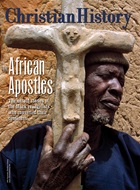
Taking a close look at the explosion of Christianity in twentieth-century Africa, we meet a remarkable group of colonial-era (roughly 1890 to World War II) apostles who were born, grew up, and ministered in sub-Saharan Africa. We have been inspired and challenged by their stories. We hope you will be, too.
While the story of Christianity's spread in Africa is nothing less than awesome, it is also nothing more than the work of God, who always uses the foolish things of a sin-scarred world as the building material for his body.
Western missions in colonial Africa proceeded by slow, painful steps. The missionaries' best efforts were often hindered by cultural misunderstandings, economic abuses, political agendas, and racist presuppositions. While missionaries were picking their tortuous way through the colonial period, indigenous African evangelists and teachers exploded onto the scene like dynamite. Yes, they worked on the same confused, conflicted landscape as the missionaries. Nonetheless, something happened when the gospel was proclaimed under African sponsorship. It revolutionized the continent.
Within a few short decades, out of the seeds first sown by the missionaries came a profusion of indigenous roots and branches, laden with a lavish variety of flowers and fruit.
How Christianity became African
To help us understand the cultural and spiritual landscape of colonial Africa, we interviewed Dr. Ogbu Kalu, Henry Winters Luce Professor of World Christianity and Mission at McCormick Theological Seminary in Chicago. Kalu, an elder in the Presbyterian Church of Nigeria, came to McCormick in 2001 from the University of Nigeria, Nsukka, where he had served as professor of Church history for 23 years.
What was the relationship between the African Christians who wanted to live a truly African faith and the colonial churches?
African Christians clearly worked from a position of reaction against colonialism. But there were several kinds of reaction, from those who largely worked within the mission churches; to those who stayed in but agitated for change, like the Ethiopianists (pp. 14 and 39); to those who struck out on their own, like the Aladura churches in the West (p. 35) and the Zionists in the South.
It is important to understand the chronology here. Colonialism was actually a very short-lived phenomenon in Africa—it lasted only the span of a single human lifetime. What we call the colonial enterprise did not gel until 1900. By 1914, when the continent was fully carved up, the European powers were on the verge of World War I, which distracted them and drained their resources. Between 1919 and 1939, you have the turbulence of the interwar years and the Great Depression. By 1945, the European countries were exhausted by World War II. That's why the French wanted to pull out of Algeria by 1957, followed by the British receding from Ghana, and so forth. Colonialism was effectively dead by 1960.
Certainly it was a very powerful phase in African history, which had physical, mental, psychological, economic, and religious import. But since the colonial governments at no point had enough European administrators to achieve effective rule in their African colonies, they left local cultures and leadership structures intact. In fact, they used a system of almost entirely indigenous rule to keep order.
The missionaries, however, operated in just the opposite way. Although most of them—especially the Roman Catholics—did train indigenous helpers, they generally dragged their feet on ordaining Africans. The story of Crowther (p. 10) was highly unusual for its time, and Kiwanuka (p. 16) came later and in a different regional situation.
African Christians recognized early on that if they were to build the church with their own leaders, they would have to assert their distinctiveness from the mission-built denominational structures.
Many stopped short of full separation—the Ethiopianist church movement grew out of Africans willing to work within missionary structures, but critiquing those structures. Some Ethiopianists did think you should divest yourself of English names, start your own schools and your own churches, and reject all funding from white missionary groups. But others, like James Johnson (p. 14) saw something in Western civilization that Africans should capture and use in prosecuting their spiritual and political goals. Their goal was not to separate for the sake of separating, but to build an African church lifting up its hands to God.
What was it about the missionary way of doing Christianity that was so distressing to their African converts?
African Christians experienced at every turn the scientific racism that the mission churches had absorbed—this was simply the dominant theme in Western thought about other cultures.
This ideology presumed the inferiority of African intelligence, African cultural forms, the African way of life. And it translated into a strict distinction between African culture and Christian culture: African culture was ruled by demons in the form of native spirits. Christian culture, on the other hand, was Western culture, full stop.
When the Presbyterians translated the Bible into Efik in Southeastern Nigeria, for example, they did not want to use the local words for spirit to indicate the Holy Spirit. They were afraid the people might think this was the same as one of their tribal spirits. So they simply left the Third Person of the Trinity untranslated.
Missionaries rejected absolutely all the African ways of talking about and handling the spirit world. They did not study the indigenous worldview, but rather used dismissive terms like "fetish," "heathen," and "pagan." This has only begun to change recently, as missionary scholars like Andrew Walls, who are faithful Christians but believe you should know indigenous cultures from the inside, have used instead terms like "primary worldview" and "traditional religion."
Because African converts were not allowed to enter fully into a Christianity they could recognize as their own, they began to work towards indigenous churches.
When Africans did begin to make Christian faith their own, how was that indigenous African Christianity different from Western forms?
First, we have to acknowledge the success of the missions effort: the Africans did indeed absorb the missionaries' teachings! They picked up their biblicism—their high view of Scripture. They picked up their emphasis on conversion. They pursued social activism on the missionaries' evangelical model. And they followed them in strongly emphasizing the person of Christ and eschatology. They even heeded the proscriptions against "fetishes."
But they also drew out of Scripture different emphases than had their teachers.
The missionaries read the Bible through the lenses of the Protestant emphasis on Word over Spirit and the Enlightenment desacralization of the universe.
The Africans, on the other hand, read the Bible through their own traditionally "charismatic" worldview: they knew there were spirits in the sky, the water, the land, and the ancestral worlds. Only, now, they proclaimed the power of Jesus over these other powers.
For example, when confronted with illness, the Africans read their Bibles and came up with a straightforward belief in healing. They were used to seeing illness and health as spiritual matters. They had always accepted witchcraft as the source of illness.
Another example is the African Christian view of evil. For the African, evil not only dehumanizes people and separates them from God. It also causes sickness, poverty, untoward events. Therefore the traditional religions revolved around manipulating or dealing with the good and powerful forces to protect one from the evil forces.
This "precarious vision" of the world found its echo in the Christian language of a personal Devil. The Devil is very present in the theology and practice of even mainline African churches.
Closely related is the matter of the "prosperity gospel" now so widespread in Africa. Africans appropriated Christian teaching on prosperity and poverty not because they were gulled by televangelists, but because the televangelists were addressing a deep vein in the indigenous worldview.
Africans have always known poverty as a dire threat, and they have attempted to explain and deal with it from a religious rather than a secular economic perspective. When they read in their Bibles promises of spiritual power that can deal with issues of wealth and prosperity and protect people from the devastating effects of poverty, then these elements became dominant in their theology.
Copyright © 2003 by the author or Christianity Today/Christian History magazine.
Click here for reprint information on Christian History.

Support Our Work
Subscribe to CT for less than $4.25/month