Midwife of the Christian Bible
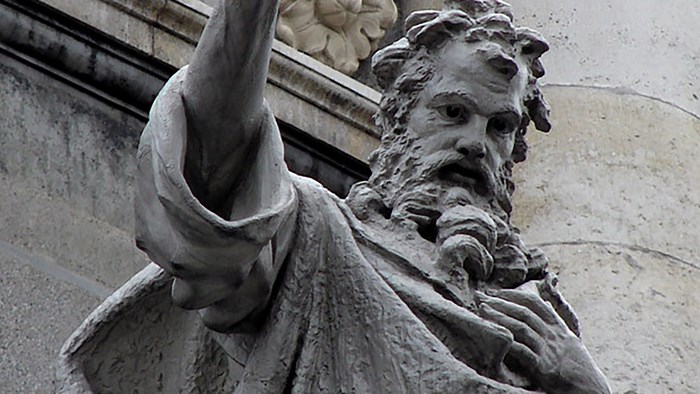


Irenaeus was a living link to the apostles. Although he became bishop of Lyons, in France, he was originally from the East. He was probably born in Asia Minor (modern day Turkey) around A.D. 130-140. As a youth he had seen and heard Polycarp of Smyrna, who, as Irenaeus put it, had received the things concerning the Lord from "the eyewitnesses of the Word of Life" (the name of John the disciple is often mentioned as one of these).
Irenaeus used these reports of Jesus, given "according to the Scriptures," delivered in the beginning by the apostles, to defend the truth of Christianity against a bewildering variety of early anti-Christian and heretical groups. As he did so, he gave the church a clear vision of the scriptural framework of its faith.
At the heart of this vision was Irenaeus's teaching of the right use of both the New Testament and the Old. Before Irenaeus, there was no New Testament. He is the first Christian writer to use, as Scripture, almost all the books that are in our New Testament today. And he insisted that these books could be properly used only by those people who accepted four authorities:
1. The "rule [canon] of truth"; that is, the belief in one God, one Son, and one Holy Spirit—the basis of the later creeds.
2. The whole canonical body of Scripture, Old and New.
3. The apostolic tradition; that is, the deposit handed down, once for all, by the apostles and preserved intact in the church to the present—referring to the contemplation of Christ according to the Scriptures.
4. The bishops whose very lives—as direct successors to the apostles—provided the church with a visible witness that the true teaching about Christ was still being preserved and preached.
For all his decisive importance, we know very little about the life of Irenaeus. On his journey westward he probably visited Rome, where he would have encountered teachers such as the apologist Justin Martyr.
He also probably led the church in Vienne (near Lyons) during a violent persecution in 177, and then he assumed responsibility for the community in Lyons when its bishop, Pothinus, was imprisoned awaiting martyrdom.
Irenaeus is remembered as a martyr—though the claim dates from long after his death, which cannot be dated precisely. Only two of his written works have survived. The first is the collection of five books entitled The Refutation and Overthrow of Knowledge Falsely So-called, also known as Against the Heresies. The other, the Demonstration of the Apostolic Preaching, was discovered only at the beginning of the twentieth century.
Rightly uniting the Word
The Demonstration of the Apostolic Preaching provides the best insight into Irenaeus' vision. Here he links the preaching of the apostles—the New Testament writers—to its source in the Law, the Psalms and the Prophets.
First he outlines the faith handed down by the elders, who had known the apostles, epitomized in the three articles of the "canon of faith"—the one God and Father; the one Lord, the crucified and risen Jesus Christ; and the one Holy Spirit.
Then he recounts, in the manner of the great apostolic speeches in Acts, the scriptural narrative of God's work of salvation culminating in Christ. Finally, he demonstrates that what the apostles proclaimed as fulfilled in Christ, shaped as it is by Scripture, was indeed foretold in Scripture.
Irenaeus stresses the way the apostles themselves used Scripture: following Paul's proclamation that Christ died and rose according to the Scriptures (1 Cor. 15:3-5), the four canonical Gospels focus their accounts of Jesus on the Passion, and they always tell the story with references to Hebrew Scripture. Neither Marcion nor Gnostic writings like the Gospel of Thomas use Scripture like this in proclaiming Christ.
Irenaeus criticizes the heretics on the grounds that they have "disregarded the order and connection of the Scriptures." They have, he charges, rearranged the members of the body of truth, much as do those who take a mosaic of a king and rearrange the stones to form a picture of a dog or fox, claiming that this is the original picture. Those who know the "canon of truth," delivered in baptism, will be able to restore the passages to their proper order, so revealing the image of the King.
The "canon of truth" functions very much like the "pattern of sound words" to which Paul urged Timothy to hold firm (2 Tim. 1:13). By holding to this canon, Christians can proclaim in a continually changing context the same gospel—the "tradition" preserved in the Church.
In this way, Christ is, for Irenaeus, the subject of Scripture throughout. The apostles proclaimed him by reference to the Scriptures. The prophets saw "the Son of God as man conversing with men; they prophesied what was to happen … declaring that the one in the heavens had descended into the 'dust of death'" (Ps. 21.16; Septuagint). Christ was not yet present, but his saving Passion was already the subject of the prophets' words and visions.
Jesus wrote it all
Not only is Jesus Christ the subject of Scripture, from beginning to end, but he is also its ultimate author: Irenaeus takes Jesus' statement that "Moses wrote of me" (John 5.46) to mean, "the writings of Moses are his words," and then extends this to include "the words of the other prophets." So, Irenaeus urges Marcion, "read with earnest care that Gospel which has been given to us by the apostles, and read with earnest care the prophets, and you will find that the whole conduct, and all the doctrine and all the sufferings of our Lord, were predicted through them."
"If anyone reads the Scriptures in this way," Irenaeus argues, "he will find in them the Word concerning Christ and a foreshadowing of the new calling." Using Christ's image of a treasure hidden in a field (Matt. 13:44), where the disciples are sent to reap what others have sown (John 4:35-8), Irenaeus suggests that Christ himself is the treasure, hidden in Scripture, in the types and parables, the words and actions of the patriarchs and prophets, which prefigure what was to happen in and through Christ in his human advent as contained in the Gospel. By their writings, the patriarchs and prophets have prepared the world for the advent of Christ, so that the field is ready for harvest.
Before their consummation in the Christ's advent, these types and prophecies could not be understood. But the cross now sheds light on these writings, revealing what they in fact mean and how they are thus the Word of God. For those who read Scripture without knowing the "explanation" (literally "exegesis") of those things pertaining to Christ, the Scriptures remain only fables. However, those who read Scripture with understanding will be illumined and shine as the stars of heaven.
John Behr is associate professor of patristics at St. Vladimir's Orthodox Theological Seminary, Crestwood, New York.
Copyright © 2003 by the author or Christianity Today/Christian History magazine.
Click here for reprint information on Christian History.

Support Our Work
Subscribe to CT for less than $4.25/month