That Most Familiar Story


On a warm, bright Christmas morning in early 16th-century Spain, Thomas of Villanova completed the gospel reading and advanced to the pulpit. The Augustinian friar was preaching on the nativity story found in Luke:
"The simple hasten eagerly to see the newborn king lying in a manger … they adore and rejoice and mingle their artless praises with the heavenly hymns. … How the Virgin rejoiced at the devotion of these simple folk! How delighted and gladdened she was by their praises! For by his own announcement God had begun to make known to human beings the mystery of divine condescension which had occurred in her womb for their salvation."
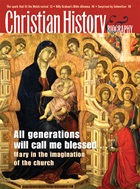
Throughout the Christian era, rich traditions have arisen surrounding the nativity of Jesus, and these traditions have given a prominent role to Mary. As the mother of the Christ, the "Word made flesh," Mary plays a special role in God's plan of salvation. Although Christians differ on this role, she has been honored throughout history for being the handmaiden of the Incarnation over 2,000 years ago.
Place of birth?
Matthew and Luke give few details about Jesus' actual birth. According to the Gospel accounts of Matthew and Luke, Mary was a young Jewish woman, possibly still a teenager, betrothed to a man named Joseph. Although the Gospels say nothing about his age, the church has traditionally viewed Joseph as much older than Mary, in part because of his apparent death before Jesus' ministry.
Whatever their ages (Luther boldly asserted Mary was 15; the early church thought 12), we do know that the couple traveled to Bethlehem, Joseph's ancestral hometown, for a census. Upon their arrival, it became clear that Mary would soon give birth, and yet they could not find a place to stay. The "inn" of most English translations need not be a hotel—it could refer to a relative's home, for instance.
It is likely that Jesus was born not in a wooden barn but in a cave or a shelter built into a hillside. The hills around Bethlehem were dotted with small caves for feeding and boarding livestock. Joseph probably had to lead the donkey bearing Mary down a rocky, jagged path into the mouth of one of these caves as she was experiencing labor contractions. The gospel writers do not mention if anyone else was present, and although Martin Luther, for example, imagined a scandalous lack of help (p. 25), self-delivery was not uncommon in 1st-century Palestine.
The exact site of Jesus' birth is unknown, but by the 3rd century, tradition had established a probable cavern. Constantine's mother, Helena, erected the Church of the Nativity in Bethlehem over the small space. Nearby is the Milk Grotto, a small cave with chalky white rocks, where it is believed Mary nursed the baby Jesus as they fled from Herod's soldiers. The story goes that she spilled a few drops of milk that whitened the rocks. To this day, Christian and Muslim women visit the Milk Grotto and ask Mary to help them conceive and nurse.
Migrants and astrologers
The birth of the Messiah was heralded by two unlikely groups. Shepherds were often feared as a dangerous migrant group on the margins of society. The Magi were probably eastern astrologers who had followed their pagan calculations to the birthplace of the Jewish Messiah. Mary welcomed these visitors and the praise they brought to her newborn baby; Luke tells us she "treasured" their words and "pondered them in her heart."
Early Christians were quick to identify the nativity scene as a reversal of Isaiah 1:3. The prophet announced that "the ox knows its owner, and the donkey its master's crib; but Israel does not know, my people do not understand." Origen and Augustine, among others, affirmed that in the guise of the shepherds and the wise men, humanity had literally returned to its master's crib.
Mother of God—or only of Jesus?
Although the story of the nativity makes clear that Mary is the physical mother of Jesus, the nature of her motherhood was hotly disputed in the Christological controversies of the 4th and 5th centuries. Was she in fact the Mother of the second person of the Holy Trinity, or was she simply the mother of Christ's human nature?
How were Christians to honor her?
As early as the 2nd century, Bishop Irenaeus wrote, "the Virgin Mary … being obedient to His Word, received from the angel the glad tidings that she would bear God." Two centuries later, Bishop Athanasius of Alexandria taught that the Word of God was "inexpressibly, inexplicably, incomprehensibly and eternally … born in time here below, of the Virgin Mary, the Mother of God."
However, in the early 5th century, the influential Patriarch of Constantinople, Nestorius, began to challenge this way of speaking about Mary. Around 428 he preached a famous sermon attacking the use of the term Theotokos, or God-bearer, to describe the mother of Jesus.
It would be more fitting, Nestorius alleged, to call her Christotokos, the one who bore the man Jesus Christ. To refer to her as the Bearer of God was to exalt her unduly. A human woman could not possibly birth the eternal Word: "No one can bring forth a son older than herself!"
Nestorius' position was rejected at the Council of Ephesus in 431, which decreed that Mary was in fact the one who gave birth to the second person of the Trinity in history. The bishops claimed it is fitting and proper to call her the Theotokos, not because she was the "origin" of God, but because the baby she delivered in Bethlehem possessed a human nature mysteriously joined to the eternal nature of God. To reject the term "Mother of God," they argued, is to deny the full divinity of Jesus.
Catholic and Orthodox believers continue to celebrate this understanding of the nativity on the first of January with a feast honoring the Theotokos.
Painless labor and the Christmas crib
Once Mary's status as Mother of God was firmly established within the church, devotion to her and contemplation of her earthly life increased among pious Christians. Mystical visions and art celebrating the nativity spread, elaborating on the biblical story.
Bridget of Sweden (1303-1373) experienced mystical visions of the nativity which she recorded in her Revelations, and which fueled popular representation of the nativity from the 14th century through the Renaissance.
Bridget described Mary's labor as painless: since Mary had been cleansed of original sin in the Immaculate Conception, she did not suffer from Eve's curse. Rather, "in an instant, she brought forth her Son, from whom there emanated such an inexpressible radiance that the sun could not be compared with it." Renaissance paintings of the nativity, which show Mary and her child shining in the center of the canvas, owe much of their visual appeal to Bridget's revelations.
St. Francis of Assisi had his own mystical experience of the nativity when he celebrated Christmas mass in a small cave in Greccio, Italy, using a crib for an altar. As he preached over a carved image of the baby Jesus, Francis experienced a vision of the Christ child in the flesh and was awed by the mystery of what Mary experienced at the moment of the Incarnation. Because of her obedience, the world received the presence of God encased in the helpless flesh of a baby. As the story spread, so did the tradition of placing cribs in Christian homes at Christmastime.
Still highly favored
In Protestant churches after the Reformation, Mary played a less central role in celebrations of the nativity, despite the fact that Luther and Calvin maintained a high view of her place in salvation history. Emphasis was increasingly placed on the Christ child alone, rather than on his mother who birthed God into the world.
Nevertheless, all Christians appreciate the important role Mary played in the life of Jesus. Though he was fully God, Jesus was born from Mary and it was from Mary that he received his humanity. She experienced intimately, in her own body, the mystery of the Incarnation. In a dank cavern, recovering from labor among the straw and squalor of penned animals, the "highly favored" Mary became the first human creature to touch the face of God.
Sarah E. Dahl is a freelance writer living in Minneapolis, Minnesota.
Copyright © 2004 by the author or Christianity Today/Christian History & Biography magazine.
Click here for reprint information on Christian History & Biography.

Support Our Work
Subscribe to CT for less than $4.25/month