How Armenia "Invented" Christendom


Only a week prior to his attack on Poland in September, 1939, Adolf Hitler reportedly delivered a secret talk to members of his General Staff, urging them to wipe out the Polish race. "After all," he argued, "who remembers today the extermination of the Armenians?"
Hitler was referring to the genocide of nearly 1.5 million Armenian Christians at the hands of Ottoman Turks from 1915 to 1923 in what is now eastern Turkey. Turkish authorities deny the atrocities ever took place, but the story of bloodbath in Armenia is one of the well-documented tragedies of our time.
Still, it's unfortunate that Armenia (today located directly east of Turkey and west of the Caspian Sea) is now known for this story above any other. It says nothing about the people of Armenia, or the part they have played in global Christianity. For contribute they did, in a manner that might surprise even a seasoned church historian.
Tortured for Christ
No man has more stature in the Armenian church today than Gregory the Illuminator. While not the first to bring Christianity to Armenia, Gregory is, at least in the minds of Armenians, the nation's spiritual father and the people's patron saint.
Born into a wealthy family around 257, Gregory nevertheless had a rough beginning—his biographer, Agathangelos, tells us Gregory's father murdered the Armenian king and paid for it with his life. But the boy was rescued from the chaos following the murder, and his new guardians raised him as a Christian in Cappadocia (east-central Turkey). There, according to Agathangelos, Gregory "became acquainted with the Scriptures of God, and drew near to the fear of the Lord."
When Gregory's tutors told him of his father's wickedness, Gregory approached the murdered king's son, Tiridates, to offer his service (all the while concealing his identity). Tiridates accepted Gregory's offer, but when Gregory refused to worship Anahit, an idol the king had raised in gratitude for military successes, Tiridates became furious: "You have come and joined us as a stranger and foreigner. How then are you able to worship that God whom I do not worship?"
Tiridates tortured Gregory, hanging him upside-down and flogging him, then fastening blocks of wood to his legs and tightening them. When these tactics failed, he tried even more gruesome measures. Still the saint refused to bow the knee. Tiridates then learned that Gregory was the son of his father's murderer, and he ordered that the missionary be thrown into a "bottommost pit" filled with dead bodies and other filth. There Gregory sat for 13 years, surviving only on bread a widow threw down each day after receiving instruction to do so in a dream.
Converting the King
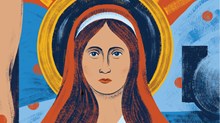
At about this time a beautiful woman named Rhipsime arrived in Armenia, fleeing an enforced marriage to the Roman emperor Diocletian. Tiridates took a liking to her too, and took her forcibly when she refused to come to him. But "strengthened by the Holy Spirit," she fought off his advances and escaped. Furious, Tiridates ordered her execution, and that night Rhipsime burned at the stake. Her abbess Gaiane soon followed her in death, along with 35 other companions.
The king, still lusting after Rhipsime, mourned her death for six days, then prepared to go hunting. But God visited on him a horrible punishment—Agathangelos calls it demon possession—reducing him to insanity and throwing his court into chaos. Tiridates' sister had a vision to send for Gregory, imprisoned so long ago. People laughed at the idea Gregory might still be alive, but recurrent visions finally convinced a nobleman, Awtay, to visit his pit. Astonished to find the missionary living, Awtay brought him to meet the king, who was feeding with swine outside the city.
Tiridates, along with other possessed members of his court, rushed at Gregory. But Gregory "immediately knelt in prayer, and they returned to sobriety." Tiridates then pleaded for Gregory's forgiveness, and the king and his whole court repented of their sin and confessed faith in Christ.
Assessing Gregory's Legacy
Scholars disagree over how much Agathangelos's history can be taken at face-value. After all, he wrote his book in 460 (Tiridates is believed by Armenians to have converted in 301), and much of his story has elements of hagiography that lead one to wonder whether the events ever happened. But even skeptics acknowledge that Gregory was a real person with considerable ecclesiastical influence in Armenia—the signature of his son and successor Aristakes can be found among those ratifying the Council of Nicaea in 325. And even if we can document little about the man, his pre-eminence among Armenia's heroes of the faith is unassailable.
Why? First, Gregory persuaded the king to build a string of churches across Armenia, beginning with Holy Etchmiadzin— according to some scholars the oldest cathedral site in the world and an important pilgrimage site for all Armenians. The seat of the Armenian church would pass to other cities, but Gregory "established" Christianity in Armenia via this church.
Gregory also introduced Christian liturgy to Armenia. These rites consisted of psalmody, scriptural readings, and prayers recited in Greek or Syriac. After Mesrop Mashtots invented an Armenian alphabet at the beginning of the fifth century, both the Bible and the liturgy were translated into the Armenian language.
Most importantly, Gregory set in motion the mass conversion of Armenia to Christianity. According to Agathangelos, the king ordered all pagan shrines to be torn down, and Gregory proceeded to baptize more than 190,000 people into the new faith. Whether the nation converted as quickly as Agathangelos implies is difficult to discern. Certainly by the fifth century, Armenia was well on its way to becoming a "Christian" nation.
Armenia is an ancient—if not the oldest—model for what we now call Christendom. Church historian Kenneth Scott Latourette notes that the Armenian church "was an instance of what was to be seen again and again, a group adoption of the Christian faith engineered by the accepted leaders and issuing in an ecclesiastical structure which became identified with a particular people, state, or nation."
Certainly the Roman Empire is a prime example of this, but Armenia is at least as old, and perhaps a more impressive example given the invasions and persecution it endured at the hands of the Turks (and before them, Arabs and Persians). Indeed even Byzantium attempted to bring Armenia within its orbit, but the nation resisted, arguing that its apostolic origins were on par with Rome.
So lest you assume Rome is our first example of Christendom, think again. Long may Armenia's church endure.
Copyright © 2005 by the author or Christianity Today/Christian History & Biography magazine.
Click here for reprint information on Christian History & Biography.

Support Our Work
Subscribe to CT for less than $4.25/month