Unforgettable


The first sight in Burma that caught Adoniram Judson's eye that July morning in 1813 was the massive Shwedagon pagoda. In this new millennium, the gleaming gold spire of Buddhism's most sacred shrine is still a magnet for the eye amidst the smog of a bustling, crowded city. In one sense, little has changed since the young missionaries first stood on the shores of the "Golden Kingdom." Then it was one of the poorest lands in Asia. In spite of strategic natural resources, it still is. Human rights organizations list Myanmar (modern-day Burma) as one of the most repressed nations on earth.
Nevertheless, something is strikingly different. Along with the pagodas, the spires of many churches dot the skyline. Judson set a goal for himself that first year: During his lifetime, he would translate the Bible into the language of the people and see a little church of 100 members. In reality, when he died in 1850, he left the entire Bible in Burmese, 100 churches, and over 8,000 believers—now grown to several million. Moreover, the Judsons' work had repercussions among Baptists in America that they could never have dreamed of. Both at home and abroad, the Judsons left an indelible mark on missions history.
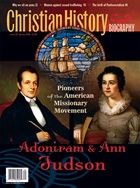
Adoniram Judson
Bearing fruit in Burma
For the Baptist mission in Burma, the period from Judson's death until the end of the American Civil War was a time of uncertainty and change. But the formation of the Burma Baptist Mission Convention in 1865—with the stated goal of promoting an indigenous church—consolidated the work. As the 19th and early 20th centuries progressed, more Baptist missionaries (among them two of Judson's own grandchildren) were joined by Methodists and Anglicans. New emphasis was given to the training of national Christian leaders. Medical and agricultural work, industrial schools, Bible translation, and publication of Christian literature expanded as the missions grew. By the time the centennial celebration of the first mission to Burma took place in 1913, a remarkable 78 percent of the 900 Burmese churches were self-supporting, and the Baptist mission in Burma was recognized as one of the most successful in the world.
Judson had once said that making a convert in Rangoon was "like drawing the eye-tooth of a live tiger," so deeply was Buddhism entrenched in the culture. Consequently, it was not among the majority "Bhama" ethnic group that Protestant (and also Roman Catholic) missionaries had the most success, but among the numerous non-Buddhist tribal groups in the hills and jungles. The Karen, once called the "Wild People," are at least 40 percent Christian today. The Kachin tribe is 90 percent Christian, and the Chin tribe 95 percent.
The church in Burma/Myanmar continues to thrive in spite of more than a century of wars, oppression, discrimination, and the corrosion of unity among the various Christian groups. With only 49 million people, including 4 million Christians, Myanmar has the third largest number of Baptists of any nation—over 2 million. Only the United States and India have more.
Roots and branches
Many individual Christians throughout Myanmar can trace their spiritual roots back to the 19th century. Ah Vong, the Chinese-Burmese printer who helped publish the first edition of Judson's Burmese Bible, became the patriarch of a huge family of Burmese believers. The Ah Vong clan continues to produce leading Christian pastors, doctors, theologians, and educators. One Ah Vong descendant married the first Burmese president of Rangoon's prestigious Judson College. Zau T. Win, a prominent senior member of the Burmese delegation to the United Nations, proudly traces his Baptist ancestry to U Khway and Daw Pu Le, great-great-great-grandparents who were baptized by Judson nearly two centuries ago.
One of the Judsons' dreams was that the Christians of Burma would reach out to their own people, and indeed they have. The Burmese government expelled Western missionaries in 1966, but the gospel has continued to spread. National Christians have established numerous schools of theology, and many pastors personally mentor young people in evangelism—another principle passed on to them by the teaching and example of Judson. By one estimate, Burma's churches have sent out over 2,000 missionaries.
And what about Judson's crowning achievement, the Burmese Bible? In the 1950s, Burma's Buddhist prime minister U Nu attended a tea held by the Burma Christian Council. Discussion arose about the possible need for a new colloquial translation of the Bible. U Nu declared, "Oh no, a new translation is not necessary. Judson's captures the language and idiom of Burmese perfectly and is very clear and understandable." After much consultation, the committee agreed. Judson's translation continues to be the most popular version of the Bible in Burma today. Furthermore, every dictionary and grammar written in Burma in the last two centuries have been based on the ones that Judson originally created.
American echoes
It is ironic that the Judsons are now more widely known and admired in Burma, their adopted country, than in America, where their lives impacted millions of Christians. Not only did Ann and Adoniram inspire generations of young people to become missionaries, but it was also because of them that the scattered Baptist churches in America forged themselves into a missionary-sending denomination.
The Judsons sailed in 1812 as Congregationalists, became Baptists, and thus ended up with no society to support them. Baptists in America—until then a persecuted minority fiercely protective of their local independence and distrustful of denominational bureaucracies and hierarchies—suddenly found themselves with missionaries to support. Luther Rice's American tour to rally the various Baptist communities behind the Judsons' mission resulted in the first national Baptist organization. The Triennial Convention united Baptists around the common goal of foreign missions, and this became the driving force behind what was soon one of the largest and most influential denominations in the nation.
Mission societies proliferated, financial giving increased, and Baptist churches enjoyed unprecedented growth. Periodicals like the American Baptist Missionary published letters by Adoniram and Ann Judson, as well as other early missionaries. These helped to give Baptists a sense of identity and purpose. Judson Press was an imprint of the American Baptist Publication Society (established in 1824), and to this day it continues to publish books that propagate the message preached by its namesake.
In 1845, the formation of the Southern Baptist Convention broke the short-lived Baptist unity, and since then numerous other groups have splintered off. But nearly all trace their heritage back to the Judsons and the need to be a missions-sending people. Untold numbers of Baptists named their sons after Adoniram, the best known being Adoniram Judson (A. J.) Gordon (1836-95), who was a leading evangelical educator and advocate for missions. Both Gordon College and Gordon-Conwell Theological Seminary in Massachusetts trace their origins to the Boston Missionary Training School, which he founded in 1889.
Today there are at least 36 Baptist churches across the United States bearing the name "Judson" in honor of America's pioneer missionary, as well as two institutions of higher education. Founded in 1963, Judson College in Elgin, Illinois, has a reputation as a significant liberal arts school. Judson College in Marion, Alabama, is the state's only college exclusively for women and one of the six oldest women's colleges in the nation. Founded in 1838, it was named for Ann Hasseltine Judson.
As Bible translators in Burma and missionary celebrities in America, the Judsons planted seeds deep in the soil of two continents. It remains to be seen what the fruits of this remarkable legacy will be in the years to come. Each July, Baptist churches throughout Burma/Myanmar celebrate "Judson Day," commemorating the arrival of Ann and Adoniram Judson in 1813. At the 1999 memorial service at Immanuel Church, one of Burma's oldest and largest churches in downtown Rangoon, the speaker concluded, "Let Judson's life be a challenge to us. He has passed on the torch. We must take it up."
Rosalie Hall Hunt is a retired missionary and the author of Bless God and Take Courage: The Judson History and Legacy.
Christianity in Burma: some key dates
1865 Burma Baptist Mission Convention founded
1885 Third Anglo-Burmese War ends Burmese monarchy; British rule opens door to more missions efforts
1914 Burma Representative Council of Missionaries founded; later evolves into the Myanmar (Burma) Council of Churches, a central coordinating body for most Protestant Christians in Myanmar today
1948 Independence from Britain followed by decades of political unrest, civil war, and religious persecution
1961 Buddhism declared state religion of Burma
1966 Burmese government expels nearly 375 Roman Catholic and Protestant missionaries
1977 90,000 Baptists gather in northern Burma; over 6,000 converts baptized
2003 Myanmar Institute of Theology (founded in 1927) dedicates Judson Research Center "to study the relations of Christianity to Theravada Buddhism, and to the primal religions of the ethnic peoples to bring about dialogue."
Copyright © 2006 by the author or Christianity Today/Christian History & Biography magazine.
Click here for reprint information on Christian History & Biography.

Support Our Work
Subscribe to CT for less than $4.25/month