



Faith of Our Mothers
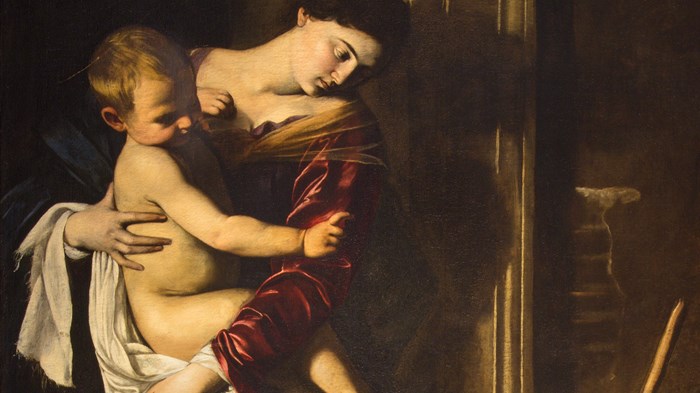

Church history might seem to suffer from "dead white male syndrome," but mothers have been central figures in the Christian tradition ever since Mary told Gabriel, "May it be to me as you have said." Some of the most notable Christian mothers have been celebrated for praying fervently for their children, modeling faith, and training their children up in the way they should go.
Prayers and tears
Probably the best known Christian mother from antiquity is Monica (331-387), a monumental figure in her son Augustine's autobiography, Confessions. Mother of three children, wife of a difficult man, she longed to secure every good thing for Augustine. Early in his life, this meant sending him to the best schools, advancing his career, and protecting him from a socially disadvantageous marriage. Later, she devoted herself to a different goal: drawing her son into the kingdom of God by whatever means necessary.
Monica had much to worry about regarding her son's spiritual health. He stole pears from a neighbor's tree, delighting in the evil of the act. He pursued his lusts heartily. He valued erudition over holiness. He fell under the sway of Manichaeism, a dualistic philosophy opposed to Christianity. More than once he ran off, largely to escape his mother's pious pressures.
When Augustine would not listen to her, Monica could only pray and weep for her wayward boy. In Confessions, Augustine recalled a mother who "wept to [God] for me, shedding more tears for my spiritual death than other mothers shed for the bodily death of a son." Eventually Monica brought her concerns to a Christian bishop, Ambrose, who assured her, "It cannot be that the son of these tears should be lost."
After years of supplication, Monica's prayers were answered. Augustine embraced Christianity and came to appreciate fully his mother's spiritual labors on his behalf. She lived to see him become a priest and died in peace, having told him, "There was one reason, and one alone, why I wished to remain a little longer in this life, and that was to see you a Catholic Christian before I died. God has granted my wish and more besides."
Monica's example inspired many Christian mothers in the Middle Ages. Bridget of Sweden (1303-1373), married at age 13 to a pious nobleman, bore eight children before she was widowed. One of those children, a son named Bengt, fell ill in his youth. Fearing that her sins had caused her son's condition, she cried out to God. She received reassurance that the illness had natural causes, and she was confident upon Bengt's death that he had gone to heaven. His brother Karl, however, posed a bigger challenge.
Karl, the black sheep of the family, caused his mother no end of anxiety. As she wept and prayed for him, she had a vision of her son standing before Christ, with Mary and an angel representing his defense and the Devil representing the prosecution. The Devil tried to damn Karl with a sack full of his sins, but the sack disappeared, then the Devil forgot what the sins were, and finally he forgot the sinner's name. The angel, vaguely echoing Ambrose, explained that Karl, who was known in heaven as "the son of tears," was already forgiven.
Models of faith
Perpetua (182-203), a well-born young wife in Carthage, had recently given birth to her first child when she was swept up in a severe persecution of Christians. Her father pleaded with her to renounce her faith, for the sake of her own life and that of her child, but she refused. Eventually Perpetua was brought into the arena to be mauled to death by wild beasts. According to the famous account of her martyrdom, just before her death she admonished the believers in the crowd, "Stand fast in the faith." It is not known what became of her child or the rest of her family, but her legend inspired countless other suffering Christians.
Macrina the Elder (died c. 340) also held onto faith in a time of persecution. Responding to the preaching of Gregory the Wonder-Worker, she and her husband were two early converts to Christianity in Asia Minor (modern Turkey). During the last great campaign against Christians in the Roman Empire, Macrina and her husband fled from their hometown. According to tradition, the couple lived for seven years in a forest, nearly starving on several occasions. After they were allowed to return home, the empire confiscated their possessions. Additionally, Macrina was widowed (she is the patron saint of widows).
Nonetheless, Macrina's Christian commitment persisted, and it flourished in subsequent generations. Three of her grandchildren became the most celebrated Christians of their era. Basil the Great and Gregory of Nyssa greatly advanced Christian theology, and Basil also founded an important monastic order. Macrina the Younger inspired her brothers and led a community of devout Christian women.
Helena (250-330), mother of Emperor Constantine, became a Christian only after her son's conversion, but from that point on she exhibited tremendous zeal. The royal biographer Eusebius recorded glowing accounts of Helena's prayers and pilgrimages to the Holy Land. She was especially concerned to rediscover key sites in early church history, strip them of pagan encrustations, and consecrate them to God's service. By retracing Jesus' steps and dedicating holy markers along the way, Eusebius wrote, "she bequeathed the fruit of her piety to future generations."
Helena displayed other Christian virtues as well. She donated money to the poor, worked to liberate prisoners, and restored exiles. When she worshiped, she dressed plainly, mingling with humbler believers. She also donated money to churches throughout the empire, building or re-building facilities in places where Christianity had been a persecuted sect just a few years earlier.
Early childhood educators
Anthusa (c. 347-407) lived in Antioch, the hub of Paul's missionary journeys, and bore a son, John, just before her husband died. Though Antioch's population was roughly one-half Christian at this time, Anthusa feared society's corrupting influence on John, so she taught him what she knew of classics and Christian faith at home. After his character was formed, she sent him to be trained by an experienced orator, who honed John's innate gifts of communication. John became one of the early church's most renowned preachers. His contemporaries named him Chrysostom, or "golden-mouthed."
Katie Luther (1499-1552), wife of the Protestant Reformer Martin Luther, schooled a large and ever-changing group in her house. She bore six children, raised four orphans, and generally rode herd over the students Martin brought home from the university where he taught. Sometimes as many as 30 people crowded under her roof, seeking to learn all they could from both Martin and his formidable wife. Luther was only half-joking when he referred to her frequently as "my lord Katie."
Susanna Wesley (1669-1742), mother of John and Charles, is sometimes called the "Mother of Methodism" as well. She ran a tightly ordered household by necessity, for her husband subsisted on a minister's salary and she bore 17 children, 9 of whom died in infancy. On top of all of her household duties, she conducted day school for her youngsters, instructing them in godliness alongside academics. Each child had chores to perform, Scriptures to learn, and character issues to address. Each child also had a personal audience with mother every week, for one-on-one attention and encouragement.
It is not hard to see how the discipline integral to the Methodist system grew from John Wesley's childhood experiences. In contrast to the Church of England, a hierarchy in which religious duties generally fell to clerics and spiritual oversight was sometimes lax, Methodism emphasized small groups in which every member was accountable for Bible study, mutual correction and edification, and Christian service.
Though Susanna lived only long enough to see John's earliest revival meetings, she would have been proud of the religious movement he founded following many of her principles.

Support Our Work
Subscribe to CT for less than $4.25/month