The Wall of Separation
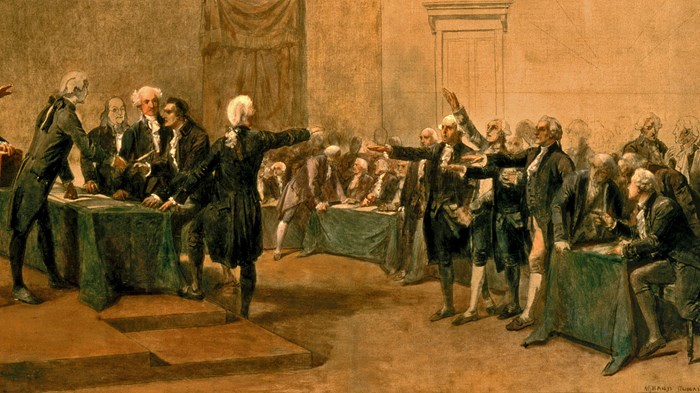

Thomas Jefferson was inaugurated the third president of the United States on March 4, 1801, following one of the most bitterly contested presidential elections in American history. He had faced the unpopular incumbent, Federalist John Adams of Massachusetts—his confrere in the independence struggle and longtime rival. The electorate was deeply divided along regional, partisan, and ideological lines. Acrimonious campaign rhetoric punctuated the polarized political landscape.
In few, if any, presidential contests has religion played a more divisive and decisive role than in the election of 1800. Jefferson's religion, or alleged lack thereof, emerged as a critical issue in the campaign. His Federalist opponents vilified him as a Jacobin and atheist. (Both charges stemmed from his notorious sympathy for the French Revolution, which in the 1790s had turned bloody and, some said, anti-Christian.) In the days before the election, the Gazette of the United States, a leading Federalist newspaper, posed the "grand question" of whether Americans should vote for "GOD—AND A RELIGIOUS PRESIDENT [John Adams]; or impiously declare for JEFFERSON—AND NO GOD!!!"
Jefferson's Federalist foes did not invent the stinging accusation that he was an infidel. Years before, his ardent advocacy for disestablishment in Virginia had led many pious Americans to conclude that Jefferson was, if not an enemy of religion, at least indifferent towards organized religion's vital role in civic life. The publication of his Notes on the State of Virginia in the mid-1780s exacerbated these fears. He wrote, "It does me no injury for my neighbor to say there are twenty gods, or no God. It neither picks my pocket nor breaks my leg." This passage came back to haunt him in the 1800 campaign. Detractors said this proved he was an infidel or, worse, an atheist.
Jefferson described himself as "a real Christian," although he was certainly aware that his beliefs were unconventional. "I am of a sect by myself," he said. He believed that human reason was the arbiter of religious truth and rejected key tenets of orthodox Christianity, including the Bible's divine origins, the deity of Christ, original sin, and the miraculous accounts in Scripture.
Despite his deviations from orthodoxy, he rejected suggestions that his views were of "that anti-Christian system imputed to me by those who know nothing of my opinions." His religion was very different, Jefferson conceded, from the leading churchmen of his day who called him an "infidel and themselves Christians and preachers of the gospel." He believed that Jesus Christ's moral teachings, stripped of the fiction and artifice carefully crafted by those calling themselves Christians, were "the most perfect and sublime that has ever been taught by man."
An infidel in office?
Jefferson's faith provided an early test of religion's place in national politics. His heterodox beliefs raised doubts about his fitness for high office. In 1798, Timothy Dwight, a Congregationalist minister and the president of Yale College, warned that the election of Jeffersonian Republicans might usher in a Jacobin regime in which "we may see the Bible cast into a bonfire, the vessels of the sacramental supper borne by an ass in public procession, and our children … chanting mockeries against God … [to] the ruin of their religion, and the loss of their souls."
In an influential pamphlet published in 1800, William Linn, a Dutch Reformed clergyman, warned that a vote for Jefferson "must be construed into no less than rebellion against God." He added ominously that the promotion of an infidel to high office would encourage public immorality and lead to the "destruction of all social order and happiness."
Presbyterian minister John Mitchell Mason similarly declaimed that it would be "a crime never to be forgiven" for the American people to confer the office of chief magistrate "upon an open enemy to their religion, their Redeemer, and their hope, [and it] would be mischief to themselves and sin against God." Jefferson's "favorite wish," Mitchell charged, is "to see a government administered without any religious principle among either rulers or ruled." He repudiated the notion gaining currency among Jeffersonians that "Religion has nothing to do with politics."
Jeffersonian partisans denied that their candidate was an atheist and advanced a separationist policy that would eventually exert much influence on American politics. "Religion and government are equally necessary," said Tunis Wortman, "but their interests should be kept separate and distinct. No legitimate connection can ever subsist between them. Upon no plan, no system, can they become united, without endangering the purity and usefulness of both—the church will corrupt the state, and the state pollute the church."
Republicans extolled Jefferson as a leader of uncommon liberality and tolerance—an enlightened man who zealously defended constitutional government, civil and religious liberty, and the separation between religion and politics. "[M]y information is that he is a sincere professor of Christianity—though not a noisy one," Wortman wrote.
The campaign rhetoric was so vitriolic that when news of Jefferson's election swept across the country, housewives in Federalist New England were seen burying their family Bibles in their gardens or hiding them in wells because they expected the Scriptures to be confiscated and burned by the new administration.
Anybody but a Presbyterian!
Although Jefferson's beliefs drew the most attention, John Adams was not immune from political smears on account of religion. When President Adams recommended a national "day of solemn humiliation, fasting, and prayer" in March 1799, political adversaries depicted him as a tool of establishmentarians intent on legally uniting a specific church with the new federal government. This allegation alarmed religious dissenters, such as the Baptists, who feared persecution by a state church.
"A general suspicion prevailed," Adams recounted a decade later, "that the Presbyterian Church [which was presumed to be behind the national day of prayer] was ambitious and aimed at an establishment as a national church." Although disclaiming any involvement in such a scheme, Adams ruefully reported that he "was represented as a Presbyterian and at the head of this political and ecclesiastical project. The secret whisper ran through all the sects, 'Let us have Jefferson, Madison, Burr, anybody, whether they be philosophers, Deists, or even atheists, rather than a Presbyterian President.'" Adams thought the controversy, which drove dissenters into Jefferson's camp, cost him the election.
Both men were deeply wounded by the vicious attacks on their characters and the ruinous campaign tactics. An anguished Jefferson compared his persecution at the hands of critics—especially among the New England clergy—with the crucified Christ: "from the clergy I expect no mercy. They crucified their Saviour, who preached that their kingdom was not of this world; and all who practice on that precept must expect the extreme of their wrath. The laws of the present day withhold their hands from blood; but lies and slander still remain to them."
The bitterness lingered long after both men had left public office. In their declining years, they resumed a correspondence, slowly repairing their ruptured friendship.
Church and state
Jefferson enjoyed one pocket of support in staunchly Federalist New England: the Baptists. In October 1801, the Baptist Association of Danbury, Connecticut, wrote to congratulate the recently inaugurated president. The Danbury Baptists were a beleaguered religious minority in a state where Congregationalism was the established church. They celebrated Jefferson's advocacy for religious liberty and chastised those who criticized him "because he will not, dares not assume the prerogative of Jehovah and make Laws to govern the Kingdom of Christ." They expressed a heartfelt desire "that the sentiments of our beloved President, which have had such genial Effect already, like the radiant beams of the Sun, will shine & prevail through all these States and all the world till Hierarchy and tyranny be destroyed from the Earth."
On New Year's Day, 1802, President Jefferson penned a reply. The carefully crafted letter reassured the Baptists of his commitment to their rights of conscience and struck back at the Congregationalist-Federalist establishment in New England for shamelessly vilifying him in the recent campaign. The First Amendment, he wrote, denied Congress the authority to establish a religion or prohibit its free exercise, "thus building a wall of separation between Church & State."
Jefferson's wall, according to conventional wisdom, represents a universal principle on the constitutional relationship between religion and the state. To the contrary, this wall had less to do with the separation between religion and all civil government than with the separation between national and state governments on matters pertaining to religion. The "wall of separation" was a metaphoric construction of the First Amendment, which Jefferson time and again said imposed its restrictions on the national government only (see, for example, Jefferson's 1798 draft of the Kentucky Resolutions).
How did this wall, limited in its jurisdictional application, come to exert such enormous influence on American law and politics? Jefferson's metaphor might have slipped into obscurity had it not been "rediscovered" by the U.S. Supreme Court in 1947. Asked to interpret the First Amendment's prohibition on laws "respecting an establishment of religion," the justices declared: "In the words of Jefferson," the First Amendment "erect[ed] 'a wall of separation between church and State' … [that] must be kept high and impregnable. We could not approve the slightest breach."
This landmark ruling laid the foundations for a long line of legal decisions restricting religion's place in public life. The "wall" metaphor, in particular, provided the rationale for censoring religious expression in schools, stripping public spaces of religious symbols, and denying public benefits to faith communities.
The bitterness of the election of 1800 has long faded from public memory. The partisanship and rancorous rhetoric that characterized the contest, however, have become familiar features of the political culture. An enduring legacy of the campaign is the perennial debate regarding the constitutional place of religion in civic life. Religion, argues one side, is an indispensable support for political prosperity, providing a vital moral compass in a regime of self-government. The other side, echoing Jeffersonian partisans, asserts that social cohesion and democratic values are threatened whenever bricks are removed from the wall of separation between religion and politics.
This debate is as old as the Republic and as current as the morning newspaper.
Daniel L. Dreisbach is professor of justice, law and society at American University.
Copyright © 2008 by the author or Christianity Today/Christian History & Biography magazine.
Click here for reprint information on Christian History & Biography.

Support Our Work
Subscribe to CT for less than $4.25/month