The Ancient Rise and Recent Fall of Tithing
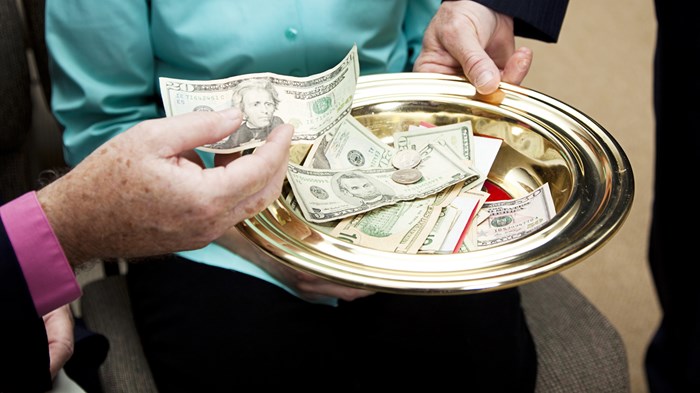


During the first few years of the twenty-first century, Americans have already contended with a remarkable amount of political and economic tumult, ranging from the Sept. 11 attacks to the collapse of the 1990s economic boom to military conflicts in Afghanistan and Iraq. Uneasiness and caution have ruled the financial decision-making of many American households. Now, recently released statistics from the Barna Research Group indicate that this pervasive apprehension may have contributed to a dramatic one-year decrease in the number of American homes that tithe to their churches.
Barna's data shows that only 3 percent of adults contributed 10 percent of their 2002 income to churches, which marks a 62 percent decrease from 2001 when 8 percent of American adults tithed. Among born-again Christians, the decline was similarly steep, from 14 percent in 2001 to 6 percent in 2002. Barna attributes the sudden drop to a variety of factors, including the soft economy and ongoing terrorism threat. But he also pegs shifting church demographics—younger adults don't share their parents' and grandparents' convictions about tithing.
This generation seems not so much put off as mystified by the concept. Their questions are honest enough: "Who came up with the figure of ten percent? Why should we take this figure as authoritative? Isn't tithing legalism?" Here, as in most churchly matters, a bit of history can go a long way.
Most discussions of tithing begin with the Old Testament precedent, first recorded in Genesis 14:20. After winning an astounding victory in battle and retrieving his nephew Lot along with all his lost possessions, Abram thanked God by giving Melchizedek one-tenth of all he had. Then, in Numbers 18:21, we find tithing included in the Mosaic Law. Its purpose was to provide for the Levites, whom God wanted to concentrate on priestly duties.
While the New Testament contains no explicit command to tithe, many have argued that this relationship between the Levites and the other tribes of Israel prefigures how Christians should provide for their ministers. This view of tithing, known as parallelism, gained prominence in the church around the sixth century.
Many non-Jewish and pre-Christian societies also practiced tithing-like giving. Some ancient sources describe how kings imposed a type of first-fruits tax to maintain holy shrines and support clergy. From Nebuchadnezzar's Babylonia to the temples of Apollo in Delphi and Athena in Athens, pre-Christian centers of worship collected tithes for their gods. Ancient cultures as disparate as the Greeks and Chinese—including the Arabians, Phoenicians, Romans, and Carthaginians—gave in ways mirroring the tithe. Some scholars believe ancient cultures hit on the seemingly arbitrary figure of one-tenth because they often did calculations on their fingers.
The early church's views on tithing foreshadowed many of today's stewardship debates. The Eastern Church began tithing out of obligation because they believed Jesus' conversation with the rich young man demanded sacrificial generosity. Clement of Alexandria and Irenaeus pleaded with the church to surpass even the Old Testament tithe since Christ had freed them from the Law.
Later church fathers—John Chrysostom, Cyprian, Origen, and Augustine among them—complained from time to time that their followers lacked Christian charity. Chrysostom even shamed his stingy church for marveling at those who tithed. He contrasted their amazement with the dutiful giving of Old Testament Jews.
The early church's expectation that every Christian would tithe found formal expression at the Synod of Mâçon in 585, which embedded the practice in canon law. A millennium later, the Council of Trent sharpened this law's teeth: it provided for excommunication if any Catholic declined to contribute his tithe. This, despite the stain in the Church's monetary record that Luther had so recently uncovered in his critique of papal indulgences.
Post-Reformation Europe, however, didn't do much better: in the centuries after Luther, secular governments often acted on behalf of the churches by collecting mandatory tithes. These more closely resembled American property taxes than Jewish monetary offerings.
Without a state-imposed tithe, giving in the United States developed quite differently than in Europe. American church leaders have often emphasized the New Testament's command to give freely and cheerfully, which some leaders have cited to advocate giving less or even more than ten percent. As a result, tithing has been practiced only sporadically in the modern church, though some revival has been seen in recent decades among Baptists and elements of the Wesleyan holiness movement and Pentecostalism.
Still, Barna's new research reveals that the vast majority of Christians apparently remain unmoved by the message of John Bunyan's couplet: "There was a man, some called him mad; The more he gave, the more he had."
Copyright © 2003 Christianity Today. Click for reprint information.

Support Our Work
Subscribe to CT for less than $4.25/month