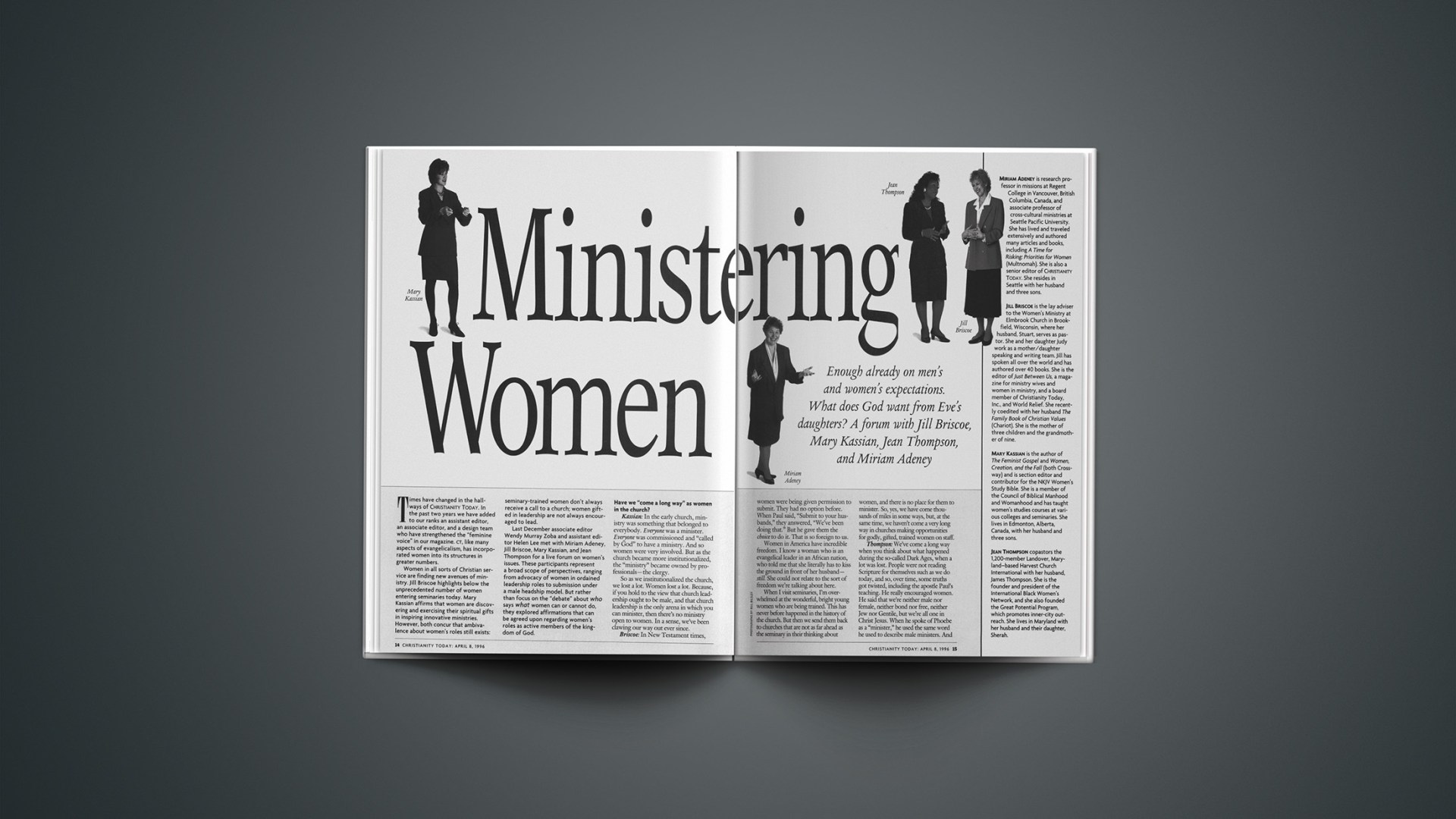

What does God want from Eve’s daughters? A forum with Jill Briscoe, Mary Kassian, Jean Thompson, and Miriam Adeney
Times have changed in the hall-ways of CHRISTIANITY TODAY. In the past two years we have added to our ranks an assistant editor, an associate editor, and a design team who have strengthened the “feminine voice” in our magazine. CT, like many aspects of evangelicalism, has incorporated women into its structures in greater numbers.
Women in all sorts of Christian service are finding new avenues of ministry. Jill Briscoe highlights below the unprecedented number of women entering seminaries today. Mary Kassian affirms that women are discovering and exercising their spiritual gifts in inspiring innovative ministries. However, both concur that ambivalence about women’s roles still exists: seminary-trained women don’t always receive a call to a church; women gifted in leadership are not always encouraged to lead.
Last December associate editor Wendy Murray Zoba and assistant editor Helen Lee met with Miriam Adeney, Jill Briscoe, Mary Kassian, and Jean Thompson for a live forum on women’s issues. These participants represent a broad scope of perspectives, ranging from advocacy of women in ordained leadership roles to submission under a male headship model. But rather than focus on the “debate” about who says what women can or cannot do, they explored affirmations that can be agreed upon regarding women’s roles as active members of the kingdom of God.
HAVE WE “COME A LONG WAY” AS WOMEN IN THE CHURCH?
Kassian: In the early church, ministry was something that belonged to everybody. Everyone was a minister. Everyone was commissioned and “called by God” to have a ministry. And so women were very involved. But as the church became more institutionalized, the “ministry” became owned by professionals—the clergy.
So as we institutionalized the church, we lost a lot. Women lost a lot. Because, if you hold to the view that church leadership ought to be male, and that church leadership is the only arena in which you can minister, then there’s no ministry open to women. In a sense, we’ve been clawing our way out ever since.
Briscoe: In New Testament times, women were being given permission to submit. They had no option before. When Paul said, “Submit to your husbands,” they answered, “We’ve been doing that.” But he gave them the choice to do it. That is so foreign to us.
Women in America have incredible freedom. I know a woman who is an evangelical leader in an African nation, who told me that she literally has to kiss the ground in front of her husband—still. She could not relate to the sort of freedom we’re talking about here.
When I visit seminaries, I’m overwhelmed at the wonderful, bright young women who are being trained. This has never before happened in the history of the church. But then we send them back to churches that are not as far ahead as the seminary in their thinking about women, and there is no place for them to minister. So, yes, we have come thousands of miles in some ways, but, at the same time, we haven’t come a very long way in churches making opportunities for godly, gifted, trained women on staff.
Thompson: We’ve come a long way when you think about what happened during the so-called Dark Ages, when a lot was lost. People were not reading Scripture for themselves such as we do today, and so, over time, some truths got twisted, including the apostle Paul’s teaching. He really encouraged women. He said that we’re neither male nor female, neither bond nor free, neither Jew nor Gentile, but we’re all one in Christ Jesus. When he spoke of Phoebe as a “minister,” he used the same word he used to describe male ministers. And he said to “give her whatever she needs” because she risked her life. She was a minister in the full sense.
The Lord has himself broken down the walls of partition that used to separate us. Paul would argue that we should accept one another regardless of the race and regardless of the gender. So we’ve “come a long way” since the Dark Ages, but we’re just beginning to get back to where the Lord Jesus Christ wants us to be.
Adeney: Have we come a long way?
I would say no, although there are exceptions. But I think the overriding reality is that there is a wave of restrictions on women that seems to be recurring—not just in Christianity, but also in Islam. Dana Robert wrote about how at the turn of the century there were some 3 million American women involved in over 40 denominational women’s mission societies. “A celebration in 1910″—I’m quoting here—”listed 2,500 women missionaries, 6,000 indigenous women workers who were in fellowship with these missionaries, 3,263 schools, 80 hospitals, 11 colleges, and many other institutions being supported by American Christian women.”
But she observes that when these women’s societies became co-opted into general and denominational mission boards, the impetus behind grassroots mission education waned, and it has never fully recovered. Robert concludes: “In some ways women involved in mission today face greater barriers than they did in the early twentieth century.” I would say that is not “coming a long way.”
Briscoe: That trend is due to the fact that in a lot of places there aren’t any women making the decisions for women. So we need men to go to bat for us. I’m usually the first woman to do this or that—one of the first women on the board of CTi, or the first woman on the board of World Relief. And it has been men who have made that possible, not women, because women aren’t making the decisions about who we should have on an all-male board.
I’m often telling men, “We’re in your hands. The opportunities we have are yours to make, because women are not now in a position to make those choices.” In the last ten years, I have seen many men who are very prominent speak up for women. My husband wrote an article for Moody about 15 years ago on women’s gifts and how we must not bury our talents—as in the parable. He asked in the article, “What would happen if we buried somebody else’s talent?” And then he talked about how he did not want to stand before God and hear God say: “You buried your wife’s talent, or your daughter’s.” And so he began to see his responsibility as head of our home as making sure we were equal. You should have seen the letters he got from women thanking him for affirming them—for using his influence to encourage their gifting.
Thompson: It’s good to see men who are encouraging women. My husband is my greatest encourager. He’s said, “If God calls the women, who is the one that is big enough to send them back?” I see a similarity with blacks, when they, along with women, were shunned. But God isn’t shutting anybody out.
Kassian: Jill, you mentioned the headship of your husband in terms of serving and encouraging you in your giftedness. Do you see that as the role of men also in the church?
Briscoe: I accept headship as a biblical concept. I also accept equality as another biblical concept. And just as I cannot bring predestination and free will together, I cannot bring headship and equality together, but I embrace them both. And sometimes I model submission to my husband as head, and sometimes I model equality with my husband. Just as sometimes, if I’m in trouble, I’m a Calvinist. And if I’m talking to someone on the plane, I’m an Arminian, because I’m going to lead him to Christ, and I believe he’s got a free will. At that moment, I cannot reconcile both predestination and free will. And so my husband, in his headship, makes sure I’m equal, but it’s no less headship for that.
Kassian: I agree that all women are gifted, that women’s gifts are vast, and that they ought to be exercising those gifts in the church. And yet, I see a difference in how that works out in terms of being male and female. What often happens is that headship is taken to mean what Scripture never intended—as a means to lord it over someone else. But in Scripture, authority exists for the purpose of service. The last thing Christ did before he died was to wash the disciples’ feet. He said, “I have set an example for you.” And so you lead by laying down your life, by pouring yourself out completely. I’ve seen that so vividly in my marriage. I can’t help wondering what the church would look like if we had church leaders doing that on a consistent basis.
WHAT MESSAGES HAVE YOU RECEIVED FROM YOUR CHURCHES IN TERMS OF YOUR ROLE AND YOUR PLACE AS A WOMAN?
Briscoe: You can be caught off guard such as I once was. I was the speaker on the last day of a convention for 3,000 young people. I introduced my subject and opened the Scriptures and read them and began to explain them. At that point, a pastor stood up and told me, “Stop, in the name of the Lord!” and said that I was out of order. He then rebuked my husband, saying that he should be ashamed to allow his wife to usurp his authority. He then took his young people out, and several other people followed. The good thing was that 3,000 rather bored kids suddenly became very attentive. But it left me feeling vulnerable and shocked.
Kassian: I come from a Baptist church structure, and yet, in my denomination the churches are very autonomous, and there’s very little interference from the denomination. There is a lot of freedom, because there has been a lot of emphasis on the giftings that God is putting on women and men by the Holy Spirit.
We have women who are gifted in evangelism. In fact, one woman could be considered the evangelist of the church. We have women who are gifted prophetically. We have women who are pray-ers—one woman prays for people three to four evenings a week, three to four hours an evening. We have women who have a heart to pray for healings. So if somebody’s sick they send the elders and the women’s prayer team there with a pot of oil to pray for healing.
And yet, there is a leadership structure in our church where certain authority roles are reserved for men—not because of particular giftedness or virtue, or because they’re more capable, but simply because we believe that there was a structure set at Creation, and even in the Godhead. That structure is there for protection, and it gives a lot of freedom if it is allowed to work in the servanthood model of the Bible.
Briscoe: Being English and coming from a very conservative background that held to a hierarchical, male-oriented view of the church, I happily submitted for years. I never had a question about it. The role of the women in that mission was the work role, physical work.
But my husband observed back then that there wasn’t a place in that conservative situation for the gifts I had spiritually. And while he was concerned about keeping the unity of the Spirit and the bond of peace, he also saw it as his job to make sure I was able to exercise my gift of evangelism. And so he made it possible. He said, “There’s a great big world out there, Jill. Go get it.”
And for eight years I preached and taught and saw people come to Christ on the streets. The hierarchy of the mission was thrilled and affirmed that gift in me. And the place for me was made not by argument or disruption, but by doing it, and being a blessing. The people who have set me free to minister to men as well as to women have been men, not women.
In my own church, through my husband and the elders, women have gained huge freedoms—we have “come a long way.” We have women pastors on staff. We have women in every echelon of leadership, apart from the council of elders.
And so I would say thank-you to all the men who have stepped out of that traditional conservative role on behalf of a woman.
Adeney: I think when you have a pioneering church a lot of your “women’s problems” are solved, because there are lots of opportunities for women to use their gifts in diverse ways. “Women’s issues” usually come up for discussion when the church is trying to consolidate and become a bureaucracy. Then everybody has to have at least an M.Div. in order to do anything, and the women start getting the coffee and doing luncheons.
My own church, which is not a typical church, provides an extremely positive experience. Our bulletin says, “Every member a minister”—though, mind you, the clergy have their retirement benefits. But there is a strong feeling that the people there are generally very capable people. So people are encouraged if they have a dream.
Thompson: At Harvest Church we try to apply Ephesians 5:21, “Submit to one another,” and we ask, “Who does God want to use for this responsibility?” Once my husband and I were invited to speak at an evangelistic meeting, and I said to him, “You preach. You give the altar call.” He sensed that I was picking up that it was a male setting, and that I wanted to be respectful and submit to whatever authority was operating there. (I don’t mind sitting in the background.) But my husband said, “I believe the Lord wants you to give the altar call. And if I speak when God didn’t tell me to, maybe nobody will come to Christ.” And so I went, and I ministered, and over 50 people came to Christ. Usually the Lord does make room for your gifts.
HOW DOES THE CONCEPT OF ORDINATION COME INTO PLAY, THEN, FOR WOMEN OR MEN?
Kassian: The whole “women’s question” is not a women’s question at all. It’s a question of how we do church—how we view ministry and the Spirit’s gifting. I have a problem with “ordination,” because I think that it is God and the Spirit who ordain people. But we will not “recognize” it unless someone has an M.Div. or has gone through Bible school. So engineers who might also be evangelists or intercessors aren’t ordained. Well, why not? God’s calling is on their lives. Why aren’t we laying hands on them and recognizing God’s call?
When people ask me, “Do you believe in the ordination of women?” I stumble, because, on the one hand, I do think certain leadership offices in the church are restricted to men. But, on the other hand, I do believe in the “ordination” of women if you mean recognizing God’s gifting on her life. I believe in ordaining anyone whom the Spirit ordains—but not in the traditional sense that once you’re ordained you receive your salary and a title.
Thompson: At Harvest Church, ordination is not a question of whether or not they are male or female but if there is fruit in their lives. We look to see who God is using and if they will radiate the love of the Lord and not personal ambition.
I think of one brother who had been diagnosed with a terminal brain tumor. When I came to pray for him, he said, “A woman!” But God has a sense of humor. He’s alive today. We don’t look at one another and say, “What are you, male or female?” or, “Where did you come from?” Instead, we ask, “Do I see Jesus in you?” My husband knows that, at first, I wasn’t excited about being a pastor. But God called me, and I accepted the call, and I’m glad I did.
Adeney: If you don’t make a big division between laity and clergy, then the “issue” of ordination doesn’t make so much difference. If you do make a division, then it’s a much more serious thing.
Copyright © 1996 Christianity Today. Click for reprint information.