


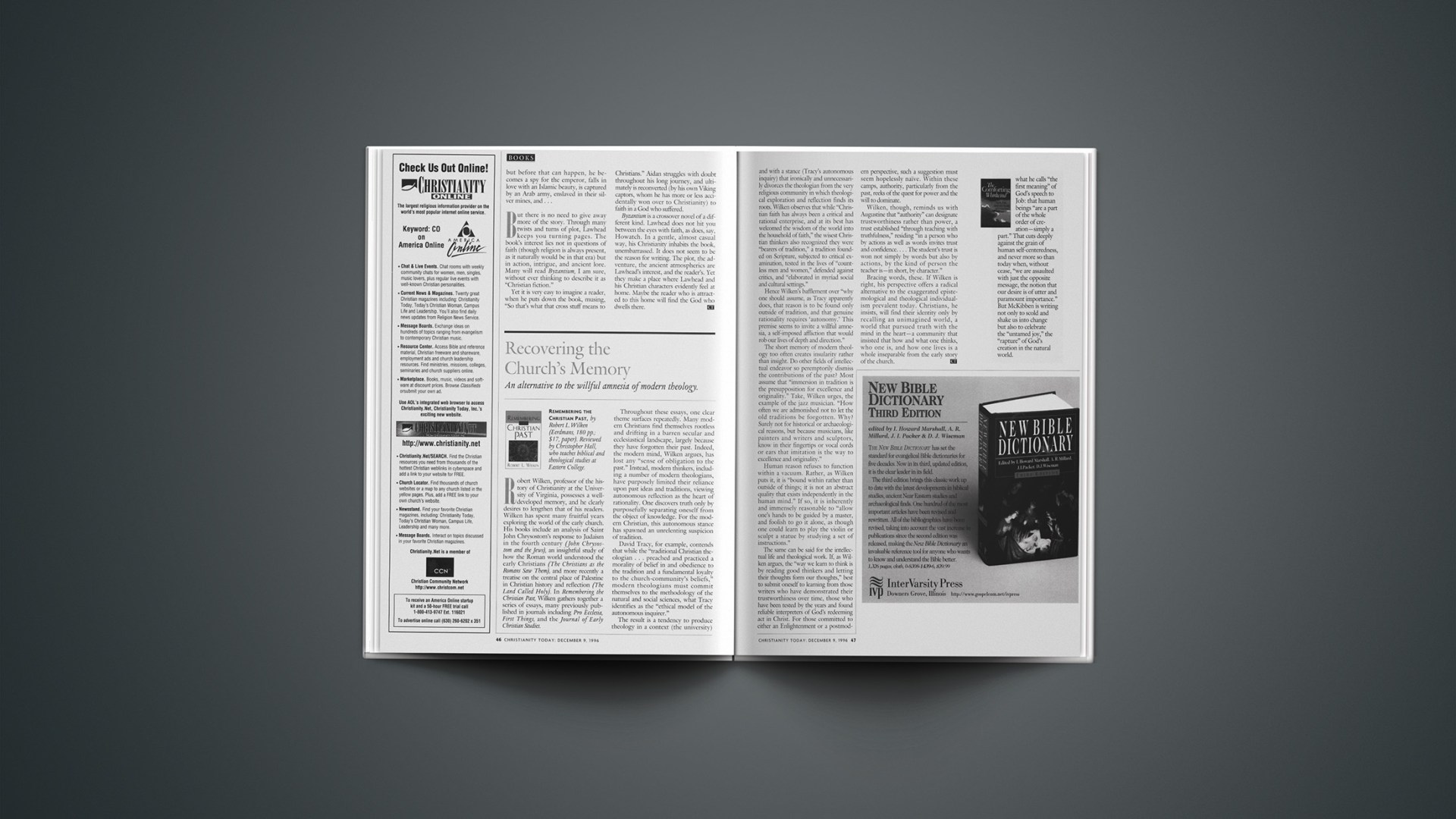

Remembering the Christian Past, by Robert L. Wilken (Eerdmans, 180 pp.; $17, paper). Reviewed by Christopher Hall, who teaches biblical and theological studies at Eastern College.
Robert Wilken, professor of the history of Christianity at the University of Virginia, possesses a well-developed memory, and he clearly desires to lengthen that of his readers. Wilken has spent many fruitful years exploring the world of the early church. His books include an analysis of Saint John Chrysostom’s response to Judaism in the fourth century (John Chrysostom and the Jews), an insightful study of how the Roman world understood the early Christians (The Christians as the Romans Saw Them), and more recently a treatise on the central place of Palestine in Christian history and reflection (The Land Called Holy). In Remembering the Christian Past, Wilken gathers together a series of essays, many previously published in journals including Pro Ecclesia, First Things, and the Journal of Early Christian Studies.
Throughout these essays, one clear theme surfaces repeatedly. Many modern Christians find themselves rootless and drifting in a barren secular and ecclesiastical landscape, largely because they have forgotten their past. Indeed, the modern mind, Wilken argues, has lost any “sense of obligation to the past.” Instead, modern thinkers, including a number of modern theologians, have purposely limited their reliance upon past ideas and traditions, viewing autonomous reflection as the heart of rationality. One discovers truth only by purposefully separating oneself from the object of knowledge. For the modern Christian, this autonomous stance has spawned an unrelenting suspicion of tradition.
David Tracy, for example, contends that while the “traditional Christian theologian … preached and practiced a morality of belief in and obedience to the tradition and a fundamental loyalty to the church-community’s beliefs,” modern theologians must commit themselves to the methodology of the natural and social sciences, what Tracy identifies as the “ethical model of the autonomous inquirer.”
The result is a tendency to produce theology in a context (the university) and with a stance (Tracy’s autonomous inquiry) that ironically and unnecessarily divorces the theologian from the very religious community in which theological exploration and reflection finds its roots. Wilken observes that while “Christian faith has always been a critical and rational enterprise, and at its best has welcomed the wisdom of the world into the household of faith,” the wisest Christian thinkers also recognized they were “bearers of tradition,” a tradition founded on Scripture, subjected to critical examination, tested in the lives of “countless men and women,” defended against critics, and “elaborated in myriad social and cultural settings.”
Hence Wilken’s bafflement over “why one should assume, as Tracy apparently does, that reason is to be found only outside of tradition, and that genuine rationality requires ‘autonomy.’ This premise seems to invite a willful amnesia, a self-imposed affliction that would rob our lives of depth and direction.”
The short memory of modern theology too often creates insularity rather than insight. Do other fields of intellectual endeavor so peremptorily dismiss the contributions of the past? Most assume that “immersion in tradition is the presupposition for excellence and originality.” Take, Wilken urges, the example of the jazz musician. “How often we are admonished not to let the old traditions be forgotten. Why? Surely not for historical or archaeological reasons, but because musicians, like painters and writers and sculptors, know in their fingertips or vocal cords or ears that imitation is the way to excellence and originality.”
Human reason refuses to function within a vacuum. Rather, as Wilken puts it, it is “bound within rather than outside of things; it is not an abstract quality that exists independently in the human mind.” If so, it is inherently and immensely reasonable to “allow one’s hands to be guided by a master, and foolish to go it alone, as though one could learn to play the violin or sculpt a statue by studying a set of instructions.”
The same can be said for the intellectual life and theological work. If, as Wilken argues, the “way we learn to think is by reading good thinkers and letting their thoughts form our thoughts,” best to submit oneself to learning from those writers who have demonstrated their trustworthiness over time, those who have been tested by the years and found reliable interpreters of God’s redeeming act in Christ. For those committed to either an Enlightenment or a postmodern perspective, such a suggestion must seem hopelessly naive. Within these camps, authority, particularly from the past, reeks of the quest for power and the will to dominate.
Wilken, though, reminds us with Augustine that “authority” can designate trustworthiness rather than power, a trust established “through teaching with truthfulness,” residing “in a person who by actions as well as words invites trust and confidence. … The student’s trust is won not simply by words but also by actions, by the kind of person the teacher is—in short, by character.”
Bracing words, these. If Wilken is right, his perspective offers a radical alternative to the exaggerated epistemological and theological individualism prevalent today. Christians, he insists, will find their identity only by recalling an unimagined world, a world that pursued truth with the mind in the heart—a community that insisted that how and what one thinks, who one is, and how one lives is a whole inseparable from the early story of the church.
Copyright © 1996 Christianity Today. Click for reprint information.