
Exclusion and Embrace: A Theological Exploration of Identity, Otherness, and Reconciliation By Miroslav Volf Abingdon 336 pp.; $19.95, paper
If you've browsed lately in a seminary bookstore, you will have noticed the shelf-straining quantity of new or recently published works of systematic theology and the even greater volume of biblical commentary—including many books in both categories by evangelicals. And a few blocks away in the mall, the Christian bookstore will be well supplied with popular guides that offer practical application of Christian principles to every manner of concern, from child-raising to love-making to managing your finances. But where do you go to find books that bridge the gap between the seminary and the mall—books in which theological reflection and biblical interpretation are brought to bear on our common lives with clarity and intellectual rigor?
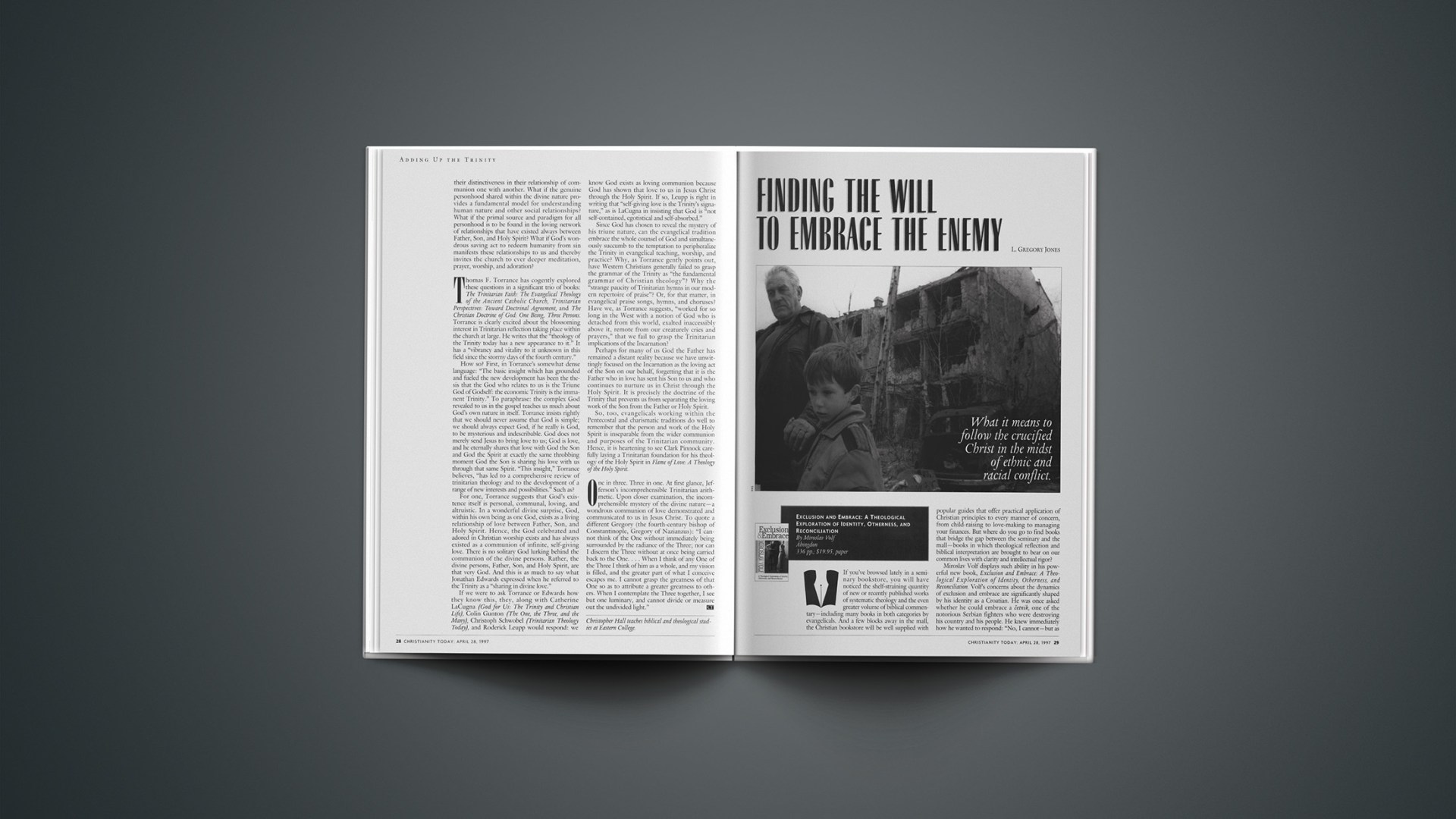
Miroslav Volf displays such ability in his powerful new book, Exclusion and Embrace: A Theological Exploration of Identity, Otherness, and Reconciliation. Volf's concerns about the dynamics of exclusion and embrace are significantly shaped by his identity as a Croatian. He was once asked whether he could embrace a cetnik, one of the notorious Serbian fighters who were destroying his country and his people. He knew immediately how he wanted to respond: "No, I cannot—but as a follower of Christ I think I should be able to."
Exclusion and Embrace provides a poignantly honest and profoundly theological account of the moral significance of both sides of that response. As Volf puts it in his preface,
The tension between the message of the cross and the world of violence presented itself to me as a conflict between the desire to follow the Crucified and the disinclination either simply to watch others be crucified or let myself be nailed to the cross. An account of an intellectual struggle, the book is also a record of a spiritual journey. I wrote it for myself—and for all those who in a world of injustice, deception, and violence have made the gospel story their own and therefore wish neither to assign the demands of the Crucified to the murky regions of unreason nor abandon the struggle for justice, truth, and peace.
The book is moving and insightful as a record of a spiritual journey, a journey that Christians from a variety of perspectives and backgrounds can travel with Volf. After all, Volf begins his reflections by invoking hatreds that have led not only to the shelling of Sarajevo, but also to the racial tensions and riots in Los Angeles, and to Neo-Nazi skinheads marching in Berlin. These cities have particular significance for Volf, for they represent the country of his origin, the location of his residence (he teaches at Fuller Theological Seminary), and the place where, in 1992, he gave a lecture on the social and cultural upheavals in Europe. Such cities, close to Volf's own experience (he has lived and taught in Germany as well as in Croatia and the United States), are emblematic of so many of our communities, near and far, which harbor legacies of divisiveness. Whether the news is coming from Africa or the former Soviet Union, from Brooklyn or from Paris, it drives home the harsh realities of cultural and ethnic conflict.
As Christians, we wonder how we ought to respond to such situations. We know somehow that we ought to invoke God's love and forgiveness, and we recognize our dismay or even horror at the effects of sin and evil in our world (no less than in our own hearts). But, we wonder, can our responses do justice to the pain and suffering of others, or do we tend to offer cheap grace? Further, how should we respond when Christians are so often found on both sides of cultural and ethnic conflicts? Perhaps most pointedly, in a world in which we are often more marked by our cultural identities than our Christian faith (for many of us, we are Americans first, Christians second), we are forced to ask whether Christ really has "broken down the dividing wall, that is, the hostility between us," so that we are "no longer strangers and aliens," but rather "citizens with the saints and also members of the household of God" (Eph. 2:14, 19). No longer strangers? Or estranged as a result of hostility?
The power of Volf's spiritual journey in confronting such issues is complemented by the richness of his account of "an intellectual struggle." He does not shy away from knotty theological, philosophical, and political issues that can help to illumine our perplexities. Even so, Volf wears his scholarship lightly; his lucid writing and deft use of examples make the book accessible to general readers and professional theologians alike. Indeed, one of the unexpected delights of the book is his insightful engagement with Scripture. He offers powerful interpretations of such well-known biblical stories as Cain and Abel, the parable of the prodigal son, the confrontation between Jesus and Pilate, and Pentecost.
It might be tempting to suggest that this is a book for "excluders," for they are the ones who need to repent. But that is precisely the trap that Volf's analysis resists; he recognizes that even he, as a Croat, must resist the temptation of placing all blame on the Serbian side, thereby preserving a false innocence for Croats. More generally, Volf notes the glaring incongruity that "in a world so manifestly drenched with evil everybody is innocent in their own eyes." This is as true of Serbs and Croats as it is of Jews and Palestinians, and of Americans whose social lives are built on more subtle means of excluding strangers from our midst. Unless we have a sense of belonging and distance in relation to our own identities, unless we unmask our own illusions of innocence in confrontation with the crucified and risen Christ—the only truly innocent victim—we will condemn ourselves to go on drenching our world with sin and evil. For, as Volf accurately notes, our contemporary problem with "identity politics" is not merely some peculiar feature of contemporary life, much less a sign of cultures that have not progressed to the bright lights of modernity. Rather, our problems with strangers and enemies, and our constructions of our own innocence, are signs of our separation from the God of Jesus Christ.
By contrast, the metaphor of "embrace" in the book's title suggests the welcoming of the other by which we have ourselves been welcomed by God through Christ (see Rom. 15:7). This metaphor draws together three of Volf's central theological themes: (1) the mutuality of self-giving love in the Trinity, (2) the outstretched arms of Christ on the cross, reaching out to the "godless," and (3) the open arms of the "father" receiving the "prodigal." In response to God's work of salvation, we are called to learn to embrace others, including those who are strange to us and those from whom we have become estranged in often bitter conflicts. Volf's emphasis on the importance of embrace, however, should not be taken as a fashionably pluralistic appeal to "inclusivity"; both exclusion and embrace, in Volf's analysis, are defined and shaped by Christ.
After the chapters on exclusion and embrace, Volf develops his account through provocative analyses of Gender Identity, Oppression and Justice, Deception and Truth, and Violence and Peace. Though in some ways the chapter dealing with gender seems peripheral to other aspects of the book, it provides a crucial test case for Volf's reflections on identity and otherness. It also enables him to explore important feminist theological concerns about the priority given to "self-giving love." Throughout, Volf weaves together social analysis, biblical interpretation, and theological reflection in order to deepen our understanding of how to follow faithfully the crucified and risen Messiah without abandoning the struggle for justice, truth, and peace.
While it should be clear that, in my judgment, Exclusion and Embrace is that rare theological book equally significant for laypeople, clergy, and theologians, it is not without weaknesses. Any book that ranges over such wide terrain is likely to hit some rough stretches. Here I briefly identify two central issues that remain unresolved.
First, while Volf rightly emphasizes the fluidity in how our cultural and Christian identities are constructed over time, he does not adequately articulate how our "basic Christian commitments" are to be formed in the absence of coherent traditions and in the presence of hybrid cultural contexts. At least part of the problem here is Volf's relatively scant attention to the role of the church—and, specifically, local congregations—in the dynamics of exclusion and embrace.
Second, Volf offers a highly suggestive analysis of the possibility of "forgetting" past sin and evil as a "divine gift of nonremembering." Though Volf's concerns are well placed, and his argument is quite subtle, he does not seem adequately to explore the issues surrounding the claim that the risen Christ continues to bear the wounds of the crucifixion. To be sure, Volf concludes his reflection by suggesting that the cross of Christ provides the context for that "divine gift of nonremembering." Yet one is compelled to ask, Does not God remember the full range of human history precisely in the wounds of the Lamb who was slain, albeit wounds that are healing?
Such issues and questions are themselves a testimony to the wide-ranging significance of Exclusion and Embrace. In conclusion, I draw on one other feature of the book: Volf suggests that we can help to overcome exclusion and cultivate a will to embrace others if we learn the practice of "double vision." By this he means that we need to let the voices and perspectives of others—especially those with whom we have been in conflict—resonate within us. He argues that this is a recommendation drawn from the inner logic of the Cross, from the identity of the Triune God.
Volf's own work embodies precisely this "double vision." He consistently draws others into his analysis through charitable interpretation, considering potential objections to his argument, and self-critically assessing his own potential blind spots. One senses that, in his life as well as in his writing, Volf has been "quick to listen, slow to speak" (James 1:19)—a habit as necessary to overcoming division as it is difficult to learn. We will have traveled a long way toward living as faithful citizens of the household of God if we can learn, from Volf's analysis and his style, to practice such double vision ourselves—with friends, strangers, and those from whom we have become estranged.
-L. Gregory Jones is associate professor of theology at Loyola College, Baltimore, Maryland, and author of Embodying Forgiveness: A Theological Analysis (Eerdmans).
John Ortberg, teaching pastor at Willow Creek Community Church, South Barrington, Illinois, and author of The Life You've Always Wanted: Spiritual Transformation for Ordinary People (forthcoming from Zondervan).
You'd think that after writing one best-seller on forgiveness (Forgive and Forget), Lew Smedes's well would be about dry on that subject. Turns out he was just priming the pump. He has forgotten more about forgiving and forgetting than most of us will ever know.
The Art of Forgiving (Moorings) is a gem of a book. Where Smedes's earlier work was devoted to what exactly forgiveness is (and is not), this book teaches us how actually to pursue it. It bears the mark of his best stuff. It is literate—graced by the presence of Dostoevsky and Simon Wiesenthal and Henrik Ibsen. It is gritty and realistic, embracing the difficulty of forgiving real people—including difficult people, undeserving people, even dead people. There is a school of thought that forgiving ought always to include reconciliation. But there is none of that here; Smedes recognizes that in this world there are times when reunion is impossible and yet forgiveness is indispensible. Best of all, it is genuinely helpful. Smedes helps us tease out when forgiveness is needed, how we go about pursuing it, and what the signs are that we may have actually done it.
Forgiveness, he says, is the hardest chord to play in the human concerto. This is the book for anyone who wants to hit the right notes.
Diane Komp, professor of pediatrics at Yale University School of Medicine and author of Breakfast for the Heart: Meditations to Nourish Your Soul (Zondervan).
Imagine this: A publicity-seeking, death-delivering doctor signs to star in a film that is a thinly veiled fictionalization of his most notorious case. Kevorkian gone Hollywood? No—at least not yet. In The Black Stork: Eugenics and the Death of "Defective" Babies in American Medicine and Motion Pictures Since 1915 (Oxford University Press), historian Martin S. Pernick treats us to some fine writing on the fascinating and bizarre career of Dr. Harry Haiselden, a Chicago surgeon who "delivered" infants with birth defects from their "defective" lives on this earth.
In a 1915 film also named The Black Stork, Haiselden played himself as "Dr. Dickey," who refuses to perform surgery on a handicapped child. The film ends with the mother agreeing with Dickey's judgment and the baby's soul leaping into the arms of a waiting Jesus.
Like Kevorkian, Haiselden had glowing letters of support from families whose children he "delivered." Unlike Kevorkian, he was never brought up on charges for euthanasia or infanticide, although there were strong grounds under laws extant at the time to charge both the doctor and the parents with neglect of their respective duties to the babies. As the dust jacket warns us, "Pernick's narrative is a strong warning about the slippery slope of determining what life is worth living."
Copyright © 1997 Christianity Today. Click for reprint information.