


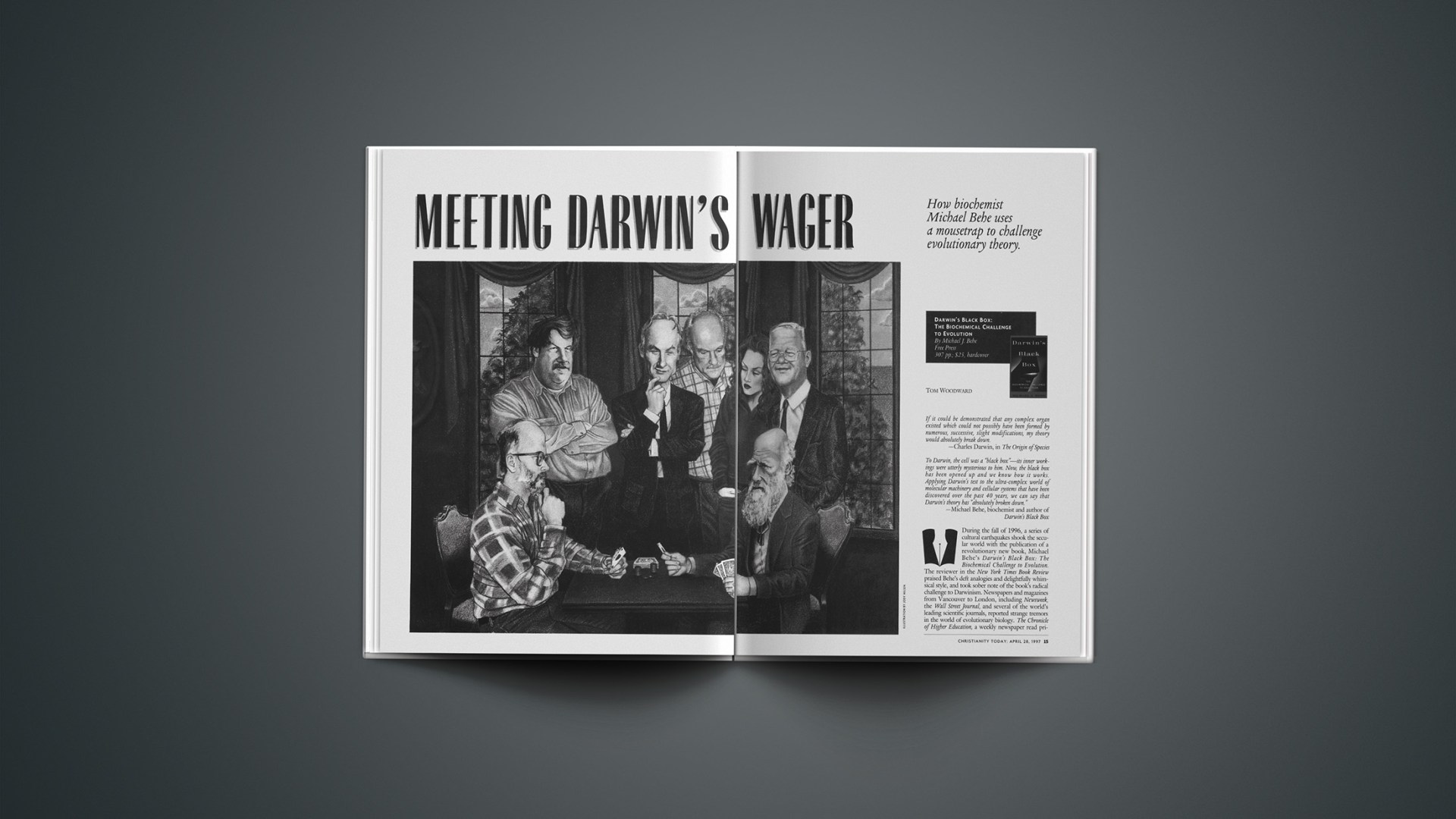

Darwin’s Black Box: The Biochemical Challenge to EvolutionBy Michael J. Behe Free Press 307 pp.; $25, hardcover
If it could be demonstrated that any complex organ existed which could not possibly have been formed by numerous, successive, slight modifications, my theory would absolutely break down.
—Charles Darwin, in The Origin of Species
To Darwin, the cell was a “black box”—its inner workings were utterly mysterious to him. Now, the black box has been opened up and we know how it works. Applying Darwin’s test to the ultra-complex world of molecular machinery and cellular systems that have been discovered over the past 40 years, we can say that Darwin’s theory has “absolutely broken down.”
—Michael Behe, biochemist and author of Darwin’s Black Box
During the fall of 1996, a series of cultural earthquakes shook the secular world with the publication of a revolutionary new book, Michael Behe’s Darwin’s Black Box: The Biochemical Challenge to Evolution. The reviewer in the New York Times Book Review praised Behe’s deft analogies and delightfully whimsical style, and took sober note of the book’s radical challenge to Darwinism. Newspapers and magazines from Vancouver to London, including Newsweek, the Wall Street Journal, and several of the world’s leading scientific journals, reported strange tremors in the world of evolutionary biology. The Chronicle of Higher Education, a weekly newspaper read primarily by university professors and administrators, did a feature story on the author two months after his book appeared. The eye-catching headline read, “A Biochemist Urges Darwinists to Acknowledge the Role Played by an ‘Intelligent Designer.’ “
Now reporters are making their pilgrimage to Bethlehem, Pennsylvania, to interview the author at the center of these quakes: 44-year-old Lehigh University biochemist Michael J. Behe (pronounced “bee-hee”).
Behe, who typically sports a lumberjack shirt, jeans, and black Adidas sneakers, toils long hours with his students in the biochemistry lab, doing research on DNA and the structure of proteins. He is short, balding, and has thick, dark-rimmed glasses; he looks as much like a hardware-store clerk as a scientific renegade.
Seated at a lab table, surrounded by bottles filled with clear, smelly fluids designed to rearrange DNA sequences, he explains that advances in his own field—where scientists have been furiously unraveling the mysteries of exactly how cells work—have yielded a startling finding: Molecular machinery and complex systems in the cell are dependent upon far too many interconnected parts to have been built up gradually, step by tiny step, over time.
With his book already in its eighth printing, Behe finds his calendar filling up with speaking engagements. In a recent trip to the University of South Florida in Tampa, he spoke to biologists, students, and schoolteachers who had braved rains from an approaching hurricane to hear him.
In his talk, Behe quickly reviewed the modern theory of evolution and then flashed onto a screen his favorite quote by Darwin from The Origin of Species (see p. 15), acknowledging the kind of evidence that would be necessary to refute the Darwinian theory of evolution.
Behe took up the challenge of Darwin’s test and asked, “What type of biological system could not be formed by numerous, successive, slight modifications? Well, for starters, a system that has a quality that I call irreducible complexity.”
Encouraging the nonscientists in the audience to stay tuned, Behe explained briefly what he meant by the phrase “When I say that something is irreducibly complex, I simply mean it is a system composed of several well-matched, interacting parts that contribute to the basic function, wherein the removal of any one of the parts causes the system to effectively cease functioning.”
With his characteristically impish grin breaking through a full beard, Behe flashed on the screen a diagram of the humble mousetrap, his trademark illustration of “irreducible complexity.” After pointing out the five parts necessary for mousetrap function, he added, “You need all the parts to catch a mouse. You can’t catch a few mice with a platform, then add the spring and catch a few more, and then add the hammer and improve its function. All the parts must be there to have any function at all. The mousetrap is irreducibly complex.”
Behe was suddenly a tour guide, piloting his listeners on a theme park ride through the cell and pointing out systems that exhibited this eerie mousetrap kind of complexity. Using photos and diagrams, he walked through the chemical chain reaction that gives rise to vision and detailed the elegant but complex structure of the whiplike cilium with which many kinds of cells are equipped. Far Side and Calvin and Hobbes cartoons punctuated the lecture, and even an outlandish Rube Goldberg contraption—the “Mosquito Bite Scratcher”—was displayed as an analogy to the complicated mechanism by which blood clots form.
“The cell is no longer a mysterious black box as it was for Darwin,” Behe continued; “we now know precisely how it works at the molecular level. And the cell is chock full of systems like these that are irreducibly complex.”
Finally, he showed a New Yorker cartoon with a professor being confronted in his office by his department chairman and by a hit man who is screwing a silencer onto his gun. The caption reads, “Surely, professor, you knew when you took this position, it is publish or perish!”
His listeners relished the humor, but the mood in the room turned serious as Behe made his point:
As you search the professional literature of the last several decades, looking for articles that have been published even attempting to explain the possible Darwinian step-by-step origin of any of these systems, you will encounter a thundering silence. Absolutely no one—not one scientist—has published any detailed proposal or explanation of the possible evolution of any such complex biochemical system. And when a science does not publish, it ought to perish.
In short, Behe said, modern evolutionary theory, applying Darwin’s own test, flunks spectacularly at the molecular level. Rather, everywhere we look inside the cell, evidence is staring scientists in the face that suggests the systems were directly designed by an intelligent agent.
Michael Behe is the father of six children, three boys and three girls ranging in age from two through eleven, with a seventh on the way. No wall of separation stands between his fathering and his writing about biochemistry. He weaves into many of his chapters homey images drawn from the Behes’ family room at 2258 Apple Street. For example, the joyous task of assembling his son’s tricycle on Christmas Day illustrates the importance of detailed instructions in living systems. Putting together snap-lock beads and Tinkertoys with his kids on the family-room rug provides pictures of how organic molecules are built. His youngest daughter’s dolly wagon is pressed into service to help explain how antibodies latch onto the body’s invaders. Behe, the master-teacher, can hardly make a point without bringing in something familiar and concrete, such as tuna cans, an elephant, chocolate cake, and even “roadkill.”
Behe’s wife, Celeste, has a teaching career as well; she home schools four of the Behe children. When Mike Behe comes home from the biology lab, he enjoys playing Frisbee with his children and reading to them. In fact, the Behe home is like a library—children’s books are scattered throughout the house and are stacked on 16 shelves in a room set aside especially for reading. Since the Behes decided seven years ago not to keep a tv in their home, the Behe children have found time for reading good books, learning karate and piano, and singing in the church choir.
Mike Behe’s efforts in fathering his children are balanced by his new fathering task in his own scientific field. One could describe Darwin’s Black Box as a “birthing book”; it is Behe’s proposal to give birth to a new perspective in biology that stops ignoring the pervasive presence of “design.” He is not alone in the task; Behe has worked closely with an interdisciplinary team of scientific colleagues scattered in colleges and universities from Seattle to Princeton, New Jersey.
The acknowledged leader of the “design movement” is Phillip Johnson, a law professor at the University of California at Berkeley, whose Darwin on Trial (revised 1993) has stirred vigorous interaction with the world’s most prestigious evolutionists, including Stephen Jay Gould of Harvard University and Niles Eldredge of the American Museum of Natural History.
According to Johnson, Behe’s book has inaugurated a new phase of the critique of Darwinism. Behe not only devastates the case for Darwinism at the molecular level, he is also leading the way in fashioning a new frame of reference on origins.
The goal of the design movement is to liberate science from its shackles of naturalistic philosophy so that scientists who probe the origin of nature’s wonders will have the freedom to consider all the possible explanations—including design by an intelligent agent. An international conference was held in November 1996 at Biola University in Los Angeles (CT, Jan. 6, 1997, p. 64), drawing together 180 college professors and other researchers to consider a revolutionary proposal for new scientific and mathematical principles that can help determine how something in nature arose.
The basic idea is to ask, “Which of three possible explanations fits best in explaining a given phenomenon X? Can X be explained by law-like actions of nature, or could X be the result of random events, or, failing these possibilities, is X the result of action by an intelligent agent?” This three-way test (dubbed “the Explanatory Filter”) became the centerpiece of the conference as Behe and his colleagues reviewed new evidence that points to design. Some observers say that the design movement may be embarking upon the first stage of a transitional process in science, which philosophers call a “paradigm shift.”
In his book, Behe argues that the time has come for biological science to face the logical implications of what it has been finding in biochemistry and to get down to an important new task: identifying which contraptions in the cell clearly bear the marks of intelligent design, and which ones could have developed from earlier systems.
The timing for such a revolutionary turn seems to be right, as is suggested by the furor provoked by the June 1996 issue of Commentary magazine. The lead article of that issue was “The Deniable Darwin,” a sophisticated skewering of Darwinism by Princeton-trained philosopher and logician David Berlinski. Under the title appeared the provocative line, “The fossil record is incomplete, the reasoning flawed; is the theory of evolution fit to survive?”
Commentary published in its September issue an astonishing 33-page section devoted to the wave of responses to Berlinski’s article. Angry letters had poured in from the world’s leading Darwinists, but other scholars praised the author for his rigorous analysis and the editors for their intellectual courage in publishing the piece. The author took 13 pages to respond, point-by-point, to each letter.
Berlinski, author of the recent award-winning book A Tour of the Calculus, says that skepticism regarding Darwinian orthodoxy has now exploded out of its evangelical Protestant ghetto and that revolution is in the air. He points to Behe’s work as a turning point in this process: “Darwin’s Black Box is simply an extraordinary piece of work that will come to be regarded as one of the most important books ever written about Darwinian theory. No one in the evolutionary camp can propose to defend Darwin without meeting the challenges that Behe has set out in his book—it’s really quite compelling.”
Instead of ignoring Behe, as many tried to do to Phillip Johnson, both the media and the scientific establishment are paying close attention to the feisty biochemist at Lehigh.
The treatment accorded Behe in the New York Times, “the paper of record,” is one sign of this cultural shift. The first significant notice came on August 4, 1996, when Darwin’s Black Box was honored by a review in the New York Times Book Review. Evolutionist James Shreeve expressed appreciation for Behe’s knack of explaining natural wonders. In the end, Shreeve did not agree with Behe’s intelligent design proposal, saying we should not jump the gun and say “God did it” but rather leave some mysteries for our grandchildren to work on. But the review conveyed Behe’s thesis clearly:
He argues that the origin of intracellular processes underlying the foundation of life cannot be explained by natural selection or by any other mechanism based purely on chance. When examined with the powerful tools of modern biology, but not with its modern prejudices, life on a biochemical level can be a product … only of intelligent design. Coming from a practicing scientist … this proposition is close to heretical.
Even more noteworthy was the appearance of Behe’s own article, “Darwin Under the Microscope,” in the op/ed pages of the New York Times (Oct. 29, 1996). The steps leading to this began in mid-September when an editor of the Times startled Behe by asking if he would consider submitting an article explaining the main theses of his book.
First of three parts; (click here to read part 2)
Copyright © 1997 Christianity Today. Click for reprint information.