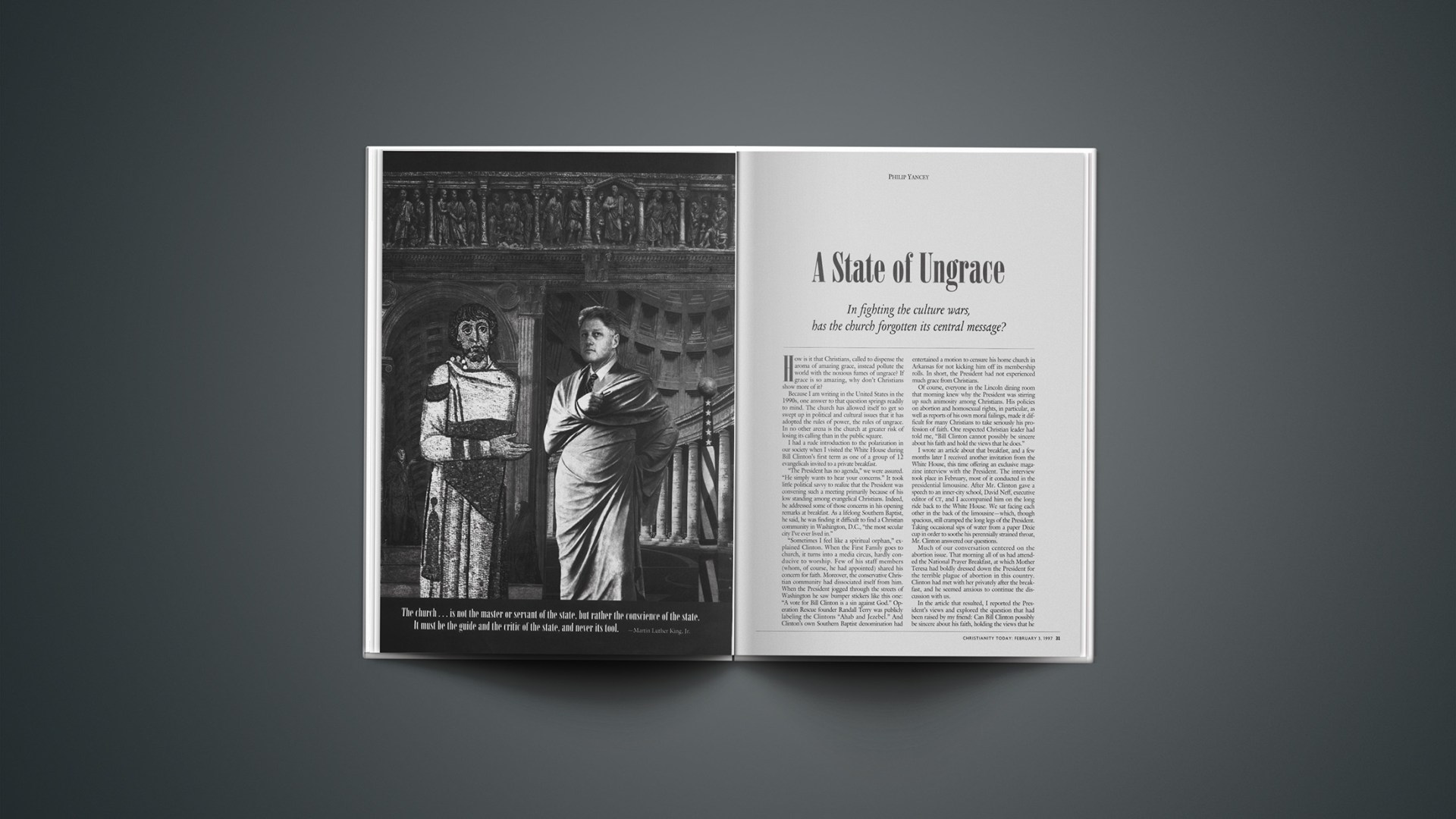

* (beginning in previous article)
Nowadays the government is far less likely to acknowledge the Christian consensus in the United States, if indeed one still exists. The change occurred with such breathtaking speed that anyone born in the last 30 years may wonder what Christian consensus I am talking about. The Supreme Court has banned prayer in schools, some teachers try to prohibit their students from writing about any religious themes, television rarely mentions Christians except in derogation, and courts routinely strip manger scenes and other religious symbols from public places.
It seems incredible that the words “under God” were added to the Pledge of Allegiance only in 1954, and the phrase “In God we trust” became the nation’s official motto in 1956. Much of the outrage of the Religious Right traces back to the swiftness of this cultural shift. Harold O. J. Brown, one of the early evangelical activists against abortion, says that he and others experienced the Roe v. Wade ruling as a wake-up call in the middle of the night. Christians had viewed the Supreme Court as a mostly trustworthy group of sages who drew their conclusions from the moral consensus of the rest of the country. Suddenly the bombshell dropped, a decision that divided the country along fault lines: either the moral consensus had changed dramatically, or the Supreme Court was badly out of touch.
Since that time, other court decisions—establishing a “right to die,” redefining marriage, protecting pornography—have sent conservative Christians reeling. Bill Bright, founder of Campus Crusade for Christ, hyperbolically called the 1963 ruling against prayer in public schools “the darkest hour in the history of the nation.” The moral landscape has indeed changed. Every year the church in the United States draws closer and closer to the situation faced by the New Testament church: an embattled minority living in a pluralistic, pagan society. Christians in places like Sri Lanka, Tibet, Sudan, and Saudi Arabia have faced open hostility from their governments for years. But in the United States, with a history so congenial to the faith, we don’t like it. What should we do about it? And how should grace flavor our response?
I must admit that after rereading Niebuhr’s book recently, I am no more confident of my position than I was 25 years ago. Of all my friends, a group of communal Hutterians, German immigrants who fled Hitler’s Germany, demonstrate lives most faithful to Jesus’ teaching. Yet I also admire the tradition of the Christian Reformed Church, which advocates “bringing every thought captive” under the mind of Christ; that tiny “transforming” denomination has had an enormous influence on science, philosophy, and the arts.
I feel pulled this way and that. When a Christian consensus held sway in the United States, these issues were less urgent. Now, all of us who love our faith and also our nation must decide how best to express that care. I offer three preliminary conclusions that should apply, I believe, no matter what church-state model we choose.
First, as should be clear by now, I believe that grace is the Christian’s main contribution to the world. As Gordon MacDonald said, the world can do anything the church can do except one thing: it cannot show grace. At the same time, I believe we Christians are not doing a very good job of dispensing grace to the world. We stumble especially in this field of faith and politics.
I know how easy it is to get caught up in the polarization, to shout across the picket lines at the “enemy” on the other side. “Love your enemy,” Jesus commanded. For Will Campbell, that meant the redneck Klansmen who killed his friend. For Martin Luther King, Jr., that meant the white sheriffs who sicced their police dogs on him. Who is my enemy? The promiscuous person dying of AIDS? The abortionists? The Hollywood producers polluting our culture? The secularists attacking my moral principles? The drug lords ruling our inner cities? If I cannot show love to such people, then I have not understood Jesus’ gospel. I am stuck with law, not the gospel of grace. If my activism, however well-motivated, drives out such love, I betray Jesus’ kingdom.
The issues facing society today are pivotal, and perhaps a culture war is inevitable. But Christians should use different weapons in fighting wars, the “weapons of mercy” in Dorothy Day’s wonderful phrase. Jesus declared that Christians are known by one distinguishing mark: not political correctness or moral superiority, but love. Paul added that without love nothing we do—no miracle of faith, no theological brilliance, no flaming personal sacrifice—will avail (1 Corinthians 13). This is the “fruit” that the Spirit grows: love, joy, peace, patience, kindness, goodness, faithfulness, gentleness, and self-control. The Bible speaks of God’s judgment, to be sure. But Jewish, Christian, and Muslim scriptures all record ten times as many references to God’s mercy, to God’s grace.
My second conclusion may appear to contradict the first: a commitment to a style of grace does not mean Christians will live in perfect harmony with the state. The two great power sources will, and should, conflict. As Kenneth Kaunda, the former President of Zambia, has written, “What a nation needs more than anything else is not a Christian ruler in the palace but a Christian prophet within earshot.”
From the very beginning, Christianity—whose founder, after all, was executed by the state—has lived in tension with the state. As the church spread throughout the Roman Empire, its followers took up the slogan “Christ is Lord,” a direct affront to Roman authorities who required all citizens to take the oath “Caesar [the state] is Lord.” An immovable object had met an irresistible force.
Early Christians hammered out rules to govern their duties to the state. They forbade certain professions: the actor who had to play the part of pagan gods, the teacher forced to teach pagan mythology in public schools, the gladiator who took human life for sport, the soldier who killed, the policeman, and the judge. A leader named Justin (who would become a martyr) spelled out the limits of obedience to Rome: “to God alone we render worship, but in other things we gladly serve you, acknowledging you as kings and rulers of men, and praying that with your kingly power you be found to possess also sound judgment.”
Centuries later, as missionaries carried the gospel throughout the world, they saw the need to challenge certain practices, bringing them into direct conflict with the state. In India they attacked the caste system, child marriage, bride burning, and the immolation of widows. In South America they banned human sacrifice. In Africa they opposed polygamy and slavery. Christians understood that their faith was not merely private and devotional; it had implications for all of society, affecting law, general morality, health, and human welfare.
In our own century, the church’s challenge to the state has often broken into open conflict, especially when totalitarian states assert themselves as “Lord.” Nazi Germany posed the severest test to Luther’s doctrine of two kingdoms, a test that the church mostly failed. Martin Niemoller, one of the leaders of the resistance against Hitler, confessed that the church by and large had lacked the courage to resist Hitler. Practicing an individualistic faith, accustomed to submitting to the state, they waited far too late to protest. Indeed, many Protestant leaders—including Niemoller himself—initially thanked God for the rise of the Nazis, who seemed the only alternative to communism.
Ominously, evangelical Christians were attracted to Hitler’s promise to restore morality to government and society. According to Karl Barth, the church “almost unanimously welcomed the Hitler regime, with real confidence, indeed with the highest hopes.” German Protestants had no strong tradition of opposing the state. Christians adopted the motto “The Swastika on our breasts, the Cross in our hearts.” Their pastors dressed in Nazi uniforms and sang Nazi hymns. Too late did they learn that once again the church had been seduced by the power of the state.
Eventually a minority did wake up to the Nazi threat. Niemoller published a series of sermons with the in-your-face title Christus ist mein Fuhrer (Christ [not Hitler] is my Fuhrer). He spent seven years in a concentration camp; Dietrich Bonhoeffer was executed in another. In the end, faithful Christians were the only significant group to oppose Hitler within Germany. Trade unions, Parliament, politicians, doctors, scientists, university professors, lawyers—all these capitulated. Only Christians who understood their loyalty to a higher power resisted. Their courageous stand attracted the world’s attention: from 1933 to 1937, the New York Times ran approximately 1,000 news accounts on the German church struggle.
Thankfully, the church in the United States has never had to face such a stark choice against tyranny. To the contrary, American democracy has historically welcomed religious-based activism. In the words of Robert Bellah, “there has not been a major issue in the history of the United States on which religious bodies did not speak out, publicly and vociferously.”
Those who express alarm over the activism of the Religious Right forget that, for most of American history, church leaders led the way in moral crusades that are now viewed as progressive. As Charles Taylor points out, it was no accident that Christians led the way in the antislavery movement, for their beliefs had theological underpinnings. Philosophers like David Hume considered blacks inferior, and business viewed them as a cheap source of labor; Christians saw past their utility to their essential worth as human beings created by God. For all its flaws, the church has succeeded, fitfully and imperfectly, to be sure, in bringing Jesus’ message of grace to the world. It was Christianity, and only Christianity, that brought an end to slavery, and Christianity that inspired the first hospitals and hospices to treat the sick. The same energy drove the early labor movement, woman’s suffrage, human-rights campaigns, and civil rights.
More recently, Jews and Christians used the methods of nonviolent resistance to force the nation to change its laws on civil rights. The main leaders of that movement (Martin Luther King, Jr., Ralph Abernathy, Jesse Jackson, Andrew Young) were all clergy, and their stirring speeches showed it. Churches black and white provided the buildings, the networks, the ideology, the volunteers, and the theology to sustain the movement.
At first, evangelicals were slow to join the campaign, and many Southern churches fiercely resisted it, but spokesmen such as Billy Graham, Oral Roberts, and Jim Bakker gradually followed in step. Hundreds of Southern clergy lost their jobs over the race issue. As late as 1976, Jimmy Carter’s home church in Plains, Georgia, fired its “race-mixing” pastor when he adopted a mixed-blood Hawaiian child. The church then split over the issue.
King later broadened his crusade to encompass the issues of poverty and opposition to the war in Vietnam. Only recently, as political activism has shifted to conservative causes, has an alarm been sounded about Christian involvement in politics. As Stephen Carter suggests in his book The Culture of Disbelief, that alarm may simply betray the fact that those in power dislike the positions of the new activists. Conflict between church and state in the United States is hardly new; only the participants have changed.
My third conclusion about church-state relations is a principle I borrow from Chesterton: A coziness between church and state is good for the state and bad for the church.
I have warned against the church becoming “moral exterminators” for the world. Actually, the state needs moral exterminators, and often welcomes them whenever the church obliges. President Eisenhower told the nation in 1954, “Our government makes no sense unless it is founded on a deeply felt religious faith—and I don’t care what it is.”
I used to laugh at Eisenhower’s statement until one weekend I got caught in a situation that showed me the plain truth behind it. I was participating in a forum with ten Christians, ten Jews, and ten Muslims in New Orleans, coinciding with the heart of Mardi Gras season. We stayed at a Catholic retreat center far removed from the revelry downtown, but one evening several of us wandered over to Bourbon Street to watch one of the Carnival parades.
It was a frightening scene. Thousands of people jammed the streets so tightly that we were swept along in a human wave, unable to break loose. Young women hung over the balconies, yelling, “Breasts for beads!” In exchange for a gaudy plastic necklace they would pull up their T-shirts and bare themselves. For an elaborate necklace they would strip naked. I saw drunken men pick a teenage girl from the crowd and yell at her “Show your tits!” When she refused, they stripped off her top, hoisted her to their shoulders, and pawed at her as she screamed in protest.
In their drunkenness, lust, and violence, the revelers at Mardi Gras were demonstrating what happens when human desires are allowed to go unchecked. For all the differences among us, Christians, Jews, and Muslims represent a moral consensus, a curb against destructive self-indulgence.
A few years ago, philosopher Glenn Tinder wrote a widely discussed article for the Atlantic Monthly titled, “Can We Be Good Without God?” His meticulously argued conclusion was, in a word, no. Human beings inevitably drift toward hedonism and selfishness unless something transcendent—agape love, Tinder argued—causes them to care about someone other than themselves. With ironic timing, the article appeared one month after the Iron Curtain fell, an event that dashed forever the idealism of those who had tried to build a just society without God.
But in our enthusiasm over the vital role the church can play in a democratic society, we dare not forget the last part of Chesterton’s aphorism: while a coziness between church and state may be good for the state, it is bad for the church. Herein lies the chief danger to grace.
The evangelicals who welcomed Hitler were surprised to learn one day that the German government, not the church, would now appoint church officials. Soon all pastors were required to take a loyalty oath to Hitler and his government. In Russia, Stalin required the church to give to the state full control of religious instruction, seminary education, and the appointment of bishops.
When Christianity becomes a part of the state, Soren Kierkegaard contended, it ceases to be Christianity: “As soon as Christ’s kingdom comes to terms with the world, Christianity is abolished.” The church works best as a force of resistance, a counterbalance to the consuming power of the state. The cozier it gets with the state, the more watered-down it becomes and the less able to challenge the surrounding culture.
A state government can shut down stores and theaters on Sunday, but it cannot compel worship. It can arrest and punish KKK murderers, but it cannot cure their hate, much less teach them love. It can ban adultery but not lust, theft but not covetousness, cheating but not pride. It can encourage virtue, but not holiness.
In sum, the state must always water down the absolute quality of Jesus’ commands and turn them into a form of external morality—precisely the opposite of the gospel of grace. Jacques Ellul goes so far as to say the New Testament teaches no such thing as a “Judeo-Christian ethic.” It commands conversion and then this: “Be perfect, as your father in heaven is perfect.” Reread the Sermon the Mount and try to imagine any government enacting that set of laws.
-This essay will appear in fuller form as two chapters in What’s So Amazing About Grace and Why the World Needs More of It, which will be published by Zondervan in the fall of 1997.
Copyright © 1997 Christianity Today. Click for reprint information.
February 3, 1997 Vol. 41, No. 2, Page 30