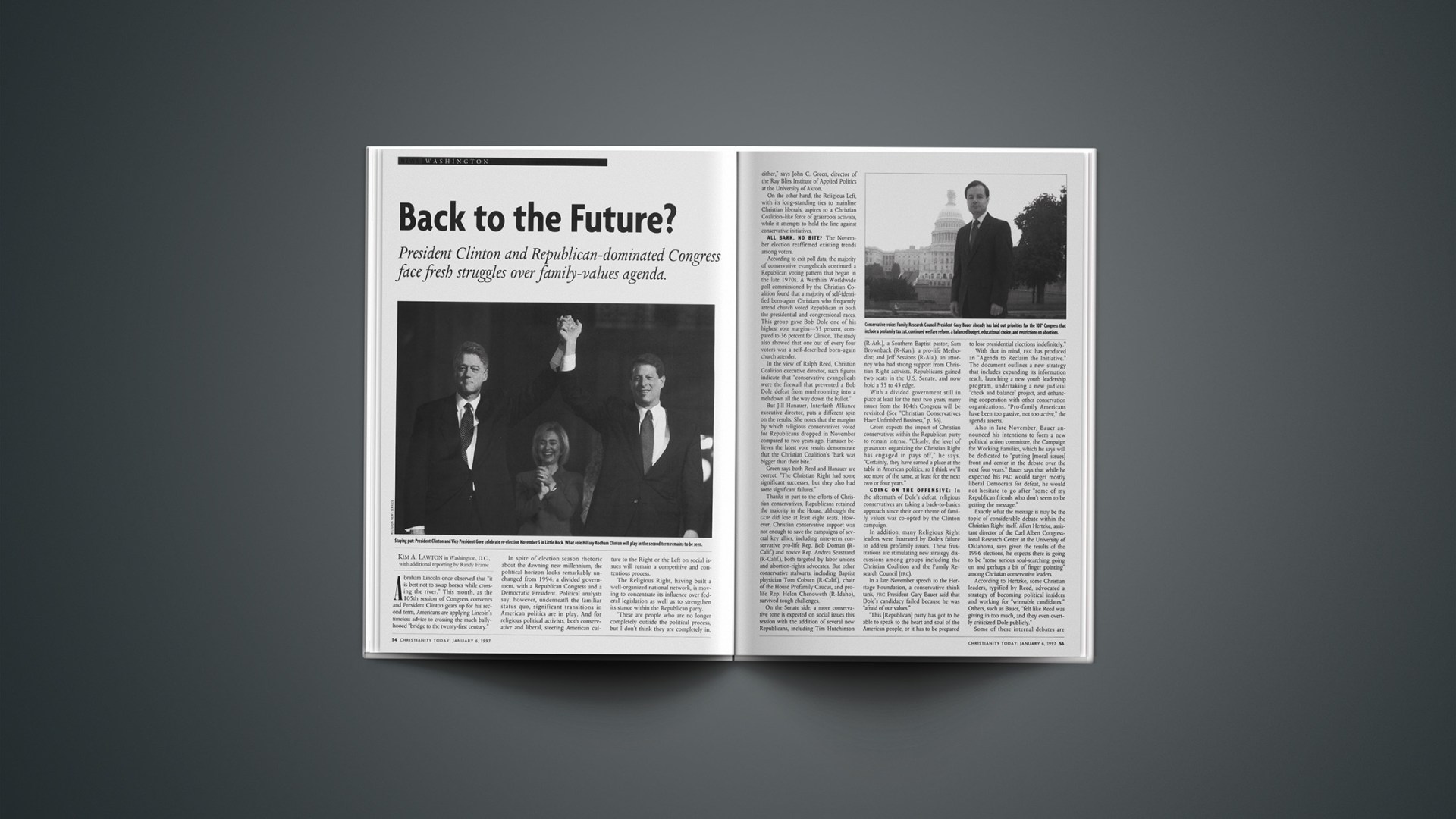

Abraham Lincoln once observed that “it is best not to swap horses while crossing the river.” This month, as the 105th session of Congress convenes and President Clinton gears up for his second term, Americans are applying Lincoln’s timeless advice to crossing the much ballyhooed “bridge to the twenty-first century.”
In spite of election season rhetoric about the dawning new millennium, the political horizon looks remarkable unchanged from 1994: a divided government, with a Republican Congress and a Democratic President. Political analysts say, however, underneath the familiar status quo, significant transitions in American politics are in play. And for religious political activists, both conservative and liberal, steering American culture to the Right or the Left on social issues will remain a competitive and contentious process.
The Religious Right, having built a well-organized national network, is moving to concentrate its influence over federal legislation as well as to strengthen it stance within the Republican party.
“These are people who are no longer completely outside the political process, but I don’t think they are completely in, either,” says John C. Green, director of the Ray Bliss Institute of Applied Politics at the University of Akron.
On the other hand, the Religious Left, with its long-standing ties to mainline Christian liberals, aspires to a Christian Coalition—like force of grassroots activists, while it attempts to hold the line against conservative initiatives.
ALL BARK, NO BITE? The November election reaffirmed existing trends among voters.
According to exit poll data, the majority of conservative evangelicals continued a Republican voting pattern that began in the late 1970s. A Wirthlin Worldwide poll commissioned by the Christian Coalition found that a majority of self-identified born-again Christians who frequently attend church voted Republican in both the presidential and congressional races. This group gave Bob Dole one of his highest vote margins—53 percent, compared to 36 percent for Clinton. The study also showed that one out of every four voters was a self-described born-again church attender.
In the view of Ralph Reed, Christian Coalition executive director, such figures indicate that “conservative evangelicals were the firewall that prevented a Bob Dole defeat from mushrooming into a meltdown all the way down the ballot.”
But Jill Hanauer, Interfaith Alliance executive director, puts a different spin on the results. She notes that the margins by which religious conservatives voted for Republicans dropped in November compared to two years ago. Hanauer believes the latest vote results demonstrate that the Christian Coalition’s “bark was bigger than their bite.”
Green says both Reed and Hanauer are correct. “The Christian Right had some significant successes, but they also had some significant failures.”
Thanks in part to the efforts of Christian conservatives, Republicans retained the majority in the House, although the GOP did lose at least eight seats. However, Christian conservative support was not enough to save the campaigns of several key allies, including nine-term conservative pro-life Rep. Bob Dornan (R – Calif.) and novice Rep. Andrea Seastrand (R – Calif.), both targeted by labor unions and abortion-rights advocates. But other conservative stalwarts, including Baptist physician Tom Coburn (R – Calif.), chair of the House Profamily Caucus, and pro-life Rep. Helen Chenoweth (R – Idaho), survived tough challenges.
On the Senate side, a more conservative tone is expected on social issues this session with the addition of several new Republicans, including Tim Hutchinson (R – Ark.), a Southern Baptist pastor; Sam Brownback (R – Kan.), a pro-life Methodist; and Jeff Sessiona (R – Ala.), an attorney who had strong support from Christian Right activists. Republicans gained two seats in the U.S. Senate, and now hold a 55 to 45 edge.
With a divided government still in place at least for the next two years, many issues from the 104th Congress will be revisited (See “Christian Conservatives Have Unfinished Business,” p. 56).
Green expects the impact of Christian conservatives within the Republican party to remain intense. “Clearly, the level of grassroots organizing the Christian Right has engaged in pays off,” he says. “Certainly, they have earned a place at the table in American politics, so I think we’ll see more of the same, at least for the next two or four years.”
GOING ON THE OFFENSIVE: In the aftermath of Dole’s defeat, religious conservatives are taking a back-to-basics approach since their core theme of family values was co-opted by the Clinton campaign.
In addition, many Religious Right leaders were frustrated by Dole’s failure to address profamily issues. These frustrations are stimulating new strategy discussions among groups including the Christian Coalition and the Family Research Council (FRC).
In a late November speech to the Heritage Foundation, a conservative think tank, FRC President Gary Bauer said that Dole’s candidacy failed because he was “afraid of our values.”
“This [Republican] party has got to be able to speak to the heart and soul of the American people, or it has to be prepared to lose presidential elections indefinitely.”
With that in mind, FRC has produced an “Agenda to Reclaim the Initiative.” The document outlines a new strategy that includes expanding its information reach, launching a new youth leadership program, undertaking a new judicial “check and balance” project, and enhancing cooperation with other conservation organizations. “Pro-family Americans have been too passive, not too active,” the agenda asserts.
Also in late November, Bauer announced his intentions to form a new political action committee, the Campaign for Working Families, which he says will be dedicated to “putting [moral issues] front and center in the debate over the next four years.” Bauer says that while he expected his PAC would target mostly liberal Democrats for defeat, he would not hesitate to go after “some of my Republican friends who don’t seem to be getting the message.”
Exactly what the message is may be the topic of considerable debate within the Christian Right itself. Allen Hertzke, assistant director of the Carl Albert Congressional Research Center at the University of Oklahoma, says given the results of the 1996 elections, he expects there is going to be “some serious soul-searching going on and perhaps a bit of finger pointing” among Christian conservative leaders.
According to Hertzke, some Christian leaders, typified by Reed, advocated a strategy of becoming political insiders and working for “winnable candidates.” Others, such as Bauer, “felt like Reed was giving too much, and they even overtly criticized Dole publicly.”
Some of these internal debates are already evident. After the election, Reed told the Wall Street Journal that “the evolution of the Republican party into a confident, conservative, aggressive, profamily Southern and Western party is complete.”
In its new agenda, FRC specifically calls this assertion “the ticket to this perennial defeat for the GOP,” saying such a philosophy would write off Roman Catholic voters and lead to “increased frustration for evangelical voters, whose enthusiasm for the GOP presidential nominees has noticeable cooled since 1988.”
The Christian Coalition downplays any movement divisions. “There’s always a constant tinkering and rethinking and coming up with new approaches, and I’m not sure where it’s going to lead,” says Brian Lopina, director of the Christian Coalition’s governmental affairs office.
Bauer and Reed agree in their criticism of Dole and other party leaders for giving short shrift to their social concerns. And they both put the blame on what Bauer calls the Republican party’s overreliance on “pollsters, pundits, gurus, spin masters, and focus groups.”
VOICES OF MODERATION? Meanwhile, religious liberals and moderates will be focusing their attention in grassroots organizing in coming months.
The Interfaith Alliance (CT Oct. 7, 1996, p. 79) and the Call to Renewal (CT, Oct. 28, 1996, p. 86) both formed in the past two years as rival voices to the Christian Coalition. The Interfaith Alliance has 109 local chapters in 36 states and plans to recruit actively. “Over the next two years, we will replicate, state by state, community by community, our grassroots, clergy-led structure of dedicated activists,” Hanauer says.
The Call to Renewal describes itself as an association of “progressive evangelicals, mainline Protestants, and Catholics.” Convener Jim Wallis says his organization will build networks that do not settle for “marginal partisan victories” to determine their strength. “We are trying to set a new table in local communities where evangelicals come together with Catholics and black churches and mainline churches who want to … create new solutions in the civil society that don’t rely too heavily on government or the market,” he says.
Much of the political work of moderate and liberal religious activists will be aimed at helping the poor who will be affected by the new welfare-reform legislation. But David Beckmann, president of the Christian antihunger group Bread for the World, admits “the fact that we have the same President and a very similar Congress means they probably won’t undo much of the damage done” in the past year.
COURTING CATHOLICS: Both the Religious Right and the Religious Left aim to build stronger links with Roman Catholic voters, still a significant voting bloc nationally. According to exit pools of Catholic voters, Clinton received about 54 percent of the vote, while Dole won 36 percent—despite Catholic bishops heavily criticizing Clinton for vetoing the ban on partial-birth abortions (CT, Nov. 11, 1996, p. 94). In 1984, Ronald Reagan won 54 percent of the Catholic vote.
According to Hertzke, Dole’s focus on tax cuts and individual economic strength did not resonate well with Catholics concerned for community well-being.
One key challenge for all religious activists will be maintaining grassroots enthusiasm in the face of political losses. “In certain places, there is quite a bit of continued enthusiasm and energy,” says Hertzke. “In other places, I suspect there will be some dispirited folks who will begin to say, ‘You know, politics is not really what we are about.'”
TURNED-OFF VOTERS: Across the board, disenchantment with politics is high. Less than half of all eligible voters went to the polls in November, the lowest voter turnout since 1924. While there are complex reasons for the low turnout, dissatisfaction with the system certainly is a strong factor, analysts say.
Ron Sider of Evangelicals for Social Action notes, “The choices were unacceptable; big money owned both parties; neither candidate trusted the people enough to tell us the truth about big issues like Medicare, social security, and welfare reform. People are fed up.”
However, Lopina of the Christian Coalition says he has been pleasantly surprised that in the context of an overall period of electoral disillusionment an apathy, his organization has seen “the largest amount ever of not just voting, but political activism.”
Yet Bauer wonders how long some of these newly recruited Republican voters—mainly Midwestern Catholics and Southern evangelicals—will stay involved if the party does not soon begin to emphasize social values over economics.
“I believe their patience is wearing thin,” he says. ” I think we’re in a situation over these next four years that if the party cannot soon find a way without shame or embarrassment to speak for the values of these people, then it will be inevitable that some other alternative will spring up. That will be a disaster for all of us.”
CHOOSING ALTERNATIVES: While some traditional GOP supporters simply stayed home on November 5, others looked elsewhere, further splintering the evangelical vote.
The U.S. Taxpayers party secured endorsements from several conservative leaders, including American Life League President Judie Brown and Christian Film and Television Commission Chair Ted Baehr.
Presidential candidate Howard Philips finished with 178,779 votes, or 0.2 percent of the total. While such a minuscule tally had no bearing on the Clinton-Dole outcome, the U.S. Taxpayers party could wound the GOP’s chances in 2000 if it siphons off additional conservative Christians. “Howard Philips is 100 percent pro-life and pro-family,” Brown says. “He is an uncompromising, no-exceptions champion of the unborn.”
Baehr, who publishes Movieguide, says he supported the Taxpayers party because it is “committed to restoring our jurisprudence to its biblical presuppositions and to limiting the federal government to its prescribed constitutional boundaries.”
“It is an uphill fight, but we have got to start somewhere,” Baehr wrote in a fundraising letter for the Taxpayers party. “That’s why, instead of wasting my vote on the lesser of two evils, I am investing it in a party which offers hope for America’s future.”
But Green says he does not believe that will become a widespread trend in the near future. “The two parties are really the dominant institutions, and if you want to have influence, you have to work with them,” Green says.
Prison Fellowship founder Charles Colson believes the problem goes deeper than the two-party system. He believes an arrogant and activist judiciary is threatening the “moral legitimacy” of the U.S. government. Based largely on the Supreme Court’s Romer v. Evans decision last year that invalidated Colorado’s referendum denying special legal protections for homosexuals, Colson argues the country must prepare “for what the future seems likely to bring under a regime in which the courts have usurped the democratic process by reckless exercise of naked power.”
Colson is calling on Christians to resist this trend, but he emphasizes he is not advocating revolt. But given a growing disillusionment with the process, many Christian activists wonder how much resistance can be mustered.
GROWING CYNICISM: According to Hertzke, even more ominous than disillusionment is the cynicism that is increasingly creeping into the American view of politics.
He cites pre-election polls that found that while a majority of voters said they did not trust clinton, they nonetheless intended to vote for him.
To Hertzke, this signal something deeper than a healthy skepticism. “People no longer think the process is serious,” he says. “It’s this postmodern notion that nobody is who they say they are, and it’s all a game.”
Hertzkee warns that this could be the biggest battle facing religious political activists. “Cynicism is one of the most corrosive diseases of a democracy, ” he says.
According to Bauer, such an atmosphere poses special challenges for Christians involved in politics. “All Christian activists ought to be sending a message that makes it clear that they are Christians first who happen to be Republicans or Democrats or independents. Then I think our fellow Christians and our fellow Americans will take us seriously,” Bauer says. “If we just look like another special-interest group … I think it will be damaging in the long term.”
At the other end of the political spectrum, Wallis is sounding similar themes: “A truly faith-based social movement means more than winning partisan elections. It means making an impact on society.”
Copyright © 1997 Christianity Today. Click for reprint information.