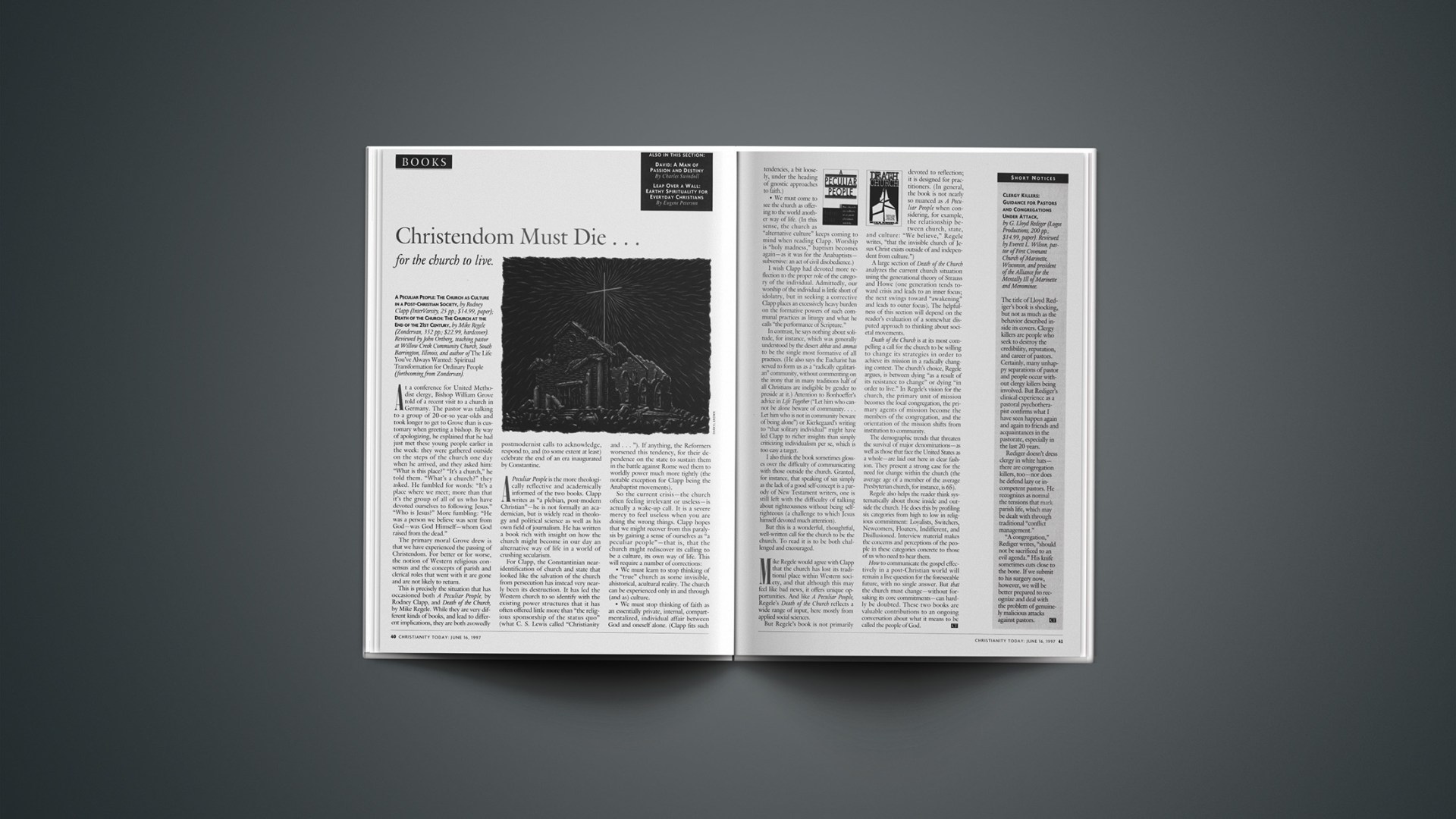

A Peculiar People: The Church as Culture in a Post-Christian Society, by Rodney Clapp (InterVarsity, 25 pp.; $14.99, paper);
Death of the Church: The Church at the End of the 21st Century, by Mike Regele (Zondervan, 352 pp.; $22.99, hardcover). Reviewed by John Ortberg, teaching pastor at Willow Creek Community Church, South Barrington, Illinois, and author of The Life You’ve Always Wanted: Spiritual Transformation for Ordinary People (forthcoming from Zondervan).
At a conference for United Methodist clergy, Bishop William Grove told of a recent visit to a church in Germany. The pastor was talking to a group of 20-or-so year-olds and took longer to get to Grove than is customary when greeting a bishop. By way of apologizing, he explained that he had just met these young people earlier in the week: they were gathered outside on the steps of the church one day when he arrived, and they asked him: “What is this place?” “It’s a church,” he told them. “What’s a church?” they asked. He fumbled for words: “It’s a place where we meet; more than that it’s the group of all of us who have devoted ourselves to following Jesus.” “Who is Jesus?” More fumbling: “He was a person we believe was sent from God—was God Himself—whom God raised from the dead.”
The primary moral Grove drew is that we have experienced the passing of Christendom. For better or for worse, the notion of Western religious consensus and the concepts of parish and clerical roles that went with it are gone and are not likely to return.
This is precisely the situation that has occasioned both A Peculiar People, by Rodney Clapp, and Death of the Church, by Mike Regele. While they are very different kinds of books, and lead to different implications, they are both avowedly postmodernist calls to acknowledge, respond to, and (to some extent at least) celebrate the end of an era inaugurated by Constantine.
A Peculiar People is the more theologically reflective and academically informed of the two books. Clapp writes as “a plebian, post-modern Christian”—he is not formally an academician, but is widely read in theology and political science as well as his own field of journalism. He has written a book rich with insight on how the church might become in our day an alternative way of life in a world of crushing secularism.
For Clapp, the Constantinian near-identification of church and state that looked like the salvation of the church from persecution has instead very nearly been its destruction. It has led the Western church to so identify with the existing power structures that it has often offered little more than “the religious sponsorship of the status quo” (what C. S. Lewis called “Christianity and … “). If anything, the Reformers worsened this tendency, for their dependence on the state to sustain them in the battle against Rome wed them to worldly power much more tightly (the notable exception for Clapp being the Anabaptist movements).
So the current crisis—the church often feeling irrelevant or useless—is actually a wake-up call. It is a severe mercy to feel useless when you are doing the wrong things. Clapp hopes that we might recover from this paralysis by gaining a sense of ourselves as “a peculiar people”—that is, that the church might rediscover its calling to be a culture, its own way of life. This will require a number of corrections:
—We must learn to stop thinking of the “true” church as some invisible, ahistorical, acultural reality. The church can be experienced only in and through (and as) culture.
—We must stop thinking of faith as an essentially private, internal, compartmentalized, individual affair between God and oneself alone. (Clapp fits such tendencies, a bit loosely, under the heading of gnostic approaches to faith.)
—We must come to see the church as offering to the world another way of life. (In this sense, the church as “alternative culture” keeps coming to mind when reading Clapp. Worship is “holy madness,” baptism becomes again—as it was for the Anapbaptists—subversive: an act of civil disobedience.)
I wish Clapp had devoted more reflection to the proper role of the category of the individual. Admittedly, our worship of the individual is little short of idolatry, but in seeking a corrective Clapp places an excessively heavy burden on the formative powers of such communal practices as liturgy and what he calls “the performance of Scripture.”
In contrast, he says nothing about solitude, for instance, which was generally understood by the desert abbas and ammas to be the single most formative of all practices. (He also says the Eucharist has served to form us as a “radically egalitarian” community, without commenting on the irony that in many traditions half of all Christians are ineligible by gender to preside at it.) Attention to Bonhoeffer’s advice in Life Together (“Let him who cannot be alone beware of community. … Let him who is not in community beware of being alone”) or Kierkegaard’s writing to “that solitary individual” might have led Clapp to richer insights than simply criticizing individualism per se, which is too easy a target.
I also think the book sometimes glosses over the difficulty of communicating with those outside the church. Granted, for instance, that speaking of sin simply as the lack of a good self-concept is a parody of New Testament writers, one is still left with the difficulty of talking about righteousness without being self-righteous (a challenge to which Jesus himself devoted much attention).
But this is a wonderful, thoughtful, well-written call for the church to be the church. To read it is to be both challenged and encouraged.
Mike Regele would agree with Clapp that the church has lost its traditional place within Western society, and that although this may feel like bad news, it offers unique opportunities. And like A Peculiar People, Regele’s Death of the Church reflects a wide range of input, here mostly from applied social sciences.
But Regele’s book is not primarily devoted to reflection; it is designed for practitioners. (In general, the book is not nearly so nuanced as A Peculiar People when considering, for example, the relationship between church, state, and culture: “We believe,” Regele writes, “that the invisible church of Jesus Christ exists outside of and independent from culture.”)
A large section of Death of the Church analyzes the current church situation using the generational theory of Strauss and Howe (one generation tends toward crisis and leads to an inner focus; the next swings toward “awakening” and leads to outer focus). The helpfulness of this section will depend on the reader’s evaluation of a somewhat disputed approach to thinking about societal movements.
Death of the Church is at its most compelling a call for the church to be willing to change its strategies in order to achieve its mission in a radically changing context. The church’s choice, Regele argues, is between dying “as a result of its resistance to change” or dying “in order to live.” In Regele’s vision for the church, the primary unit of mission becomes the local congregation, the primary agents of mission become the members of the congregation, and the orientation of the mission shifts from institution to community.
The demographic trends that threaten the survival of major denominations—as well as those that face the United States as a whole—are laid out here in clear fashion. They present a strong case for the need for change within the church (the average age of a member of the average Presbyterian church, for instance, is 65).
Regele also helps the reader think systematically about those inside and outside the church. He does this by profiling six categories from high to low in religious commitment: Loyalists, Switchers, Newcomers, Floaters, Indifferent, and Disillusioned. Interview material makes the concerns and perceptions of the people in these categories concrete to those of us who need to hear them.
How to communicate the gospel effectively in a post-Christian world will remain a live question for the foreseeable future, with no single answer. But that the church must change—without forsaking its core commitments—can hardly be doubted. These two books are valuable contributions to an ongoing conversation about what it means to be called the people of God.
Short Notices Clergy Killers: Guidance for Pastors and Congregations Under Attack, by G. Lloyd Rediger (Logos Productions, 200 pp.; $14.99, paper). Reviewed by Everett L. Wilson, pastor of First Covenant Church of Marinette, Wisconsin, and president of the Alliance for the Mentally Ill of Marinette and Menominee.
The title of Lloyd Rediger’s book is shocking, but not as much as the behavior described inside its covers. Clergy killers are people who seek to destroy the credibility, reputation, and career of pastors. Certainly, many unhappy separations of pastor and people occur without clergy killers being involved. But Rediger’s clinical experience as a pastoral psychotherapist confirms what I have seen happen again and again to friends and acquaintances in the pastorate, especially in the last 20 years.
Rediger doesn’t dress clergy in white hats—there are congregation killers, too—nor does he defend lazy or incompetent pastors. He recognizes as normal the tensions that mark parish life, which may be dealt with through traditional “conflict management.”
“A congregation,” Rediger writes, “should not be sacrificed to an evil agenda.” His knife sometimes cuts close to the bone. If we submit to his surgery now, however, we will be better prepared to recognize and deal with the problem of genuinely malicious attacks against pastors.
Copyright © 1997 by Christianity Today International/Christianity Today Magazine.