



Part two of three parts; click here to read part one
Recalls Abegg: “I was hoping all the time Wacholder was doing these negotiations that it wasn’t just a word list, that it was a key word in context, like Strong’s concordance. Actually, I found it was better than that, because if you looked up the last word in an entry or in a verse, Strong’s wouldn’t give you the next word in the next verse; but this concordance did.”
Because the cards were keyed to each other, Abegg could type one card after the other into his word processor until he had reconstructed whole texts—texts that had never before been published. When in 1991 the editor of Biblical Archaeology Review, Hershel Shanks, who since the mideighties had been calling for the “release” of the scrolls, caught wind of Abegg’s reconstructed texts, he encouraged Abegg to let him publish them.
Abegg found himself facing an ethical dilemma. On the one hand, there was the academic protocol against publishing other people’s work—coding the 3×5 cards represented hundreds of days of piecing the texts together. On the other hand, says Abegg, “we saw that this material had been done in the late fifties and could have been published then. They had held on to this material, were telling everyone it couldn’t be published because there had been no transcriptions. And then we found out that, indeed, there had been transcriptions back in the fifties—they were pulling the wool over our eyes all these years.”
The texts went to print in September 1991. The Huntington Library in California quickly followed by making public actual photos of the manuscripts. And finally, even the Israel Antiquities Authority, which controlled the scrolls, ruled that it now supported open access to copies of the scrolls. From the New York Times to Newsweek, Wacholder and Abegg were declared the liberators of the scrolls. “Andy Warhol talks about your 15 minutes of fame,” says Abegg, whose steady gaze and conventional haircut make the 47-year-old father seem anything but a publicity-seeking renegade. “I had my 15 minutes many times over that year.”
The limelight has faded in the six years since. Abegg is now busy doing what he loves best: teaching and working on the scroll texts themselves. And even Tov, whom Abegg always deeply admired, has apparently welcomed back his prodigal son: this past summer Abegg was invited to become one of Tov’s official scroll editors.
OUR OLD TESTAMENT TO THE “T”—ALMOST
( … just as) it is written in the b(ook) of Isaiah the prophet …
—4Q265, fragment 2
Abegg and Flint, who together are codirectors of the Dead Sea Scrolls Institute, are two of nearly a dozen evangelical scholars who have been added to the international team of scroll editors in the last decade. Not surprisingly, says Flint, their presence is influencing the scholarly discussion surrounding the scrolls. “Just as Jews have helped focus on things like ritual purity, food laws, and things of interest to Jews, I think evangelicals have helped focus the interest on the reliability of the Bible, how we got our Bible, and also on the relation between Jesus and the Dead Sea Scrolls,” he says.
Flint, 46, believes that evangelicals have arrived late on the scene in exploring the significance of the scrolls for Christian faith. So when Trinity Western—a school of the Evangelical Free Church begun in 1962—called in 1995, asking him to help begin the institute in conjunction with the school’s graduate program in biblical studies, he was more than ready. And more than qualified.
Flint is no journalist’s dream to interview—he is painstakingly methodical (try getting him to answer even one question out of the logical order of the discussion), contentedly introverted, and exasperatingly careful. But it is exactly those qualities that make him a top candidate for editing something so intricate as the scrolls.
Raised in a Christian family in South Africa, he eventually came to the United States with the specific goal of studying with the best of the Dead Sea Scrolls scholars. His Ph.D. adviser at the University of Notre Dame was Eugene Ulrich, chief editor of the Dead Sea Scrolls for North America. After serving for a number of years as Ulrich’s research assistant, Flint was asked to join the official team of scroll editors in 1991. He brought with him his knowledge of 11 modern and ancient languages.
Like the Jesus Seminar, which over the years has publicized its work on the Gospels, Flint and his colleagues seek to educate both specialists and laypeople about their work. They do this by speaking in churches, participating in learned societies such as the Society of Biblical Literature, presenting papers at archaeological and ancient-languages seminars, and conducting an annual Dead Sea Scrolls symposium at Trinity Western. But in marked contrast to the shock tactics of their ideological counterpart, says Flint, the institute seeks to instill in its audiences a reasoned confidence in the Scriptures.
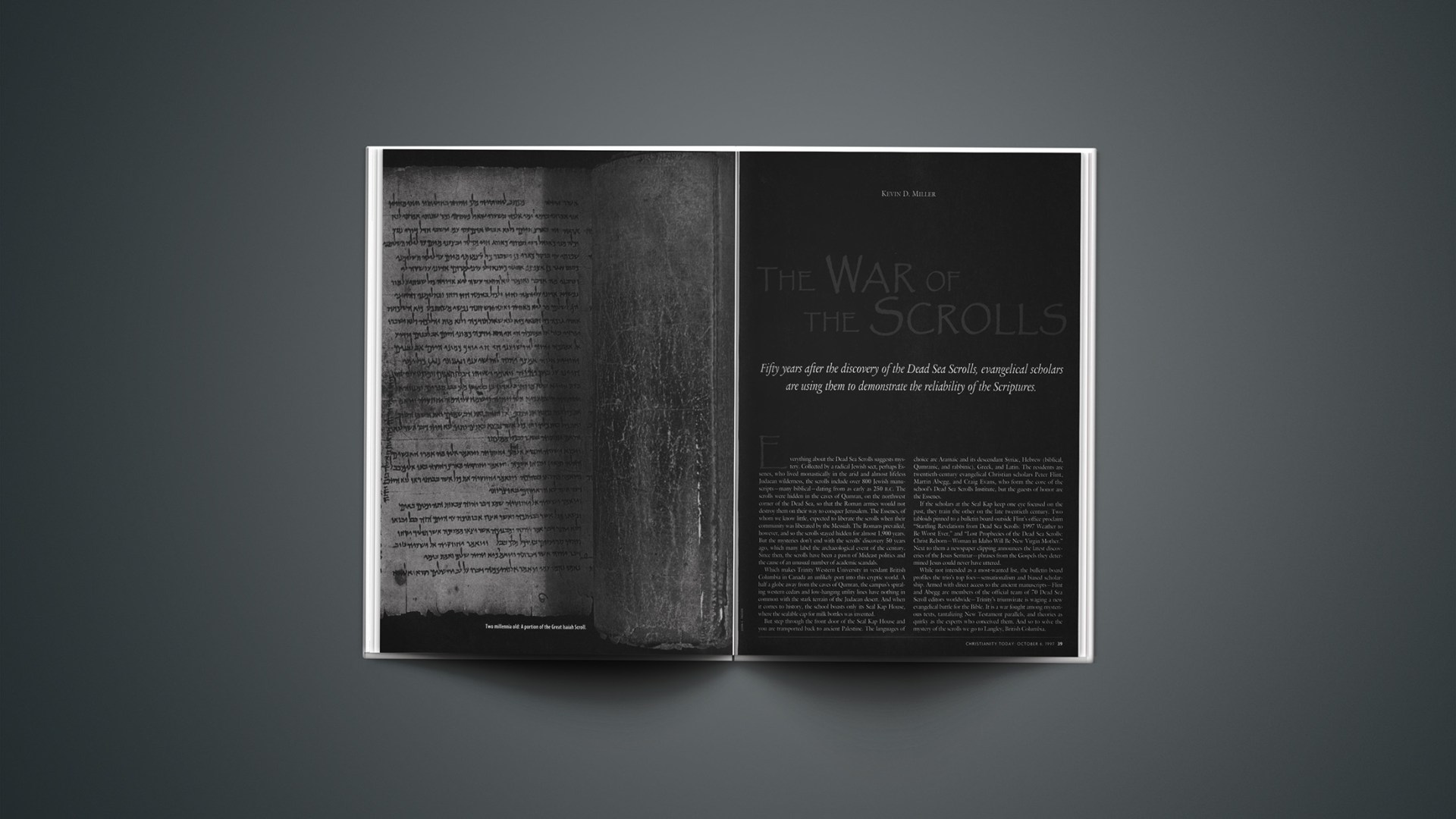
At one level, the Dead Sea Scrolls provide a wonderfully affirming resource for this job. For years, biblical conservatives have pointed happily to the Great Isaiah Scroll, which was among the original seven scrolls found in the first cave in 1947. With all 66 chapters completely preserved, this version of Isaiah—though copied down around 100 B.C.—matches the A.D. 1000 Masoretic Text upon which all modern Old Testament translations are based 99 percent of the time. Nearly the same level of accuracy is found in the other biblical manuscripts found at Qumran. “This confirms to us that our Hebrew Bible was wonderfully preserved,” Flint says.
When it comes to the 1 percent that does differ, Flint gives the discrepancies a positive, pastoral take. “I’m happy to say in a rather dramatic fashion that the scrolls often sort out problems that we’ve known about for ages. They give us in black and white a better reading of the biblical text.”
One example is an ambiguous Hebrew phrase in Psalm 22:16. Translators have often rendered it “They have pierced my hands and feet,” following the reading of the Septuagint (a Greek translation of the Hebrew Scriptures, the earliest complete manuscripts coming from the late third century A.D.). The more direct translation from the Hebrew Masoretic Text, however, is “Like a lion are my hands and feet.” But in a technical monograph, just off the press in July, titled The Dead Sea Psalms Scrolls (Brill), Flint shows that the “pierced” reading is indeed the preferred option in the Hebrew Dead Sea Psalms—dispelling charges that the phrase was a later Christian messianic misrendering. Other interesting “textual variants” include the following:
—Goliath’s height in a Hebrew manuscript of Samuel dated to the mid-third century B.C. (4QSam-b) is given as six foot, nine inches, not nine foot, nine inches, as found in the Masoretic Text (4QSam-b designates the text as being the second—or b—Samuel manuscript found in Cave 4 at Qumran).
—The number of Jacob’s descendants who traveled with him to Egypt is 70 in the Masoretic Text, but 75 in 4QExod-a. This corresponds to the number Stephen uses in his sermon in Acts 7:14 as well as to the Septuagint, which Stephen may have been using.
—A new text found in 4QSam-a contains a paragraph at the end of 1 Samuel 10 that explains that “Nahash, king of the Ammonites, had been grievously oppressing the Gadites and the Reubenites. He would gouge out the right eye of each of them and would not grant Israel a deliverer.” These words, missing from our Bibles, provide the context for Nahash’s threats to gouge out the right eyes of the Israelites in chapter 11. The New Revised Standard Version is the first translation to incorporate this new paragraph.
While leapfrogging back to a cache of manuscripts a millennium older than our previous Old Testament texts has affirmed “our” Scriptures, it also lands us in a murky pond called canon formation. It is a subject, says Flint, that some of his lay listeners find unsettling.
A case in point is a slide Flint shows of himself in which he is scrutinizing the original manuscript of 4QPs-a in the editors’ workroom at the Rockefeller Museum in Jerusalem. “I’m holding in my hands the oldest copy of the Book of Psalms in the entire world,” he says with obvious emotion. “It’s dated to about 150 B.C., which is over 1,100 years older than the Book of Psalms we use in all our seminaries. It is a very humbling experience as a biblical scholar.”
The consensus from almost all quarters of Bible scholarship is that the Dead Sea Scrolls root the Gospels inextricably within the Jewish tradition.
This particular set of psalms, however, contains only 89 selections—or the first three books of the five books found in our Masoretic-based Psalters. Other Qumran Psalters, by contrast, include Psalm 151, which appears in the Septuagint but not in the Masoretic Text or our modern Bibles (which contain only 150 psalms). In addition, some of the scrolls contain psalms not previously known. The different collections and varying orders in which the psalms are arranged, scholars agree, point to an unsettled canon of sacred Scripture in use by the Qumran sect.
For Bible historians, this evidence of canon formation at the time is nothing new—the closure of the Jewish Scriptures is thought to have occurred at the end of the first century A.D. What is new are the clues the Qumran scrolls give about varying textual traditions behind the Jewish Scriptures. The clearest and most dramatic example of this can be seen in the Qumran copies of Jeremiah.
Some of these Jeremiahs are direct ancestors of the A.D. 1000 Masoretic Text. The much-touted 99 percent correspondence of the Qumran Scripture texts applies when these proto-Masoretic versions are compared with their later medieval Masoretic descendant. But critics soon found that other of the Jeremiah manuscripts represented a distinct Hebrew text tradition—one that appeared to lie behind the Greek translation of the Septuagint. As in the Septuagint, this separate Hebrew Jeremiah presents material in a different order and is about an eighth shorter than the proto-Masoretic manuscripts. Which of these equally ancient but independent Hebrew versions of Jeremiah is closer to what Jeremiah and his scribe actually penned remains an open question.
“What the scrolls are telling us,” says Flint the scholar, “is that when the canon was incomplete, there were different versions of certain books: the Septuagints chose one version, and the Masoretics chose the other.”
But Flint the evangelical is careful to add: “While we know that at the time of Jesus there were different canons of the Old Testament because the canonical process was not yet complete, the glorious truth is that God has invited humans to be partners in the putting together of Scripture. I think the implications are that you cannot have Scripture without the community of faith. It’s not just a private revelation. God gives us Scripture, but then the community of faith, by God’s guidance, has to choose what’s in and what’s out.”
DEMYTHOLOGIZING THE JESUS SEMINAR
If a prophet or interpreter of dreams arises among you and … says, “Let us go and serve other gods” … you shall purge the evil one from your midst.
—Temple Scroll, column 54
In the 1940s, just prior to the discovery of the Dead Sea Scrolls, Edgar Goodspeed wrote his scholarly opinion that “the Gospel is Christianity’s contribution to literature. It is the most potent type of religious literature ever devised. To credit such a creation to the most barren age of a never very productive tongue like Aramaic would seem the height of improbability. For in the days of Jesus the Jews of Palestine were not engaged in writing books. It is not too much to say that a Galilean or Jerusalem Jew of the time of Christ would regard writing a book in his native tongue with positive horror.”
That’s the kind of quote that gets Craig Evans going. Professor of Biblical Studies at Trinity Western since the early eighties, he was the driving inspiration behind starting Trinity’s Dead Sea Scrolls Institute. Today he serves as the institute’s spokesman on the relationship of the scrolls to Jesus and the New Testament. A strapping six-foot-two with a bushy mustache and a charismatic personality, Evans, 45, is the most articulate of the Trinity trio. He is also the most prone to hyperbole.
“One after the other, certain nonevangelical so-called critical hypotheses are being blown out of the water by tidbits of information that the scrolls provide,” he says, showing a text of 4Q246. Its title—”The Aramaic Son of God Text”—is one that would have made Goodspeed blush. Aramaic, it turns out, is the language found in one of every six nonbiblical Qumran scrolls.
Part two of three parts; click here to read part three
Copyright © 1997 Christianity Today. Click for reprint information.