On the west coast of Canada, where my wife and I live, the Halloween cover of a community newspaper pictured a smiling couple, both with long robes and flowing hair, holding a pumpkin. The headline announced, "Wiccan Priest and Priestess to Wed on All Hallow's Eve."
The lead story enthusiastically described the details of the wedding and narrated the couple's pilgrimage to an "ancient faith" away from Christianity. The bride said that after she became an atheist, "It seemed to me that creation was sacred, the earth was sacred, and in the greater scheme of things we were not outside of it, we were part of it."
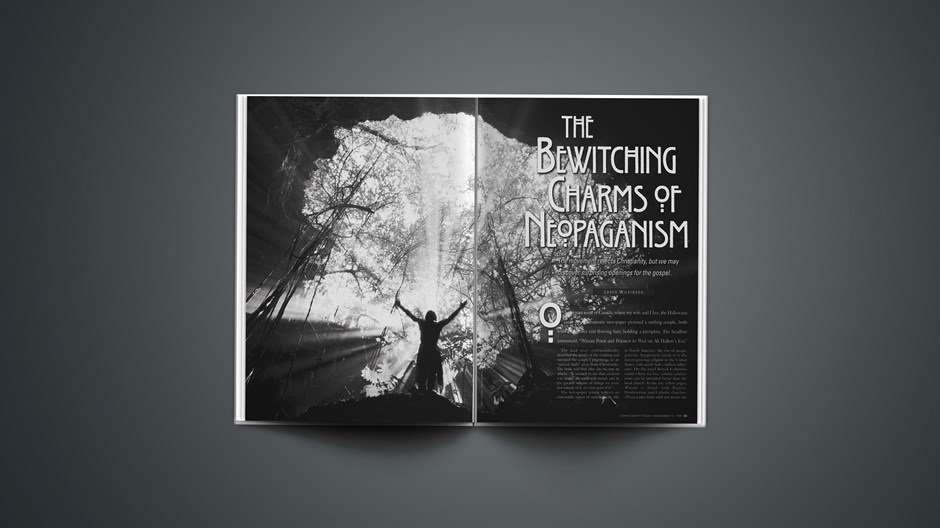
The newspaper article reflects an undeniable aspect of contemporary life in North America: the rise of neopaganism. Supporters claim it is the fastest-growing religion in the United States, with nearly half a million adherents. On the rural British Columbia island where we live, solstice celebrations can be attended better than the local church. In the city yellow pages, Wiccan is listed with Baptist, Presbyterian, and Catholic churches. (Wicca comes from witch and means one who works with natural forces by shaping or bending them. Thus, the word is closely related to wicker, not wicked.)
The thousand-acre forest that surrounds the university where I teach is called "Pacific Spirit Park" and is described as "a ground for our becoming one with nature." In many bookstores, large sections deal with magic, paganism, and Wicca and are full of volumes by mainstream publishers with titles like The Pagan Path and Voices from the Circle.
Interest in paganism is not limited to the West Coast, where some religious flakiness is expected. The largest pagan group in North America ("The Circle Network") is based in Mt. Horeb, Wisconsin. Neopagan sites are among the most frequently visited on the Internet, and hundreds of seasonal festivals in Britain and North America draw pagan celebrants. Many people are willing—even proud—to be called pagans and witches.
When neopaganism is limited by the circle of the self, it can quickly make a god of the self.
How should Christians respond to this growth of neopaganism? The two most common responses are both wrong. The first response, with a long history in Christendom, is to regard all forms of paganism as thinly veiled Satanism, a worship of evil that Christians must oppose. This attitude led to what neopagans often call "the burning times," when many witches, mostly women, were killed. It is impossible to determine the numbers, but some neopagan claims reach into the millions.
The other response, consistent with a growing acceptance of religious pluralism, is to affirm the sincerity of neopagan spirituality. Since there are many "mansions of the spirit," as the current Anglican bishop in Vancouver put it, Christians should accept this form of spirituality as an authentic way to God, just like our own Christian faith.
There are very good reasons to be concerned about the rise of neopaganism: most fundamentally neopaganism, like all religions, is a dead end unless it leads to a knowledge of God through Jesus. Neopaganism is particularly troubling when it shows up in Christian churches, often as an accommodation to two closely related themes in contemporary culture. The first is the beguiling idea that the only God we need to pay any attention to is the god within, a thinly veiled way of worshiping the self under the guise of "my own spirituality." It is a short and fatal step from "finding God within" to an affirmation of the ancient lie that we can ourselves become "like gods."
The second place where neopaganism shows up in Christian churches is in the attempt to get rid of the inescapably masculine imagery for God in the Bible. God is spirit, transcending gender, so it seems such a harmless and healing step to refer to God as she instead of he, as Mother instead of Father, or as Goddess instead of God. This opens a door to that confusion of creation and Creator which is paganism's great mistake: to worship the earth itself as the great immanent divinity that continually gives birth out of its own fertile mystery. To equate God (or Goddess) and earth in this way is to deny the distinct and transcendent personality of the God revealed in Scripture.
These are very real dangers that evangelicals need to oppose strongly. But if we merely focus on the dangers, we will miss another, more hopeful strand of neopaganism, an attribute of the movement that provides the key to our evangelism.
At home here
One of my first close contacts with neopaganism took place a few years ago when my wife, daughter, and I were involved in a blockade protesting the logging of the last large areas of old forest on the west coast of Vancouver Island. We were persuaded to participate by a new Christian who was impressed by the spiritual seriousness of the protest and the complete lack of any Christian presence there.
Article continues below
We too were impressed—and bemused—by the spiritual intensity of the event. Though most of the participants were younger than us, we were coached in nonviolent resistance techniques by a grandmotherly, white-haired woman who said she was a Wicca priestess—a witch. We were given song sheets that included hymns to "the earth goddess," and sat in the big Circle (the name denoted not only a shape but an event and an attitude) in a meeting conducted, we were told, under feminist principles of "consensus and nonviolence." And there we planned the next morning's blockade.
After the dawn arrests—by this time arrests had become almost a ritual—we returned from our brief time in jail to the bright, late-morning light of "The Circle." We decided to teach the group a song of our own, the words from Isaiah 55: "You will go out with joy, and be led forth in peace, and all the trees of the field will clap their hands."
Many of the protesters seemed surprised that the words were in the Bible—as they seemed surprised at the Scripture texts we had posted: "The Earth is the Lord's," "Creation groans," and "in Christ … a new creation." But the biggest surprise—always a pleased response—for this earnest group of protesters was that Christians were even present at the protest. "Do Christians care about the earth?" was a common inquiry.
A common tenet of neopagan religion is the belief that neither Christians nor the Christian God are concerned or connected with the earth. To neopagans, "Christian culture" seems to act as though the earth were merely raw material to be used up in getting somewhere else (either to heaven or to a golden future). Neopagans respond: We are at home here. Hence, the passionate protests to save forests or to celebrate rituals that attempt to connect participants with the cycles of nature.
For many people today, neopaganism is the result of a first, tentative response to the word about God that is broadcast nonverbally through the whole creation. Many neopagans are genuinely seeking God, and Christians need to see how the neopagan thirst for spirituality and the sacred can be filled—not from the stagnant pools of our own inwardness, but from the water of life that only Jesus gives.
Putting the “neo” in pagan
What is neopaganism? The neo is important. Even contemporary practitioners recognize that they are trying to recreate something old, for their own purposes, rather than carrying on an intact tradition from the past. For example, a group called Arn Draiocht Fein (a Gaelic phrase meaning "our own Druidism") describes itself as
Article continues below
a completely independent tradition of Neopagan Druidism. Like our sisters and brothers in other Neopagan movements, we're polytheistic Nature worshipers, attempting to revive the best aspects of the Paleopagan faiths of our ancestors within a modern scientific, artistic, ecological and wholistic context.
Neopaganism is an eclectic religion characterized by what works and is appealing now, not by faithfulness to an older tradition. As Starhawk, a well-known witch, observed in an interview in Gnosis magazine: "It's unimportant whether modern-day paganism is based on truth or myth. … It doesn't really make all that much difference in terms of our relationship with the Goddess today."
Although references to "the ancient ways" abound in neopaganism, and many old names are evoked, historical links evaporate when they are investigated closely. Historicity doesn't matter, neopagans say: what's important is to create rituals that express their experience of the sacred in the world and themselves. Imagined links with an ancient tradition seem to help validate these rituals.
For many centuries the word pagan has had a double connotation for Christians. Because it was long used to describe those who were not Christian, it has carried a taint of wickedness and idolatry. More subtly, in the European world the pagans were those who followed the old gods before their conversion, giving the word an archaic ring. To be pagan was to be old-fashioned, behind the times. Literally, however—and this is part of its current attraction—a pagan was a peasant, a dweller in nature or the countryside, in contrast to the urban Roman world. (A similar history lies behind the words heath and heathen.)
For good strategic reasons, Christianity first spread largely in the urban centers. Paul (unlike Jesus) rarely preached in the country. The New Testament was written mainly to city-dwellers. The peasants in the country were seldom the first to become Christians; hence, the old pagan religions hung on longer there than in the city. So country-dwellers were pagan in both senses of the word: they were peasants and idolaters. By the late fourth century, when Christianity had effectively become the official religion of the declining Roman empire, pagan had assumed most of the negative tone it has carried until recent times.
Article continues below
Neopagans are sometimes accurate when they say that Christians turn their back on the earth and its problems.
For many, the current fascination with paganism is the result of a reversal of this ancient trend. As cities have grown, as the promise of a modern golden age has faded, and as we have come to be more aware of our dependence on the natural world, it is no longer a slur to be called a name that means country-dweller. And in an age that is becoming less Christian all the time, it is certainly no longer a slur to be called by a name which for so long has meant unchristian.
More important than its link to the past is the fact that paganism is not Christianity. In fact, the non-Christian tone of the name is one of its main appeals. Consider, for example, this self-definition on a well-designed neopagan home page on the Internet:
A neo-pagan is an individual whose interest in the religious sphere lies in patterns of belief which are non-orthodox and non-traditional in Western society and which more specifically pre-date Western society's dominant belief systems as represented, for example, by Christianity or Judaism.
Here the main feature of neopaganism is not any particular belief or practice, but rather that it is non-orthodox, nontraditional, and is neither Christian nor Jewish.
Worshiping God naturally
Selena Fox, a Wicca practitioner from Mt. Horeb, Wisconsin, defines her belief through an eloquent credo called "I Am Pagan." She begins by affirming her participation in the cycles of nature: "I celebrate the changing seasons, the turning of the Wheel of the Year." She then lists eight pagan festivals, all with Celtic roots, such as Samhain (Halloween), Yule (the winter Solstice), and Candlemas (Groundhog Day). At Samhain, the pagan new year, this wheel of nature starts all over again.
This concern with half-forgotten seasonal festivals is not of mere antiquarian interest. It is an attempt to be reconnected to the greatest harmony Fox knows, that of nature.
Beneath the celebration of nature is an attempt to give meaning to the seasons of her own life: "I also honor the seasons of life within my life's journeys: beginnings, growth, fruition, harvest, endings, rest, and beginnings again. Life is a Circle with many cycles . …"
Fox's frequent reference to circles, cycles, and wheels—with the circle being the central neopagan symbol—reflects several important neopagan themes. The first of these themes is the idea of the interconnection of all things (as in the common "recycling" logo of three curved arrows).
Article continues below
Just as winter is linked through spring to summer and fall, so death is linked to life, and the individual to the communal and universal. The idea is a religious development of one of the key insights of ecological science: that in the biological world everything is linked to everything else. Not only is it impossible to study things in isolation from their environment, but it is dangerous—if not impossible—for human life to proceed in ignorance of our interdependencies with nonhuman things. The four seasons remind us of these connections—hence the pagan seasonal festivals.
For neopagans, the circle has another dimension: it is non-hierarchical. Nobody is at the head of a circle: all are equal. This explains the frequent close link between neopaganism and some forms of feminism, which also question both patriarchy and hierarchy.
The circle also connotes the idea of oneness and unity of all things (including the self) with the divine. To quote Fox again: "I embrace Pantheism, acknowledging that the Divine is everywhere and in everything. I honor divine oneness, the unity of all."
Everything is included in this infinite circle of divinity: not only oaks, herbs, rocks, and birds, but even (Fox's example) "my car, camera, and computers." This explicit pantheism (or "monism") underlies the confessed "polytheism" of neopagans, who are happy to invoke any god or goddess who might be useful. Clearly the various deities they invoke (Artemis, Pan, Dionysus, Thor, Isis) are regarded merely as masks or manifestations of the divinity of all.
But in neopaganism the third, and perhaps most ominous, meaning of the circle is the association of the "magic circle" with the self, the ultimate divinity, at the power-wielding center. To quote Fox again: "My worship and rituals can be anywhere since my sacred circle is portable."
In a sense, all persons are the center of circles carried with them always. Each of us lives (to some degree) in a private world; we never have direct access to another mind. But the "magic circle" in neopaganism is always for the purpose of using power. And ultimately in neopaganism this assertion of the absolute centrality of the self threatens the value and integrity of the other creatures in that vast web of connectedness of which (pagans rightly say) we are a part. Within one's "magic circle," only the self is divine.
Article continues below
Indeed, all the gods and goddesses of neopagan polytheism are ultimately only manifestations of the self, given names drawn from the bubbling pot of world mythology. No neopagan really expects to meet Artemis, Pan, or Satan in the magic circle. The only god one will meet there is the self. Indeed, one fellow islander admitted this frankly (if unintentionally) when he approached me about reserving an unused stateroom on the ferry for a prayer room. "I like to pray on these long trips," he said. "I need a place where I can get into myself."
The widespread idea that the only god that matters is the self, however many names from old lore it might be given, is very dangerous. Here we come to the fatal flaw in neopagan thought. Not far behind the idea that the self is divine, Christians will recognize the old lie, the source of all sin: "You shall be as gods." As Walker Percy has observed in Lost in the Cosmos, "two Gods in the cosmos is one too many." A world of self-centered gods is not likely to be a world of unity or relationship.
Not that such a dark possibility is the intention of any neopagans. We should not make the mistake of equating neopaganism with the conscious pursuit of evil or the worship of the devil. That would repeat the evil of the old witch-burnings. Nevertheless, in this popular postmodern idea of the divinity of the self, we see the fundamental divide between paganism and Christianity.
In response to a neopaganism that seeks to make all things (and especially the self) divine, Christians must reassert the transcendence and otherness of God. At the same time, we need to recognize the element of truth in the neopagan recognition of God's immanence. Sometimes, ironically, Christians may need to learn from neopagans that all of creation carries a divine message.
Neopagans are determined to say no to a modernity that declares the universe (including ourselves) an accidental collection of atoms in which life, mind, spirit, and God are illusions. Neopagans clearly reject a desacralized cosmos. In its place they have tried to celebrate a re-enchanted cosmos where spirit, mystery, beauty, holiness, and ceremony are central. In such a vision each thing has value; nothing is merely raw material. This is surely closer to the biblical view of creation than the current marketplace world where everything in creation is a commodity to be bought and sold; yet many American Christians live in the marketplace world with little tension.
Article continues below
Surprised by Lewis
A surprising voice in support of this kind of culture-questioning paganism is that of C. S. Lewis. In all the praise of Lewis's superlative value as a Christian apologist, not much is said about his cautious defense of paganism. The old pagan world is implicit in nearly all of his fiction—from the thinly disguised (but wonderfully baptized) Norse and Celtic world of Narnia, to the ancient myth of Cupid and Psyche in Till We Have Faces, to the Greek-god-like oyarsu in the Space Trilogy.
But Lewis is even more explicit in his affirmation of paganism as a way that opens people to the true God. In Surprised by Joy, the story of his conversion, Lewis wrote: "Sometimes I can almost think I was sent back to the false gods there to acquire some capacity for worship against the day when the true God should recall me to Himself."
His most explicit approval of paganism is in the early, allegorical account of his conversion, Pilgrim's Regress. In that story, John, the main character, seeks an island in the east—he is really seeking God, but doesn't know it yet—and he encounters a hermit in a cave, who speaks with the voice of history. The hermit explains that all the people in that country are estranged from God (the Landlord), but that the Landlord keeps getting messages through about himself. Often they come in pictures—what we might call mythology. He makes a distinction between "the shepherd people" who had "the rules" (the Jews with the revealed Law) and "the pagans" who had the pictures (mythology):
The truth is that a Shepherd is only half a man, and a Pagan is only half a man, so that neither people was well without the other, nor could either be healed until the Landlord's Son came into the country . …
What Lewis suggests is that authentic paganism—a response, however confused, to the rich and inarticulate mystery of creation—is part of the basic humanity which ought to flourish and be healed in the new life of the gospel. As he puts it even more vividly in the same section of Pilgrim's Regress:
as often as men become Pagans again, the Landlord again sends them pictures and stirs up sweet desire and so leads them back to Mother Kirk [the Christian church] even as he led the actual Pagans long ago. There is, indeed, no other way. … That is the definition of a Pagan—a man so travelling that if all goes well he arrives at Mother Kirk's chair and is carried over this gorge . …
Article continues below
The same pattern is implicit in Scripture on those few occasions when Paul addresses mainly pagan audiences. At Lystra, for example, Barnabas and he are mistaken for Zeus and Hermes. And though he begs them to forsake as "worthless things" the bulls, wreaths, and sacrifice of their ritual, he continues by declaring that the very goodness of creation to which their worship is a response is a gift of the one true God
who made heaven and earth and sea and everything in them. … He has not left himself without testimony: He has shown kindness by giving you rain from heaven and crops in their seasons; he provides you with plenty of food and fills your hearts with joy. (Acts 14:15, 17, NIV)
Paul repeats the same theme in the more sophisticated Athens, going so far to identify the "unknown god" of an altar with "the God who made the world and everything in it … who gives all men life and breath," who "is not far from each of us" and in whom, Paul says (quoting with approval a pagan poet), "we live and move and have our being" (Acts 17:24-28). Paul's strategy is first of all to affirm the divine gift and goodness of the cycles of creation—crops, sun, rain, and the joy of being alive; and then to agree that the source of all that good should be worshiped, not the gods of human invention, but the God who is revealed in Jesus: "what you worship as something unknown I am going to proclaim to you."
There is, of course, a great deal of difference between pre-Christian paganism and post-Christian neopaganism. Part of neopaganism's attraction and very self-definition is being over against Christianity. According to a questionnaire published in a recent revision of Margot Adler's Drawing Down the Moon (by far the best book on neopaganism), nearly 70 percent of those who call themselves neopagans were raised in at least a nominal Christianity. Several of these cited rejection of Christianity as their principal reason for becoming a neopagan.
But we need to be troubled by this neopagan rejection of Christianity. For when we look at what neopagans think Christians believe, it becomes clear that they are rejecting a caricature. One of the most common neopagan complaints is against a distant Christian God, whom they see as a kind of emblem for patriarchy, an aloof giver of laws, a cosmic killjoy. "The concept of divine immanence," says one neopagan writer, "is completely lacking in Judeo-Christianity."
Article continues below
Of course such a criticism is mistaken and misses the nature of the triune God whom Christians worship. Yes, the Creator God is other than Creation. Yet relationship—love and exchange—are central to God's nature. Central to the very existence of each thing, says John, is the logos of God; indeed, says Psalm 19, news about the words and deeds of God are proclaimed through creation to the ends of the earth. Nothing would exist without God's continuous and self-giving love. All things are created, says the psalmist, through the Spirit of God. Scripture shows us a God who is personally, lovingly, sacrificially active in the whole cosmos. The Creator of all things through Christ, in whom all things hold together, is concerned also with the reconciliation of all things to himself (Col. 1).
Yet it must be admitted that Christians often seem to worship a deistic, not a Trinitarian, God: a God who created at the beginning, and who might occasionally intervene in history, rather than the God of Scripture, who sustains our being at every instant, and who (in Augustine's words) is nearer to us than we are to ourselves. Christians need to show to the increasingly neopagan world more of our experience of this God "in whom we live and move and have our being."
Neopagans are quick to point out the Celtic and pagan shadows in Christian culture: the date and greenery of Christmas ("Yule"), the name of Easter, All Saint's Eve (Halloween). But if indeed the gospel is about the self-revelation of "the unknown God," once worshiped in ignorance but now made clear, those pagan remnants in Christian tradition should serve to show the true relationship of Christianity and neopaganism. The hints of divine meaning in the cycles of the natural world are made clear in Jesus.
This relationship of the pagan and the Christian is symbolized well by that best-known of Celtic symbols, the Celtic Cross—the cross superimposed on a smaller circle. (Much of the language, imagery, and vocabulary of the neopagan movement has been drawn from the pre-Christian Celtic world.) The image suggests that only through the historic reality of the death and resurrection of Jesus can the transcendent Creator be known. Then all the cycles and interconnections of the created world (the circle) will be given their meaning in Christ, "the Word without which nothing was made" who "became flesh and dwelt among us." The larger cross over the circle suggests both the transcendence and the historicity of the Incarnation.
Article continues below
When neopaganism is limited by the circle of the self, it can quickly make a god of the self. Those pagan gods in the blood have risen again and again throughout history, never more terribly than in this dying century. But when neopaganism is open to Creation as a gift, it is open also to a relationship with that great loving Other whom we meet in Jesus.
For those who already know God through Jesus, neopaganism is likely to be a door out of relationship with God. (Sadly, I know some who have gone through that door.) But for those who have been shaped by this secular age, neopaganism can be at least a hallway toward the door that leads to the reality of the transcendent and loving God. (Joyfully, I know some who have entered that way.)
Christians are "doorkeepers in the house of the Lord." Our challenge is to live and speak so that we show the door to "the Unknown God," whom some neopagans are genuinely seeking, is actually Jesus. Then they will find that the splendid, tedious, and mysterious circles of our lives, and of all Creation, are given a center and a meaning by the self-giving love of God which the Cross proclaims.
Loren Wilkinson is professor of interdisciplinary studies and philosophy at Regent College, Vancouver, British Columbia. He and his wife live on an island off the coast of the mainland. This essay is adapted from a forthcoming book, Circles and the Cross, to be published next year by Paternoster Press.














 While we pray for peace, we need moral clarity about this war.
 We’ve got little information on Jesus’ appearance and personality. But that’s the way God designed it.españolFrançais
 How groups like Hillsong learned to let go of the literal in favor of creative collaboration.españolPortuguês






