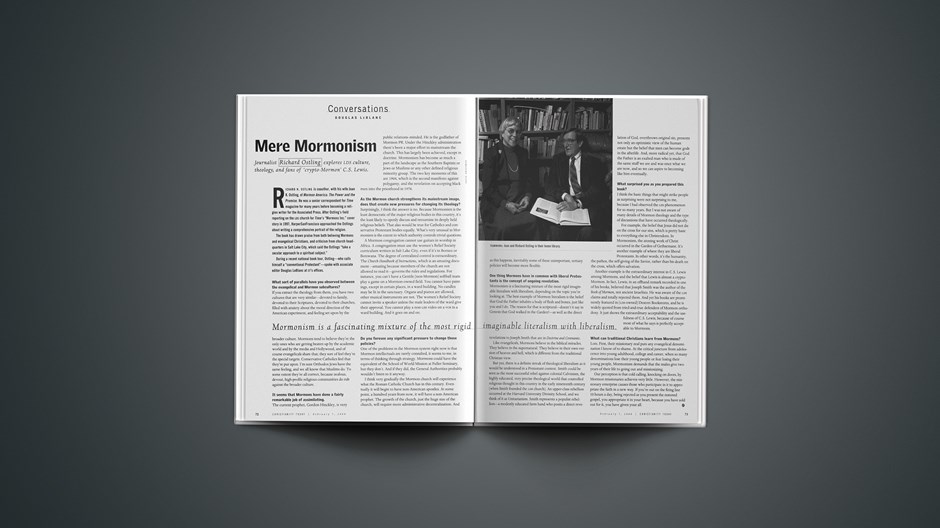
Richard N. Ostling is coauthor, with his wife Joan K. Ostling, of Mormon America: The Power and the Promise. He was a senior correspondent for Time magazine for many years before becoming a religion writer for the Associated Press. After Ostling's field reporting on the LDS church for Time's "Mormons Inc." cover story in 1997, Harper San Francisco approached the Ostlings about writing a comprehensive portrait of the religion.
The book has drawn praise from both believing Mormons and evangelical Christians, and criticism from church headquarters in Salt Lake City, which said the Ostlings "take a secular approach to a spiritual subject."
During a recent national book tour, Ostling—;who calls himself a "conventional Protestant"—;spoke with associate editor Douglas LeBlanc at CT's offices.
What sort of parallels have you observed between the evangelical and Mormon subcultures?
If you extract the theology from them, you have two cultures that are very similar—;devoted to family, devoted to their Scriptures, devoted to their churches, filled with anxiety about the moral direction of the American experiment, and feeling set upon by the broader culture. Mormons tend to believe they're the only ones who are getting beaten up by the academic world and by the media and Hollywood, and of course evangelicals share that; they sort of feel they're the special targets. Conservative Catholics feel that they're put upon. I'm sure Orthodox Jews have the same feeling, and we all know that Muslims do. To some extent they're all correct, because zealous, devout, high-profile religious communities do rub against the broader culture.
It seems that Mormons have done a fairly remarkable job of assimilating.
The current prophet, Gordon Hinckley, is very public relations-minded. He is the godfather of Mormon PR. Under the Hinckley administration there's been a major effort to mainstream the church. This has largely been achieved, except in doctrine. Mormonism has become as much a part of the landscape as the Southern Baptists or Jews or Muslims or any other defined religious minority group. The two key moments of this are 1904, which is the second manifesto against polygamy, and the revelation on accepting black men into the priesthood in 1978.
As the Mormon church strengthens its mainstream image, does that create new pressures for changing its theology?
Surprisingly, I think the answer is no. Because Mormonism is the least democratic of the major religious bodies in this country, it's the least likely to openly discuss and reexamine its deeply held religious beliefs. That also would be true for Catholics and conservative Protestant bodies equally. What's very unusual in Mormonism is the extent to which authority controls trivial questions.
A Mormon congregation cannot use guitars in worship in Africa. A congregation must use the women's Relief Society curriculum written in Salt Lake City, even if it's in Borneo or Botswana. The degree of centralized control is extraordinary. The Church Handbook of Instructions, which is an amazing document—;amazing because members of the church are not allowed to read it—;governs the rules and regulations. For instance, you can't have a Gentile [non-Mormon] softball team play a game on a Mormon-owned field. You cannot have paintings, except in certain places, in a ward building. No candles may be lit in the sanctuary. Organs and pianos are allowed, other musical instruments are not. The women's Relief Society cannot invite a speaker unless the male leaders of the ward give their approval. You cannot play a non-LDS video on a VCR in a ward building. And it goes on and on.
Do you foresee any significant pressure to change those policies?
One of the problems in the Mormon system right now is that Mormon intellectuals are rarely consulted, it seems to me, in terms of thinking through strategy. Mormons could have the equivalent of the School of World Mission at Fuller Seminary, but they don't. And if they did, the General Authorities probably wouldn't listen to it anyway.
I think very gradually the Mormon church will experience what the Roman Catholic Church has in this century. Eventually it will begin to have non-American apostles. At some point, a hundred years from now, it will have a non-American prophet. The growth of the church, just the huge size of the church, will require more administrative decentralization. And as this happens, inevitably some of these unimportant, tertiary policies will become more flexible.
One thing Mormons have in common with liberal Protestants is the concept of ongoing revelation.
Mormonism is a fascinating mixture of the most rigid imaginable literalism with liberalism, depending on the topic you're looking at. The best example of Mormon literalism is the belief that God the Father inhabits a body of flesh and bones, just like you and I do. The reason for that is scriptural—;doesn't it say in Genesis that God walked in the Garden?—;as well as the direct revelations to Joseph Smith that are in Doctrine and Covenants.
Article continues below
Like evangelicals, Mormons believe in the biblical miracles. They believe in the supernatural. They believe in their own version of heaven and hell, which is different from the traditional Christian view.
But yes, there is a definite streak of theological liberalism as it would be understood in a Protestant context. Smith could be seen as the most successful rebel against colonial Calvinism, the highly educated, very precise theological world that controlled religious thought in this country in the early nineteenth century [when Smith founded the LDS church]. An upper-class rebellion occurred at the Harvard University Divinity School, and we think of it as Unitarianism. Smith represents a populist rebellion—;a modestly educated farm hand who posits a direct revelation of God, overthrows original sin, presents not only an optimistic view of the human estate but the belief that men can become gods in the afterlife. And, more radical yet, that God the Father is an exalted man who is made of the same stuff we are and was once what we are now, and so we can aspire to becoming like him eventually.
What surprised you as you prepared this book?
I think the basic things that might strike people as surprising were not surprising to me, because I had observed the LDS phenomenon for so many years. But I was not aware of many details of Mormon theology and the type of discussions that have occurred theologically.
For example, the belief that Jesus did not die on the cross for our sins, which is pretty basic to everything else in Christendom. In Mormonism, the atoning work of Christ occurred in the Garden of Gethsemane. It's another example of where they are liberal Protestants. In other words, it's the humanity, the pathos, the self-giving of the Savior, rather than his death on the cross, which offers salvation.
Another example is the extraordinary interest in C.S. Lewis among Mormons, and the belief that Lewis is almost a crypto-Mormon. In fact, Lewis, in an offhand remark recorded in one of his books, believed that Joseph Smith was the author of the Book of Mormon, not ancient Israelites. He was aware of the LDS claims and totally rejected them. And yet his books are prominently featured in [LDS-owned] Deseret Bookstores, and he is widely quoted from tried-and-true defenders of Mormon orthodoxy. It just shows the extraordinary acceptability and the usefulness of C.S. Lewis, because of course most of what he says is perfectly acceptable to Mormons.
Article continues below
What can traditional Christians learn from Mormons?
Lots. First, their missionary zeal puts any evangelical denomination I know of to shame. At the critical juncture from adolescence into young adulthood, college and career, when so many denominations lose their young people or fear losing their young people, Mormonism demands that the males give two years of their life to going out and missionizing.
Our perception is that cold calling, knocking on doors, by Mormon missionaries achieves very little. However, the missionary enterprise causes those who participate in it to appropriate the faith in a new way. If you're out on the firing line 10 hours a day, being rejected as you present the restored gospel, you appropriate it in your heart, because you have sold out for it, you have given your all.
A review of the Ostlings' book, Mormon America, was recently published in Christianity Today sister publication Books & Culture. The review was written by two practicing Mormons.
Ostling's cover story on Mormonism, "Kingdom Come," from the August 4, 1997 of Time magazine, is available online.
HarperCollins's page on Mormon America includes an excerpt, a description, and blurbs.
The New York TimescalledMormon America "a long overdue primer on one of the fastest-growing religions in the world" and the Ostlings "diligent referees of [Mormon] fights past and present."
For more on Mormonism and Evangelical-Mormon relations, see our June 15, 1998 cover story, "Mormons on the Rise | Southern Baptists Take Up the Mormon Challenge."















 While we pray for peace, we need moral clarity about this war.
 As my doubts about his teachings grew, so did a secret fascination with Jesus.
 Beyoncé’s right. Whether listening to Cowboy Carter or reading theology, diversity is a good thing.






