
Intro | Part 1 | 2 | 3 | 4 | 5 | 6 | 7 | 8 | 9
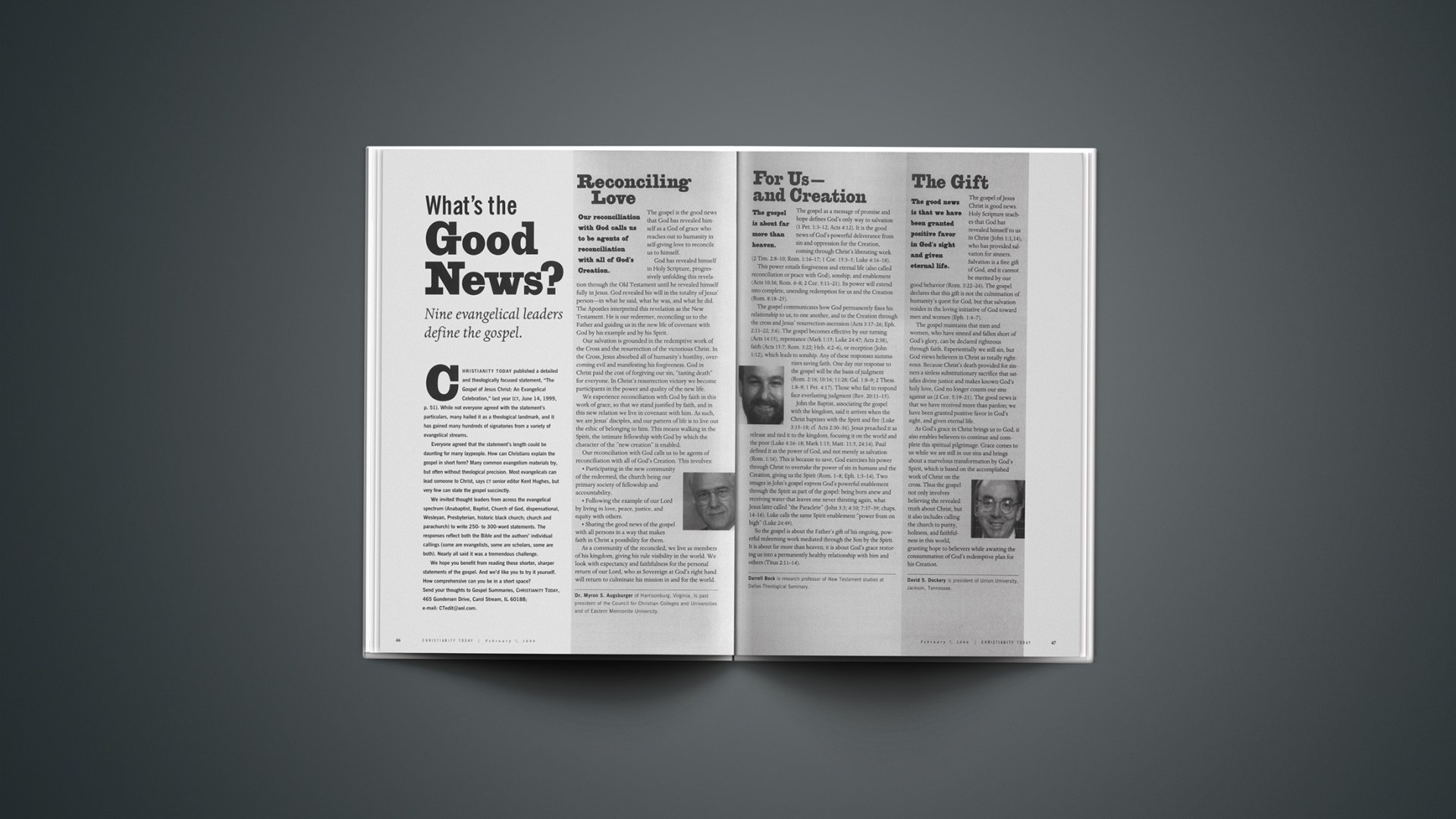
For Us—and Creation
The gospel is about far more than heaven.
The gospel as a message of promise and hope defines God’s only way to salvation (1 Peter 1:3-12; Acts 4:12). It is the good news of God’s powerful deliverance from sin and oppression for the Creation, coming through Christ’s liberating work (2 Timothy 2:8-10; Romans 1:16-17; 1 Corinthians 15:3-5; Luke 4:16-18).
This power entails forgiveness and eternal life (also called reconciliation or peace with God), sonship, and enablement (Acts 10:36; Romans 6-8; 2 Corinthians 5:11-21). Its power will extend into complete, unending redemption for us and the Creation (Romans 8:18-25).
The gospel communicates how God permanently fixes his relationship to us, to one another, and to the Creation through the cross and Jesus’ resurrection-ascension (Acts 3:17-26; Ephesians 2:11-22; 3:6). The gospel becomes effective by our turning (Acts 14:15), repentance (Mark 1:15; Luke 24:47; Acts 2:38), faith (Acts 15:7; Romans 3:22; Hebrews 4:2-6), or reception (John 1:12), which leads to sonship. Any of these responses summarizes saving faith. One day our response to the gospel will be the basis of judgment (Romans 2:16; 10:16; 11:28; Galatians 1:8-9; 2 Thessalonians 1:8-9; 1 Peter 4:17). Those who fail to respond face everlasting judgment (Revelation 20:11-15).
John the Baptist, associating the gospel with the kingdom, said it arrives when the Christ baptizes with the Spirit and fire (Luke 3:15-18; cf. Acts 2:30-36). Jesus preached it as release and tied it to the kingdom, focusing it on the world and the poor (Luke 4:16-18; Mark 1:15; Matthew 11:5, 24:14). Paul defined it as the power of God, and not merely as salvation (Romans 1:16). This is because to save, God exercises his power through Christ to overtake the power of sin in humans and the Creation, giving us the Spirit (Romans 1-8; Ephesians 1:3-14). Two images in John’s gospel express God’s powerful enablement through the Spirit as part of the gospel: being born anew and receiving water that leaves one never thirsting again, what Jesus later called “the Paraclete” (John 3:3; 4:10; 7:37-39; chaps. 14-16). Luke calls the same Spirit-enablement “power from on high” (Luke 24:49).
So the gospel is about the Father’s gift of his ongoing, powerful redeeming work mediated through the Son by the Spirit. It is about far more than heaven; it is about God’s grace restoring us into a permanently healthy relationship with him and others (Titus 2:11-14).
Darrell Bock is research professor of New Testament studies at Dallas Theological Seminary.
Next: The Gift: David S. Dockery

Copyright © 2000 Christianity Today. Click for reprint information.