When news came over the intercom system that President John F. Kennedy had been shot, students in my high school stood and cheered. They cheered because he was the President who had proposed civil-rights legislation and had then backed it up by forcing the University of Mississippi to integrate. To our comfortable enclave of racism in the suburbs outside Atlanta, Georgia, Kennedy represented an intolerable threat.
In 1966, when I was graduated from that school, no black student had ever set foot on campus. Black families had moved into the neighborhood, and whites on all sides were fleeing to Stone Mountain and other suburban points east, but no black parents dared enroll their children in our school. We all believed then, and I have no reason to disbelieve now, that Gordon single-handedly kept them away. Gordon, a tenth-grader reputed to be the nephew of the Grand Dragon of the Ku Klux Klan, had put out the word that the first black kid in our school would go home on a stretcher.
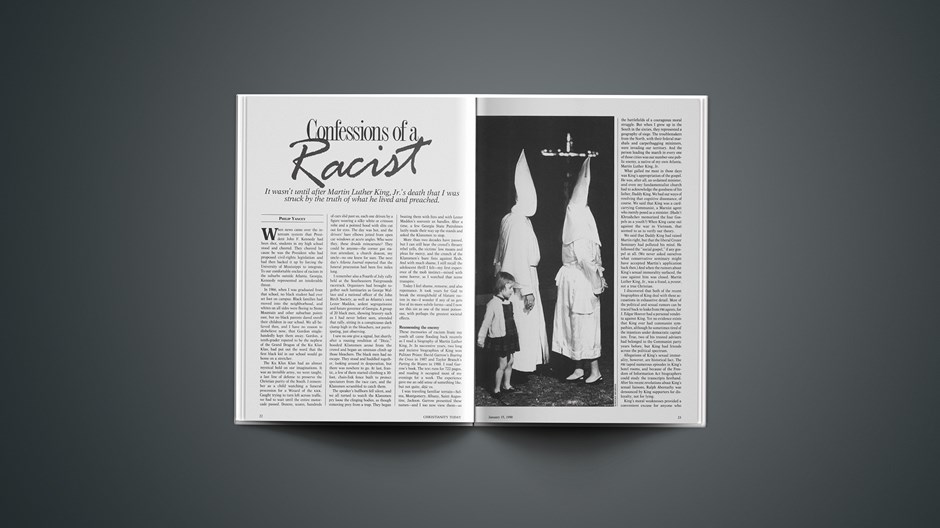
The Ku Klux Klan had an almost mystical hold on our imaginations. It was an invisible army, we were taught, a last line of defense to preserve the Christian purity of the South. I remember as a child watching a funeral procession for a Wizard of the KKK. Caught trying to turn left across traffic, we had to wait until the entire motorcade passed. Dozens, scores, hundreds of cars slid past us, each one driven by a figure wearing a silky white or crimson robe and a pointed hood with slits cut out for eyes. The day was hot, and the drivers’ bare elbows jutted from open car windows at acute angles. Who were they, these druids reincarnate? They could be anyone—the corner gas station attendant, a church deacon, my uncle—no one knew for sure. The next day’s Atlanta Journal reported that the funeral procession had been five miles long.
I remember also a Fourth of July rally held at the Southeastern Fairgrounds racetrack. Organizers had brought together such luminaries as George Wallace and a national officer of the John Birch Society, as well as Atlanta’s own Lester Maddox, ardent segregationist and future governor of Georgia. A group of 20 black men, showing bravery such as I had never before seen, attended that rally, sitting in a conspicuous dark clump high in the bleachers, not participating, just observing.
I saw no one give a signal, but shortly after a rousing rendition of “Dixie,” hooded Klansmen arose from the crowd and began an ominous climb up those bleachers. The black men had no escape. They stood and huddled together, looking around in desperation, but there was nowhere to go. At last, frantic, a few of them started climbing a 30-foot, chain-link fence built to protect spectators from the race cars, and the Klansmen scrambled to catch them.
The speaker’s bullhorn fell silent, and we all turned to watch the Klansmen pry loose the clinging bodies, as though removing prey from a trap. They began beating them with fists and with Lester Maddox’s souvenir ax handles. After a time, a few Georgia State Patrolmen lazily made their way up the stands and asked the Klansmen to stop.
More than two decades have passed, but I can still hear the crowd’s throaty rebel yells, the victims’ low moans and pleas for mercy, and the crunch of the Klansmen’s bare fists against flesh. And with much shame, I still recall the adolescent thrill I felt—my first experience of the mob instinct—mixed with some horror, as I watched that scene transpire.
Today I feel shame, remorse, and also repentance. It took years for God to break the stranglehold of blatant racism in me—I wonder if any of us gets free of its more subtle forms—and I now see this sin as one of the most poisonous, with perhaps the greatest societal effects.
Reassessing The Enemy
These memories of racism from my youth all came flooding back recently as I read a biography of Martin Luther King, Jr. In successive years, two long and incisive biographies of King won Pulitzer Prizes: David Garrow’s Bearing the Cross in 1987 and Taylor Branch’s Parting the Waters in 1988. I read Garrow’s book. The text runs for 722 pages, and reading it occupied most of my evenings for a week. The experience gave me an odd sense of something like, but not quite, déjà vu.
I was traveling familiar terrain—Selma, Montgomery, Albany, Saint Augustine, Jackson. Garrow presented these names—and I too now view them—as the battlefields of a courageous moral struggle. But when I grew up in the South in the sixties, they represented a geography of siege. The troublemakers from the North, with their federal marshals and carpetbagging ministers, were invading our territory. And the person leading the march in every one of those cities was our number-one public enemy, a native of my own Atlanta, Martin Luther King, Jr.
What galled me most in those days was King’s appropriation of the gospel. He was, after all, an ordained minister, and even my fundamentalist church had to acknowledge the goodness of his father, Daddy King. We had our ways of resolving that cognitive dissonance, of course. We said that King was a card-carrying Communist, a Marxist agent who merely posed as a minister. (Hadn’t Khrushchev memorized the four Gospels as a youth?) When King came out against the war in Vietnam, that seemed to us to verify our theory.
Article continues below
We said that Daddy King had raised Martin right, but that the liberal Crozer Seminary had polluted his mind. He followed the “social gospel,” if any gospel at all. (We never asked ourselves what conservative seminary might have accepted Martin’s application back then.) And when the rumors about King’s sexual immorality surfaced, the case against him was closed. Martin Luther King, Jr., was a fraud, a poseur, not a true Christian.
I discovered that both of the recent biographies of King deal with these accusations in exhaustive detail. Most of the political and sexual rumors can be traced back to leaks from FBI agents, for J. Edgar Hoover had a personal vendetta against King. Yet no evidence exists that King ever had communist sympathies, although he sometimes tired of the injustices under democratic capitalism. True, two of his trusted advisers had belonged to the Communist party years before, but King had friends across the political spectrum.
Allegations of King’s sexual immorality, however, are historical fact. The FBI taped numerous episodes in King’s hotel rooms, and because of the Freedom of Information Act biographers could study the transcripts firsthand. After his recent revelations about King’s sexual liaisons, Ralph Abernathy was denounced by King supporters for disloyalty, not for lying.
King’s moral weaknesses provided a convenient excuse for anyone who wanted to avoid his message. Because of those weaknesses, some Christians may still be tempted to discount the genuineness of his faith. I certainly once dismissed him. (These Christians might want to review the list of outstanding people of faith in Hebrews 11, a list that includes such moral deviants as Noah, Abraham, Samson, and David.) But now I can hardly read a page from King’s life, or a paragraph from his speeches, without sensing the centrality of his Christian conviction.
The Call
David Garrow builds his entire book around the scene of King’s supernatural “call,” which occurred early in his career. “It was the most important night of his life,” writes Garrow, “the one he always would think back to in future years when the pressures again seemed to be too great.”
Article continues below
King was thrust into civil-rights leadership in Montgomery, Alabama, after Rosa Parks had made her courageous decision not to move to the back of the bus. The community formed a new organization to lead a bus boycott and chose as a compromise candidate the new minister in town, King, who, at age 26, looked “more like a boy than a man.” Growing up in comfortable surroundings, with a kind of inherited religion, he hardly felt qualified to lead a great moral crusade.
As soon as King’s leadership of the movement was announced, the threats from the Klan began. And not only the Klan—within days King was arrested for driving 30 mph in a 25 mph zone and thrown in the Montgomery city jail. The following night King, shaken by his first jail experience, sat up in his kitchen wondering if he could take it anymore. Should he resign? It was around midnight. He felt agitated and full of fear. A few minutes before, the phone had rung. “Nigger, we are tired of you and your mess now. And if you aren’t out of this town in three days, we’re going to blow your brains out, and blow up your house.”
King sat staring at an untouched cup of coffee and tried to think of a way out. In the next room lay his wife, Coretta, already asleep, along with their newborn daughter, Yolanda. Here is how King remembers it:
And I sat at that table thinking about that little girl and thinking about the fact that she could be taken away from me any minute. And I started thinking about a dedicated, devoted and loyal wife, who was over there asleep.… And I got to the point that I couldn’t take it anymore. I was weak.…
And I discovered then that religion had to become real to me, and I had to know God for myself. And I bowed down over that cup of coffee. I never will forget it.… I prayed a prayer, and I prayed out loud that night. I said, “Lord, I’m down here trying to do what’s right. I think I’m right. I think the cause that we represent is right. But Lord, I must confess that I’m weak now. I’m faltering. I’m losing my courage.”
… And it seemed at that moment that I could hear an inner voice saying to me, “Martin Luther, stand up for righteousness. Stand up for justice. Stand up for truth. And lo I will be with you, even until the end of the world.” … I heard the voice of Jesus saying still to fight on. He promised never to leave me, never to leave me alone. No never alone. No never alone. He promised never to leave me, never to leave me alone.
Article continues below
Three nights later a bomb exploded on the front porch of King’s home, filling the house with smoke and broken glass but injuring no one. King took it calmly: “My religious experience a few nights before had given me the strength to face it.”
Garrow weaves his narrative around that “visitation” at the kitchen table. He comes back to it over and over again, for King came back to it at every critical moment in his life. For him it became the bedrock of personal faith, an anointing from God for a particular task.
As I read the account of King’s life, and his many references to that night, I was struck by the simplicity of the message he received: “I am with you.” The Jews in Haggai’s day—weak, demoralized refugees who hadn’t followed God’s orders for years—heard that same message (Hag. 1:13). So did Isaac, in the midst of a famine (Gen. 26:3); and the apostle Paul, who got a vision of comfort after harrowing experiences in Athens and Corinth (Acts 18:10). Those words express an underlying theme of the Bible: the Immanuel (“God with us”) presence of God. King reported no further visitations or visions over the next 13 years of his career. This one word was enough.
A Prophet’S Perspective
During my high school years in the Deep South, I attended two different churches. The first, a Baptist church with more than 1,000 members, took pride in its identity as a “Bible-loving church where the folks are friendly,” and in its support of 105 foreign missionaries, whose prayer cards were pinned to a wall-sized map of the world at the rear of the sanctuary. That church was one of the main watering holes for famous evangelical speakers. I learned the Bible there.
In the sixties the deacon board mobilized lookout squads, and on Sundays these took turns patrolling the entrances to keep out all black “troublemakers.” Lester Maddox himself sometimes attended there, approvingly. And when Congress passed the Civil Rights Act, that church founded a private school and kindergarten as a haven for whites, expressly barring all black students.
The next church I attended was smaller, more fundamentalist, and more overtly racist. There I learned the theological basis to racism. The pastor taught that the Hebrew word “Ham” meant “burnt black,” and that in his curse Noah consigned his son Ham to life as a lowly servant (Gen. 9). “That explains why black people make such good waiters and household servants,” my pastor would say from the pulpit. “Watch a black waiter move through a crowded restaurant, swiveling his hips, balancing a tray of food above his head. He’s good at that job because that’s the job God destined him for in the curse of Ham.” (No one bothered to point out that the curse was actually directed to Canaan, not Ham.)
Article continues below
That theology is still being taught today, in South Africa and in pockets of the American South. But far fewer people accept it now, and one of the main reasons, for me especially, is the prophetic role of Martin Luther King, Jr.
The word “prophet” is often applied to King, for, like those Old Testament figures, he endeavored to inspire change in an entire nation through moral appeal. The passion and intensity of the biblical prophets has long fascinated me. Most of them faced an audience every bit as stubborn, prejudiced, and cantankerous as I was during my teenage years. With what moral lever can one move a whole nation? I have concluded that virtually all the prophets followed a consistent two-pronged approach.
First, they gave a short-range view of what God requires immediately. This usually consisted of an exhortation to simple acts of faithfulness: Rebuild the temple. Purify your marriages. Destroy your idols.
But the prophets never stopped there. They also gave a long-range view to answer the people’s deepest questions: How can we believe that God loves us in the face of so much suffering? How can we believe in a just God when the world seems ruled by a sovereignty of evil? The prophets answered such questions by reminding their audience of who God is, and by painting a picture of a future kingdom of righteousness.
In good prophetic tradition, Martin Luther King, Jr., used that same two-pronged approach. For him, the short-range view called for one thing above all else: nonviolence. Two decades later, we may lose sight of how hard it was for King to maintain his nonviolent stance. The biographies make that clear. After you’ve been hit on the head with a policeman’s nightstick for the dozenth time, and received yet another jolt from a jailer’s cattle prod, you begin to question the effectiveness of meek submission. Many blacks abandoned King over this issue. Students especially, the heroes of the Freedom Rides, drifted toward “black power” rhetoric after their colleagues were murdered in Philadelphia, Mississippi.
Article continues below
As riots broke out in places like Los Angeles, Chicago, and Harlem, King traveled from city to city trying to cool tempers and reminding demonstrators that moral change is not accomplished through immoral means. He had learned that principle from the Sermon on the Mount and from Mahatma Gandhi, and almost all his speeches reiterated the message. “Christianity,” he said, “has always insisted that the cross we bear precedes the crown we wear. To be a Christian one must take up his cross, with all its difficulties and agonizing and tension-packed content, and carry it until that very cross leaves its mark upon us and redeems us to that more excellent way which comes only through suffering.”
Garrow tells of a tense encounter with Chicago’s tough mayor, Richard J. Daley. As was his style, King sat silent through most of the boisterous meeting. The King supporters were feeling betrayed. They thought they had reached an understanding with Daley permitting them to march through Chicago with police protection in exchange for calling off a boycott. But Daley had double-crossed them, obtaining a court order that banned further marches. The air was hostile, and it looked as if the meeting would break apart in bitterness. King finally spoke up, with what one onlooker described as a “grand and quiet and careful and calming eloquence.”
Let me say that if you are tired of demonstrations, I am tired of demonstrating. I am tired of the threat of death. I want to live. I don’t want to be a martyr. And there are moments when I doubt if I am going to make it through. I am tired of getting hit, tired of being beaten, tired of going to jail. But the important thing is not how tired I am; the important thing is to get rid of the conditions that lead us to march.
Now, gentlemen, you know we don’t have much. We don’t have much money. We don’t really have much education, and we don’t have political power. We have only our bodies and you are asking us to give up the one thing that we have when you say, “Don’t march.”
King’s speech changed the mood of the meeting and ultimately led to a new agreement with Mayor Daley.
Article continues below
Only Our Bodies
We have only our bodies, King said, and in the end that was what brought the civil-rights movement the victory it had been seeking so long. When I was in high school, the same students who cheered the news of Kennedy’s assassination also cheered King’s televised encounters with southern sheriffs, police dogs, and water hoses. Little did we know that by doing so we were playing directly into King’s strategy. He deliberately sought out individuals like Sheriff Bull Connor and stage-managed scenes of confrontation, accepting beatings, jailings, and other brutalities, because he believed a complacent nation would rally around his cause only when they saw the evil of racism manifest in its ugliest extreme.
By forcing evil out into the open, he was attempting to tap into a national reservoir of moral outrage—a concept my friends and I were not equipped to understand. Many historians point to one event as the single moment in which the movement attained at last a critical mass of support for the cause of civil rights. It occurred on a bridge outside Selma, Alabama, when Sheriff Jim Clark turned his policemen loose on unarmed black demonstrators.
The mounted troopers spurred their horses at a run into the crowd of marchers, flailing away with their nightsticks, cracking heads and driving bodies to the ground. As whites on the sidelines whooped and cheered, the troopers shot tear gas into the crowd. Most Americans got their first glimpse of the scene when ABC interrupted its Sunday movie, Judgment at Nuremberg, to show footage. What the viewers saw broadcast from Alabama bore a horrifying resemblance to what they were watching from Nazi Germany. Eight days later President Lyndon Johnson submitted the Voting Rights Act of 1965 to the U.S. Congress.
We have only our bodies, King said. Not once in his career did a Selma or a Jackson or an Albany or a Cicero respond by saying, “You know, Dr. King, you’re right. We are racists, and these discriminatory laws are unjust, unconstitutional, unbiblical, and just plain wrong. We’re sorry. We’ll repent and start over.” Not once. It took more than King’s prophetic words to break through the moral calluses of bigots like me. It took the bodies of the marchers in Selma and all the other places; it took King’s own body in Memphis.
Martin Luther King, Jr., did many things wrong, but one thing he did right. Against all odds, against all instincts of self-preservation, he stayed true to the short view. He did not strike back. Where others called for revenge, he called for love.
Article continues below
The civil-rights workers themselves, however, needed something more. They needed the long view. Already convinced of the justness of their cause, they wanted someone to interpret the long string of disheartening failures.
We now look back on the civil-rights movement as a steady tidal surge toward victory. But at the time, in the midst of daily confrontations with the power structure and under constant blackmail threats from the FBI, civil-rights leaders had no guarantee of victory. We forget how many nights those leaders spent in rank southern jails. Usually to them the present looked impossibly bleak, the future even bleaker.
To such demoralized troops, Martin Luther King, Jr., offered a vision of the world held in the hands of a just God. In 1961 he was performing the same role as had Old Testament prophets in 500 B.C.: He was raising the sights of God’s people to the permanent things. Already, at that early date, students were getting restless, and here is what King told those students:
There is something in this student movement which says to us, that we shall overcome. Before the victory is won some may have to get scarred up, but we shall overcome. Before the victory of brotherhood is achieved, some will maybe face physical death, but we shall overcome. Before the victory is won, some will lose jobs, some will be called communists, and reds, merely because they believe in brotherhood, some will be dismissed as dangerous rabblerousers and agitators merely because they’re standing up for what is right, but we shall overcome.… We shall overcome because there is something in this universe that justifies James Russell Lowell in saying, truth forever on the scaffold, wrong forever on the throne. Yet that scaffold sways the future, and behind the dim unknown, standeth God within the shadow, keeping watch above His own.
And later, when the famous march from Selma finally made it to the state capitol, the building that once served as the capitol of the Confederacy and from which the Rebel flag still flew, King addressed those scarred and weary marchers from the steps:
I know that you are asking today, “How long will it take?” I come to say to you this afternoon, however difficult the moment, however frustrating the hour, it will not be long, because truth pressed to earth will rise again.
Article continues below
How long? Not long, because no lie can live forever.
How long? Not long, because you still reap what you sow.
How long? Not long, because the arm of the moral universe is long but it bends toward justice.
How long? Not long, ’cause mine eyes have seen the glory of the coming of the Lord, trampling out the vintage where the grapes of wrath are stored. He has loosed the fateful lightning of his terrible swift sword. His truth is marching on.
He has sounded forth the trumpets that shall never call retreat. He is lifting up the hearts of man before His judgment seat. O, be swift, my soul, to answer him. Be jubilant, my feet. Our God is marching on.
For Martin Luther King, Jr., the long view meant remembering that no matter how things appear at any given moment, God reigns. In the end, only God himself truly knows the long view of history. We are simply asked to trust him, and to act faithfully on what he has revealed to us in the short view.
That is the pattern not only of the prophets, but of all history. In the Garden of Eden, God with his long view could foresee the drastic consequences of human disobedience: the devastation of creation, the loss of paradise, the plague of human evil. Adam and Eve had only the short view: a simple command not to eat the fruit.
A true prophet reminds us of both. The prophet calls us to daily acts of obedience and faithfulness, regardless of personal cost, regardless of whether we feel successful or rewarded. Build the temple, resist evil, encourage good, love your enemy, tear down walls of division, keep pure. And the prophet also reminds us that no failure, no suffering, no discouragement is too great for the God who stands within the shadows, keeping watch above his own. A prophet who can get across both those messages just may change the world.
While Martin Luther King, Jr., lived on earth, I, his neighbor to the east, did not listen to what he said. I was quick to pounce on his flaws, and slow to recognize my own blind sin. But because he stayed faithful, in the short view, by offering his body as a target but never as a weapon, and in the long view, by holding before us his dream, a dream of a new kingdom of peace and justice and love, he became a prophet for me, the most unlikely of followers.
The real goal, King used to say, was not to defeat the white man, but “to awaken a sense of shame within the oppressor and challenge his false sense of superiority.… The end is reconciliation; the end is redemption; the end is the creation of the beloved community.” And that is what Martin Luther King, Jr., finally set into motion, even in diehard racists like me.
Have something to add about this? See something we missed? Share your feedback here.
Our digital archives are a work in progress. Let us know if corrections need to be made.















 While we pray for peace, we need moral clarity about this war.
 As my doubts about his teachings grew, so did a secret fascination with Jesus.
 How groups like Hillsong learned to let go of the literal in favor of creative collaboration.españolPortuguês






