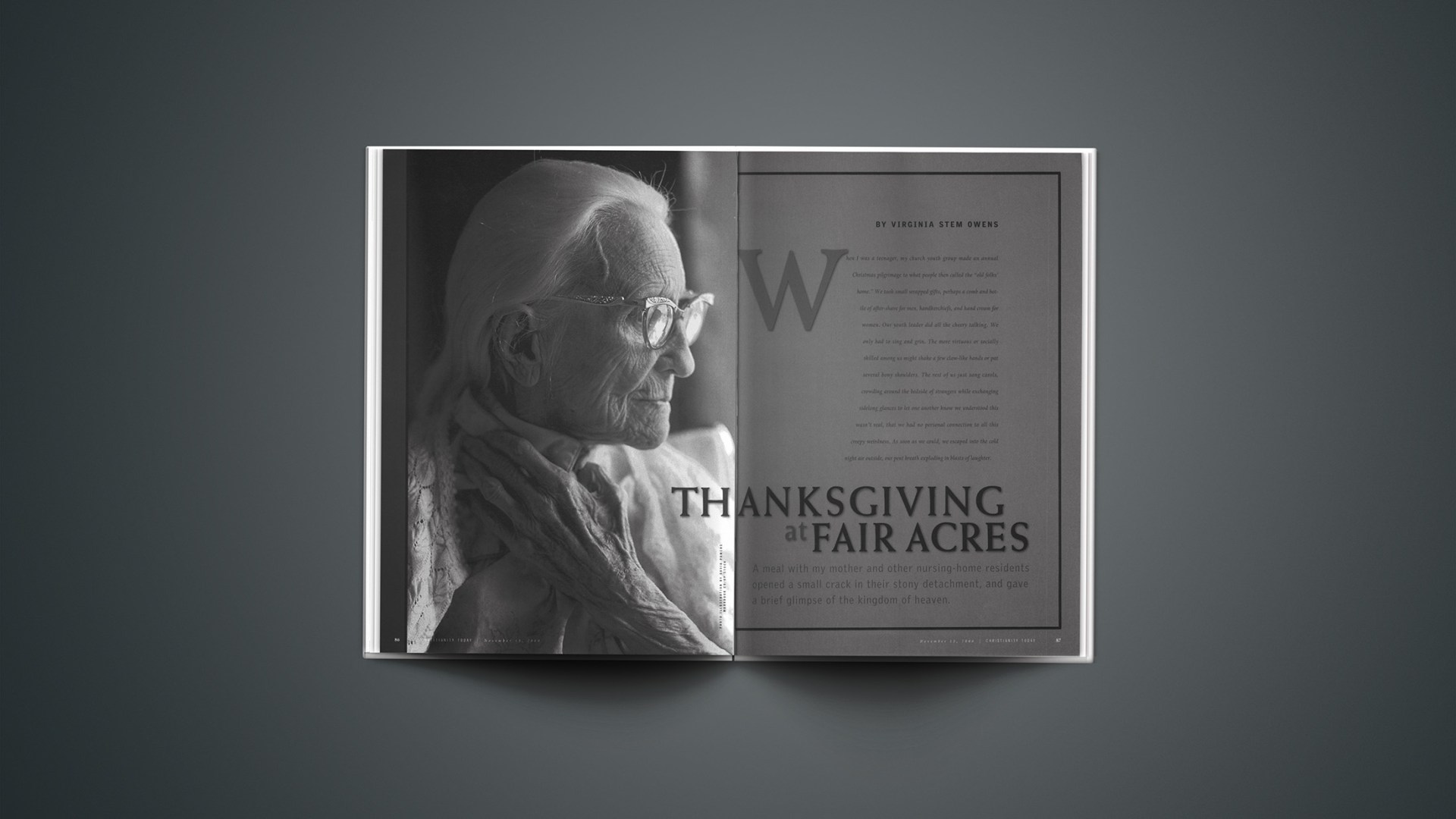

When I was a teenager, my church youth group made an annual Christmas pilgrimage to what people then called the “old folks’ home.” We took small wrapped gifts, perhaps a comb and bottle of after-shave for men, handkerchiefs, and hand cream for women. Our youth leader did all the cheery talking. We only had to sing and grin. The more virtuous or socially skilled among us might shake a few claw-like hands or pat several bony shoulders. The rest of us just sang carols, crowding around the bedside of strangers while exchanging sidelong glances to let one another know we understood this wasn’t real, that we had no personal connection to all this creepy weirdness. As soon as we could, we escaped into the cold night air outside, our pent breath exploding in blasts of laughter.
I was not one of the better people. I dreaded these nursing-home excursions, and not merely because of the sensory and metaphysical assaults aging flesh inflicts on the young. Even at 15, I knew that we were putting on an act, performing—in all the variations of that word’s meaning—our Christian duty.
For the most part, we had no idea who these deplorable figures were in their wheelchairs and sickbeds. We weren’t even curious. The season demanded charity the way it demanded colored lights, and we provided it—or at least its ceremony. We sang at the nursing homes to warm ourselves with the glow of our own virtue in the same way we Texans use angel hair and tinsel icicles to work up a fake nostalgia for snowy winter landscapes.
As an adult, I made a few visits to elderly relatives or friends in nursing homes, but my next significant exposure came in Wyoming 22 years later. We had just moved to a new town and, having a lot of free time on my hands, I decided to volunteer at a VA hospital two afternoons a week. By then I was old enough myself to be curious about old people. A number of important people in my life were nearing 80. I was beginning to face the fact that they might get seriously sick or even die someday. What would that be like?
From the patients, mostly veterans of World Wars I and II, I got an introductory course on amputation, lung cancer, and stroke. Wheeling patients to the radiology lab or physical therapy, I observed their gauze-wrapped stumps, nicotine-yellowed nails, colostomy bags. Most were men, and fitness had not been a concept, much less a priority, for them. They would sit on the side of their beds, wheezing with emphysema or struggling to drag a recognizable word from under the avalanche of a stroke-damaged brain. A few would talk, but most were sunk in the silence that comes either from illness or living alone too long.
When my circumstances changed and I was no longer able to volunteer at the hospital, I found I missed those afternoons pushing wheelchairs. They had introduced me to a world I now could see was not only real, but one with which I did indeed have some personal connection. Still, I was glad that none of my elderly relatives was living in such a place. To my knowledge, none ever had. Nor, I was certain, would my parents.
Stony, regal detachment
It’s ten days till Thanksgiving when I push open the double doors to Fair Acres Nursing Facility in Huntsville, Texas. And eight months to the day since we first brought my mother here. My father and I had spent a year and a half caring for her at home as her Parkinson’s disease, dementia, and osteoporosis had become too severe. And my father, dealing himself with declining health, could no longer take care of her.
The first couple of months I came through the dark mahogany doors of Fair Acres, inset with etched glass, I was disgusted by the irony of the foyer, masquerading as a sedate, upscale hotel. Muted light from brass lamps fell on a silk-flower arrangement atop the cherry-wood sideboard. But the Ethan Allen attempt at elegance disappeared as soon as you passed the portal to the hallway. The understated lighting gave way to fluorescent overhead panels, the carpet to vinyl tile with foldup yellow signs warning of wet floors. During those early days, I would sail past the nurses’ station, scanning to my right the be draggled but still ambulatory crew occupying the waterproof Queen Anne chairs in the common living room.
Though the furniture is arranged to form a circle (a vain attempt to foster fellowship), no one talks to anyone else. The only human voice comes from a portable radio belonging to a resident who keeps it tuned to Christian talk shows. To my left, a ring of wheelchairs circles the nurses’ station like beleaguered pioneer wagons. These are occupied by residents who generally require closer supervision—the rockers, the weepers, those who must be kept from falling out of their chairs by Lap Buddies, padded cushions the staff are careful never to call “restraints.” (Certain words, like patients, are forbidden here; everyone is a resident.) A few in that circle of wheelchairs simply prefer that location to the living room, probably because there’s more action at the nurses’ station. There phones ring, staffers banter or complain to one another, family members stop to make inquiries or requests.
Despite the action, however, the people parked around the nurses’ station, like their ambulatory counterparts in the living-room area, appear completely oblivious of one another. Their faces are as expressionless as the Easter Island monoliths. Several doze. One woman cries out monotonously, “Help me, help me.” The rest stare resolutely ahead in stony, almost regal, detachment.
Only when visitors cross the rotunda do they glance up at the alien outsiders bringing in their determined, facile cheer. Their look accuses: “Don’t think you’re doing us any favor. You’re not getting off the hook that easy.”
After the first few weeks of running this daily gantlet, I started speaking to some of the people I passed on the way to my mother’s room. By then I had scoped out the ones I thought might respond. At first, however, none returned my greeting. A few looked up with a dazed frown, as if I had startled them from deep reverie. One or two, after a second’s hesitation, gave me a single nod or at least met my gaze directly. I didn’t blame the ones who ignored me. They had every right to their withdrawal.
Two-thirds of nursing-home residents have no regular visitors. Some never have any. People who have been abandoned develop a thick coat of defensive frost.
I eventually struck up an acquaintance with a woman I passed every day. At first she only looked up when I spoke to her. Then a few days later, she nodded. By the end of the week, she was returning my greeting. Now, as soon as she sees me, a certain expectancy suffuses her face and she lifts her hands to catch mine between them.
“Those hands is too cold,” she tells me, shaking her head. “You need to warm up.”
Stella weighs 80 pounds at most. Her lips sink over her toothless gums and her chin juts sharply like a bowsprit. Her left leg has been amputated at the knee, and her right foot, usually shod in a red flat, is positioned neatly on the wheelchair’s single footrest. I have no idea how she lost the other leg. Maybe one day I’ll feel I can ask. Something prompts me to compliment her frequently on her appearance, some special care she takes to straighten her sleeve or smooth her skirt over her lap. On special occasions like today—the Family Thanksgiving Dinner—she wears a string of red beads.
Viola, who lives on Two Hundred Hall, refuge of the more independent residents, is not planning to attend the Family Thanksgiving Dinner. Not many residents from that wing will. They are the establishment’s upper crust, people who could conceivably function well at home but who, for one reason or another, have washed up on the shores of Fair Acres.
Most have physically debilitating diseases like severe diabetes or ms but remain in full control of their mental faculties. They form their own private club, playing cards in the activity room during the afternoon or visiting one another in their heavily decorated rooms.
Viola has lovely shoulder-length white hair, expertly waved in the manner of a 1940s movie star. Disabled by a bad heart, she, along with her cancer-riddled husband, moved to Fair Acres the day after they sold their home in a coastal city a hundred miles east of here. He died last week. She tells me about it, sitting in her wheelchair, parked in the doorway of her room, careful to assure me that she was fully prepared for the loss, welcomed it, in fact, “for his sake.”
She tells me my husband stopped to pray with her a few days ago. “He’s such a dear.” She makes a graceful, deprecating movement with her hand, brushing the front of her duster. “But really, I’m fine.” Her own husband’s empty bed, I notice, has already been filled with a new resident.
My husband has also made friends with Essie, another Two Hundred Hall resident, but one who, strangely enough, prefers to spend her days in the wagon train circling the nurses’ station. Essie’s son, she has confided to David, brought her to Huntsville after she’d had a stroke and installed her in Fair Acres. Now he never comes to see her. He apparently leaves that duty to his wife, a tall blonde who owns the health club where I swim.
Essie is a tall woman, or at least she would be if she could still stand. You can tell because her useless left leg, elevated on her wheelchair’s footrest to improve circulation, juts out into the traffic lane around the nurses’ station. Essie sleeps a good bit of the time, holding a washcloth to one side of her face to catch the saliva that flows from her stroke-slackened mouth. She was a schoolteacher in her former life, and her speech, slurred now as if she’d been on an all-night binge, retains its acerbic humor and no-nonsense flavor. She is already parked at a table when my father and I wheel my mother into the dining room. Her aerobic daughter-in-law sits at her side, looking slightly dazed.
Today is Family Thanksgiving Dinner at Fair Acres, though the holiday is more than a week away. In nursing-home time a week more or less does not make much difference. In any case, the abstractions of time are beyond my mother now, so I don’t tell her that next week my husband and I will be eating our “real” Thanksgiving dinner in Kansas with our daughters’ families.
She’s dressed in her newest dress and has smudges of blusher on her cheeks for the occasion. Unfortunately, though, the general air of excitement is already threatening to overwhelm her. Her eyes are darting about the room, her breath coming in short, shallow snatches.
Awkward table talk
The tables have been rearranged, end-to-end pilgrim-style, for the Thanksgiving feast, and my father and I take our places on both sides of my mother.
Across from us sit Norman, the owner of the Christian music boom box, and James, a black man in a Mister Rogers cardigan who moves with glacial stateliness to compensate for his halting, stroke-damaged gait. They maintain their usual distant reserve.
“May we join you?” I ask, making my voice bright with what I hope they will see as holiday cheer. James inclines his head in a courtly manner. Norman says, “Sure,” and blinks several times in what appears to be welcome.
“Isn’t this nice,” I say enthusiastically, gesturing toward the centerpieces—baskets of orange, yellow, and red silk leaves, accented with stalks of dried grass and little plastic ears of corn. James nods; Norman says, “Yes, nice.” My father grins encouragingly.
I take my mother’s hand and, turning my overbright social tone down a notch, point out the centerpieces to her. She points instead to a large basket of rolls, slowly growing cold on the table. I butter one and give it to her.
Meanwhile, an aide is maneuvering the wheelchair of a woman with a rust-colored perm and a silk blouse into position across from my father. Her head shakes like Katharine Hepburn’s, and in one hand she clutches a washcloth with which she continually dabs at her mouth. The washcloth, I see, is to mop up saliva pushed toward the front of her mouth by her tongue that squirms compulsively, like some small burrowing animal.
I introduce our little party. Beaming, my father half rises and extends his hand across the table. The woman shakes it loosely and tells us her name, which, after several repetitions, I finally make out to be Mary. My mother nods shyly at the woman. I search for a conversational gambit that might spin some fine thread of connection, some link of sympathy between us across the table. I feel like an old-fashioned telephone operator, plugging an array of lines into a decrepit switchboard.
Mary struggles to respond with appropriate chitchat, drawing from her own store of social pleasantries. Over the kitchen clatter, I shout inanities across the table at Norman and James alternately. “Smell that? Mmm, turkey!” “What kind of pie are you going to have? Pumpkin or pecan?” “Want a roll to tide you over?”
Amid great bustle, the food is brought from the kitchen and laid out, buffet-style. By the time the director quiets everyone to say grace, my mother is listing acutely leftward like a rag doll in her chair. I make a break for the buffet table to fill a plate for her, James and Norman close behind me.
I load a plate with turkey, dressing, gravy, sweet potatoes, fruit salad, cranberry sauce—the dishes I know my mother has always liked. After cutting the turkey into bite-sized bits, I name the plate’s contents, coaxing her appetite. “Take a bite of the dressing, Mother, you’ll like it.” She ignores me, making her way slowly but steadily through the turkey.
“Would you like another roll? I’ll butter it for you.”
She shakes her head and, after finishing the turkey, puts down her fork, leaving the rest of the meal untouched. The noise, I know, distracts her, the sounds a jumble she can’t sort into meaning.
“Dessert?” I urge. “I think there’s pumpkin pie. Or would you like cobbler?” She doesn’t answer, but I get her a small piece of pumpkin pie. She ignores it, her panting turning suddenly panicky.
Through the cracks
Telling my father to finish at his own pace, I wheel my mother back to her room. We’re both relieved by the quiet that settles around us there. I press the call button for the aides to come and lift her into bed, then I sit beside her, holding her hand until she drops into a fitful sleep.
“It went well, don’t you think?” I whisper to my father when he tiptoes into my mother’s room.
I’m feeling that sappy self-satisfaction of a hostess who has just pulled off a successful dinner party. I’m even more pleased the next day when James for the first time returns my wave from his post on the Queen Anne loveseat, lifting his index finger and smiling tentatively, as if taking a social risk.
I regret, of course, that my mother was confused and isolated at the Thanksgiving table. I have to fight back the guilt that arises from enjoying anything she can’t. And even when I sidestep the guilt, my grief for her threatens to engulf even my pleasure at everyone else’s enjoyment. But the truth is, I did feel happy. And I don’t think it came entirely from the smug satisfaction of knowing James and Norman had gotten a sliver of conversation along with their turkey and pumpkin pie. Or that Mary, probably a social powerhouse in her day, got to wow us once more with her classy blouse and nails.
“Pleased to meet you,” people say in Texas when they’re introduced. And I was glad, finally, to have met them all. I hope they were pleased as well. My own pleasure came from their having let me in through a crack in their carefully constructed indifference.
Through that crack I have caught a glimpse of the other side of the wall, the one I had fled in my teenage fear and carelessness, the side of the wall where I will live someday.
“How did the nursing home dinner go?” my daughter asked me the following week as we were recovering from the “real” Thanksgiving feast.
“You know that parable in Luke where the master sends his servant out to the highways and hedges to bring in the maimed, the halt, and the blind after the people he’d invited to the banquet don’t show up?”
“Mmm … I think so.”
“Well, that’s how it was. And I got to come too.”
Virginia Stem Owens is the author of Daughters of Eve (NavPress) and Looking for Jesus (Westminster—John Knox). She lives in Huntsville, Texas.
Copyright © 2000 Christianity Today. Click for reprint information.