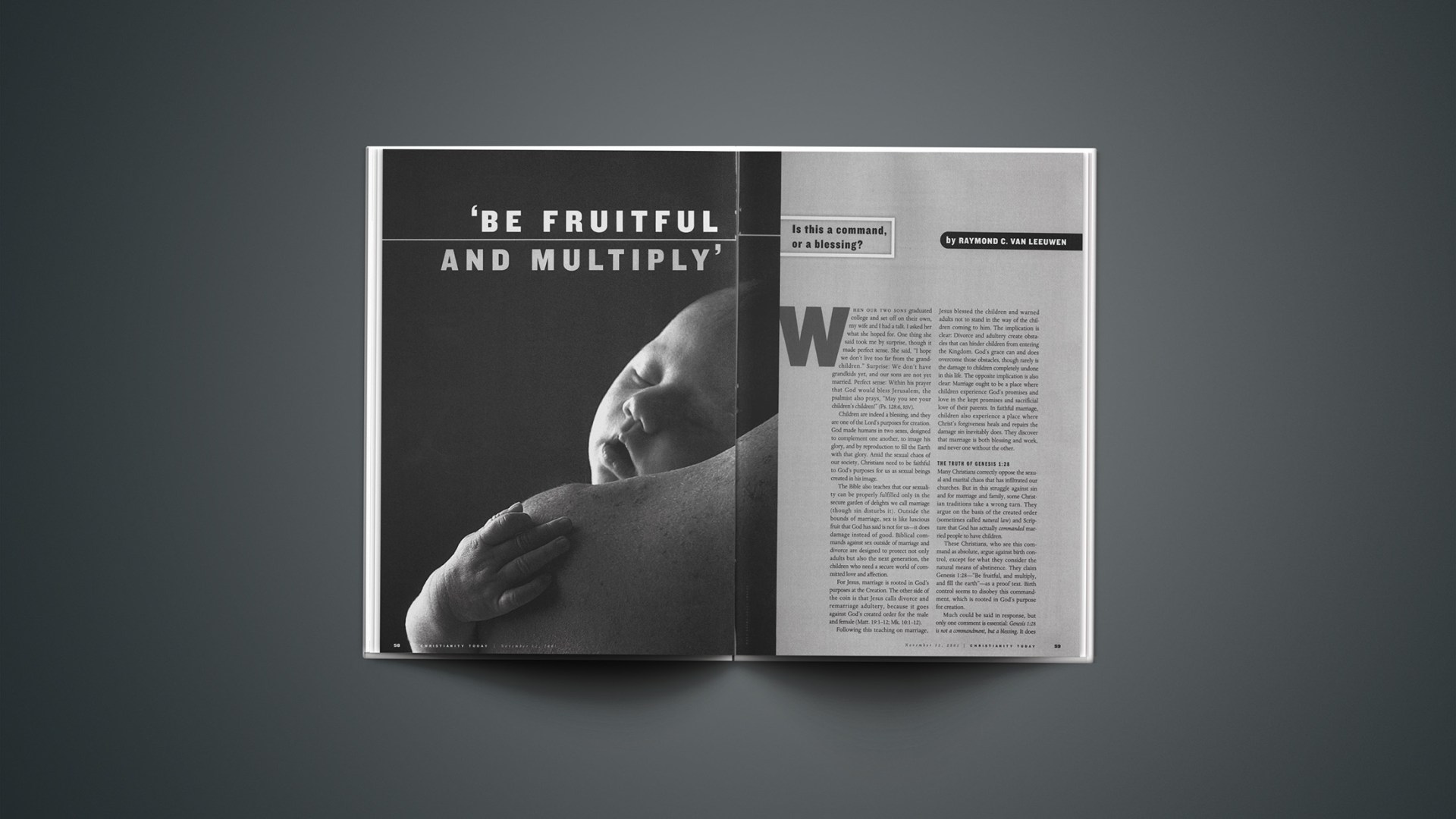

Children are indeed a blessing, and they are one of the Lord’s purposes for creation. God made humans in two sexes, designed to complement one another, to image his glory, and by reproduction to fill the Earth with that glory. Amid the sexual chaos of our society, Christians need to be faithful to God’s purposes for us as sexual beings created in his image.
The Bible also teaches that our sexuality can be properly fulfilled only in the secure garden of delights we call marriage (though sin disturbs it). Outside the bounds of marriage, sex is like luscious fruit that God has said is not for us—it does damage instead of good. Biblical commands against sex outside of marriage and divorce are designed to protect not only adults but also the next generation, the children who need a secure world of committed love and affection.
For Jesus, marriage is rooted in God’s purposes at the Creation. The other side of the coin is that Jesus calls divorce and remarriage adultery, because it goes against God’s created order for the male and female (Matt. 19:1-12; Mk. 10:1-12).
Following this teaching on marriage, Jesus blessed the children and warned adults not to stand in the way of the children coming to him. The implication is clear: Divorce and adultery create obstacles that can hinder children from entering the Kingdom. God’s grace can and does overcome those obstacles, though rarely is the damage to children completely undone in this life. The opposite implication is also clear: Marriage ought to be a place where children experience God’s promises and love in the kept promises and sacrificial love of their parents. In faithful marriage, children also experience a place where Christ’s forgiveness heals and repairs the damage sin inevitably does. They discover that marriage is both blessing and work, and never one without the other.
The Truth of Genesis 1:28
Many Christians correctly oppose the sexual and marital chaos that has infiltrated our churches. But in this struggle against sin and for marriage and family, some Christian traditions take a wrong turn. They argue on the basis of the created order (sometimes called natural law) and Scripture that God has actually commanded married people to have children.These Christians, who see this command as absolute, argue against birth control, except for what they consider the natural means of abstinence. They claim Genesis 1:28—”Be fruitful, and multiply, and fill the earth”—as a proof text. Birth control seems to disobey this commandment, which is rooted in God’s purpose for creation.
Much could be said in response, but only one comment is essential: Genesis 1:28 is not a commandment, but a blessing. It does not refer to what humans must do to please God, but to what God does for and through humankind. The text says, “God blessed them, and God said to them, ‘Be fruitful and multiply'” (RSV). Fertility is not a command but a blessing that God gives to his creatures, to animals as well as humans (Gen. 1:22). The filling of the Earth is a gift of God’s wisdom and shows forth his glory as Creator (Ps. 104:24, 31; Isa. 6:3).
In English it is easy to confuse blessing and command, because the blessing of Genesis 1:28 sounds like a command. This verse and its context is often called the cultural mandate. Instead, we should call it the cultural blessing. A look at Genesis 24:60 shows why. There, Rebekah’s family is about to send her off to marry Isaac: “And they blessed Rebekah, and said to her, ‘Our sister, be the mother of thousands of ten thousands; and may your descendants possess the gate of those who hate them!'” (RSV).
Here again, the first part of the blessing (“be the mother”) sounds like a command in English. But it is not. The human blessing appeals to God to make Rebekah and her descendants fruitful. In the next generation, when this blessing does not come for Rachel, Jacob angrily responds to her complaint, saying, “Am I in the place of God?” (Gen. 30:2, RSV).
The Hebrew grammar of blessing in Genesis 24:60 is identical to that in Genesis 1:28. But in English, the blessing comes through more clearly in the second clause of Genesis 24:60: “may your descendants possess” (RSV). In Genesis 1:28, of course, it is God who declares the blessing and fulfills it himself. So it would be inappropriate for the English translation to read, “May you be fruitful.”
What is the upshot of all this? God does not command humans to be fruitful. Rather, he himself will bless his creatures and see to it that they are fruitful. He has provided for this by making us male and female, by investing our humanness with sexual desire and love, and by ordaining marriage as the place for, among other things, joyful lovemaking. Marriage is also the God-given matrix from which family naturally springs, the place where children may be born and reared with love and wisdom, “in the fear of the Lord.” The biblical blessings show that marriage is the natural and safe place for humans to be open to, and even eager for, God’s gift of children.
We must beware of confusing matters. God gave this blessing to the human race as a whole. He does not give it to everyone. Some couples are barren, and their earnest prayers for children are not fulfilled. Others, like the apostle Paul, are called to life without marriage.
If Genesis 1:28 were a “command” that applied to every individual, then Paul would have been disobedient in his apostolic singleness. Paul and everyone else would be obligated to pursue marriage and to order their marriages to produce many descendants.
Usurping God’s Sovereignty?
Marriage exists for God’s glory, not just for the gratification of individuals. Thus marriage is a place where sex should be open to the awesome gift of children—without fear. Outside of the committed love of marriage, the words I’m pregnant have frightening implications. Within marriage, those words bring joy and gratitude to God, even if the birth was not “planned,” even if the rearing of a child may be difficult.But does the openness of marriage to children mean that birth control is forbidden? Some have argued that contraception “usurps God’s sovereignty.” It is true that God is sovereign in blessing couples with children (Ps. 127 and 128). But do we disobey God’s sovereignty or reject his providence by spacing the children we bear or by limiting their number?
And what of a couple who decide to have no children at all—though they would welcome a child that God in his wisdom might send them in spite of their precautions? Do they disobey a sovereign God? Some couples give up the good of having kids because of health problems. Others may believe they have a special calling together (say, missions in a dangerous land) that leads them to forgo the blessing and the task of parenting.
Such decisions should be rare exceptions, not undertaken lightly or for reasons of self-indulgence. They should say No to God’s blessing of children only for the sake of greater good or need.
But they do not usurp God’s providence or sovereignty. If God can use even evil to accomplish good (Gen. 45:5-8), surely he can use human actions that seek to serve God with the freedom he has given us. God’s sovereignty works in and through human actions, and, if necessary, in spite of them.
To suggest that birth control is evil or perverse because it undermines God’s sovereignty is to underestimate God’s sovereignty and reject our responsibility to serve him wisely. Of course human choices ought to be made in the realm of freedom set within the limits of God’s law. But where there is no law, our choices are free (Gal. 5)—provided they are wise and serve God.
To be sure, God then holds us responsible for our freedom. Within the limits of marriage, sex is one of the good gifts of God’s creation, to be used for love and glory, whether or not it seeks in every instance to be fruitful in a procreative sense. Within the boundaries God has set for sex, there is much room for responsible Christian freedom, for what God has made is very good indeed.
Raymond C. Van Leeuwen is professor of biblical studies at Eastern College in St. Davids, Pennsylvania.
Copyright © 2001 Christianity Today. Click for reprint information.
Related Elsewhere:
Also appearing on our site today, Sam and Bethany Torode argue that it is time for Christians to embrace childbearing as a joy and a gift.
In an October 1999 article, World magazine editor Joel Belz argued that God controls world population numbers while noting that the morality of contraception is not seriously debated among evangelical Christians.
Raymond C. Van Leeuwen recently wrote “We Really Do Need Another Bible Translation” for Christianity Today.