


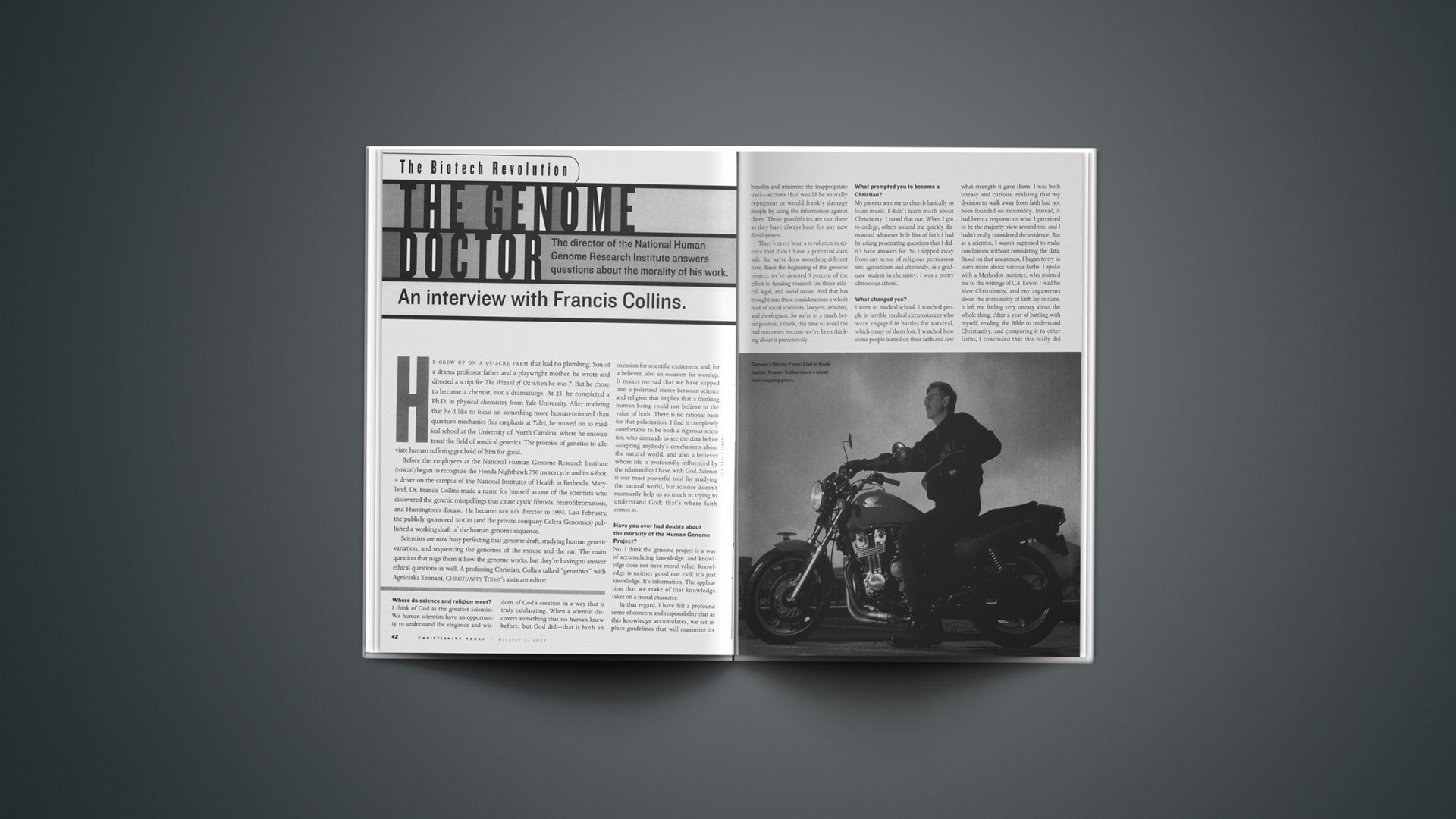

He grew up on a 95-acre farm that had no plumbing. Son of a drama professor father and a playwright mother, he wrote and directed a script for The Wizard of Oz when he was 7. But he chose to become a chemist, not a dramaturge. At 23, he completed a Ph.D. in physical chemistry from Yale University. After realizing that he'd like to focus on something more human-oriented than quantum mechanics (his emphasis at Yale), he moved on to medical school at the University of North Carolina, where he encountered the field of medical genetics. The promise of genetics to alleviate human suffering got hold of him for good.
Before the employees at the National Human Genome Research Institute (NHGRI) began to recognize the Honda Nighthawk 750 motorcycle and its 6-foot-4 driver on the campus of the National Institutes of Health in Bethesda, Maryland, Dr. Francis Collins made a name for himself as one of the scientists who discovered the genetic misspellings that cause cystic fibrosis, neurofibromatosis, and Huntington's disease. He became NHGRI's director in 1993. Last February, the publicly sponsored NHGRI (and the private company Celera Genomics) published a working draft of the human genome sequence.
Scientists are now busy perfecting that genome draft, studying human genetic variation, and sequencing the genomes of the mouse and the rat. The main question that nags them is how the genome works, but they're having to answer ethical questions as well. A professing Christian, Collins talked "genethics" with Agnieszka Tennant, Christianity Today's assistant editor.
Where do science and religion meet?
I think of God as the greatest scientist. We human scientists have an opportunity to understand the elegance and wisdom of God's creation in a way that is truly exhilarating. When a scientist discovers something that no human knew before, but God did—that is both an occasion for scientific excitement and, for a believer, also an occasion for worship. It makes me sad that we have slipped into a polarized stance between science and religion that implies that a thinking human being could not believe in the value of both. There is no rational basis for that polarization. I find it completely comfortable to be both a rigorous scientist, who demands to see the data before accepting anybody's conclusions about the natural world, and also a believer whose life is profoundly influenced by the relationship I have with God. Science is our most powerful tool for studying the natural world, but science doesn't necessarily help us so much in trying to understand God; that's where faith comes in.
Have you ever had doubts about the morality of the Human Genome Project?
No. I think the genome project is a way of accumulating knowledge, and knowledge does not have moral value. Knowledge is neither good nor evil; it's just knowledge. It's information. The application that we make of that knowledge takes on a moral character.
In that regard, I have felt a profound sense of concern and responsibility that as this knowledge accumulates, we set in place guidelines that will maximize its benefits and minimize the inappropriate uses—actions that would be morally repugnant or would frankly damage people by using the information against them. Those possibilities are out there as they have always been for any new development.
There's never been a revolution in science that didn't have a potential dark side. But we've done something different here. Since the beginning of the genome project, we've devoted 5 percent of the effort to funding research on those ethical, legal, and social issues. And that has brought into these considerations a whole host of social scientists, lawyers, ethicists, and theologians. So we're in a much better position, I think, this time to avoid the bad outcomes because we've been thinking about it preventively.
What prompted you to become a Christian?
My parents sent me to church basically to learn music. I didn't learn much about Christianity. I tuned that out. When I got to college, others around me quickly dismantled whatever little bits of faith I had by asking penetrating questions that I didn't have answers for. So I slipped away from any sense of religious persuasion into agnosticism and ultimately, as a graduate student in chemistry, I was a pretty obnoxious atheist.
What changed you?
I went to medical school. I watched people in terrible medical circumstances who were engaged in battles for survival, which many of them lost. I watched how some people leaned on their faith and saw what strength it gave them. I was both uneasy and curious, realizing that my decision to walk away from faith had not been founded on rationality. Instead, it had been a response to what I perceived to be the majority view around me, and I hadn't really considered the evidence. But as a scientist, I wasn't supposed to make conclusions without considering the data. Based on that uneasiness, I began to try to learn more about various faiths. I spoke with a Methodist minister, who pointed me to the writings of C.S. Lewis. I read his Mere Christianity, and my arguments about the irrationality of faith lay in ruins. It left me feeling very uneasy about the whole thing. After a year of battling with myself, reading the Bible to understand Christianity, and comparing it to other faiths, I concluded that this really did make a lot of sense. I developed a very strong sense of wanting to give my life to Christ and that set of principles. I did so at the age of 27.
Was your love for God written in your genes?
No. I reject the notion that spirituality is something that will be explained by the study of the genome. The study of the genome will tell us a lot about our biological nature, about the parts of us that are mechanical, but I don't believe it will tell us why almost every human being has a sense of longing for God. I don't believe studying DNA will tell us where the sense of right and wrong we share comes from. I don't believe it will explain why we have this shared urge to do the right thing, even to the extent of putting our own lives in danger to save another, which would be exactly the opposite of what evolution would suggest we should do. All those aspects of humanity are some of the best evidence that there is more to us than chemicals and DNA, that there is a spiritual part to our nature.
Do you believe in evolution?
I think evolution is a very compelling explanation for the relatedness of living things on this planet. You can't study DNA without noting the relatedness of the sequences between us and other animals, bacteria, and plants. But I don't have any problem with putting that together with my belief in God as the Creator of life and in God as one who desires fellowship with humankind. If God decided to use the mechanism of evolution to create human beings, who are we to say that was a bad way to do it? In that regard, I would be called a theistic evolutionist, as are many people who work in biology and who also believe in God.
You once said that the potential benefits of genome research are so promising that "the unethical thing would be to slow it down." Pragmatically speaking, what is the promise of the genome project?
I'm a physician, and my interest in the genome project will always be because of its medical promise. Genetics will tell us about the pathways that go awry in diabetes, in heart disease, in mental illness, in cancer, in asthma. I could go on for hours listing the conditions that could benefit from this research because they all have at least some hereditary contribution. Uncovering those hereditary factors will allow us to make predictions about who's at risk for what, and hence to practice better prevention. Even more dramatic will be the development of new therapies targeted at the primary problems instead of some downstream effects.
What are the latest and most important discoveries of genome research?
We encountered a host of surprises when we had the chance to read through this "instruction book" for the first time. One that got great attention was how few genes it turns out that we have. It's wondrous that our genes are able to direct all the things that they do, with only 31,000 or so of them to do so. Everybody had expected that number would be more like 100,000, so that was a stunner. But we found that, on average, each human gene seems to make about three different proteins, which may explain how we get by with such a small number of them. Human genes are very cleverly constructed in comparison to their counterparts in worms or flies. Our genes seem to have more punch, more complexity packed into each gene, than simpler organisms do.
How do you respond to Christians who equate genetic engineering with playing God?
I love to engage such folks in a dialogue. "Playing God" is a term that people throw around without necessarily defining what they're speaking of. If humans played God with the same benevolence that God did, then perhaps we wouldn't worry about it. But of course that's not usually the case. We need to first define what we mean by "playing God." I'd refer your readers to Ted Peters's wonderful book by that name, which outlines areas we should be concerned about and other areas that we should be celebrating and pressing forward as rapidly as we can.
What type of genetic engineering might end up trampling on human dignity?
The notion that we could eventually take charge of our own evolutionary state and improve ourselves is a chilling one for most people, and especially, I think, for people of faith. The idea is that we would re-engineer the human race by deciding which features we would like to improve upon, such as making ourselves smarter and stronger. But who's going to decide what's an improvement? I think any kind of activity where we systematically change our very nature jeopardizes our relationship with God, who I believe was intent on creating humankind in our current state.
Where's the fine line between genetic determinism and the legitimate gene therapy that leads to cures and alleviation of human suffering?
I don't know that those two things are in conflict. Projects to develop gene therapy and gene-based drug therapy are highly moral, ethical activities that we should all support. Gene therapy, which does not affect the germline (it's not passed on), fits in with the tradition of alleviating human suffering that has been a primary tenet of all religions and particularly Christianity. It would be the most unethical stance, I think, to say that we shouldn't be pursuing it because it involves genes. If we can do gene therapy safely and ethically, and if we can cure terrible diseases that afflict children and adults, we are almost obligated to do that.
Genetic determinism is a separate, more conceptual issue. In our enthusiasm to use the tools of genetics to uncover answers to long-sought medical mysteries, we may mislead the public—and sometimes even ourselves—into concluding that we are nothing more than machines whose activities are programmed by our DNA sequence. We, as scientists, have to continually remind ourselves and the public that when you get beyond medical applications of genetics into the nature of what it means to be human, DNA isn't going to tell us everything. Free will is a very important part of who we are, and the study of the genome is not going to make that obsolete.
Some insurance companies, employers, schools, and courts have already begun discriminating against people because of their genes. How do we protect ourselves from it?
The Burlington Northern and Santa Fe Railroad recently tested many of its employees, without their knowledge, for a rare genetic condition that might cause carpal tunnel syndrome. The company tried to avoid responsibility for its employees' workplace injuries. The railroad hoped to blame the problem on their workers' genes, figure out how not to cover their medical expenses, and potentially even to fire them. This profound violation of genetic justice has led to a storm of concern, and I hope it will lead to a solution—in this instance, the passage of federal legislation that outlaws the use of genetic information in the workplace and in health insurance. Our DNA is passed to us from our parents without anybody asking our permission, and it is unjust to have the information used in discriminatory ways.
Should genome information be patented, or shared with everyone for free?
This is a very difficult and controversial issue. Some people approach gene patenting from a moral perspective and others from a legal perspective. I think we ought to ask ourselves whether a particular patent is likely to generate public benefit or not. If not, we shouldn't allow it. If yes, then we ought to strongly consider patenting. That position bothers some people because the very notion of patenting a gene that we all have seems to allow somebody to claim ownership over a creation they didn't have much to do with. But in reality, when you file a patent on a human gene, it is not the gene in its natural state. It is a re-engineered, recombinant DNA version of the gene that nobody has in their body. It's also not true that having a patent on something means you own it. It means that you have certain legal rights to the commercialization of that discovery. There are clear instances when patenting a gene has led to the development of a product that has greatly benefited the public.
Could you give an example?
If I had a heart attack and I rolled into the emergency room with chest pain, I would be given a blood clot-dissolving drug called TPA. TPA was produced by Genentech using recombinant DNA. It cost the company half a billion dollars to bring that drug to market. Genentech representatives would tell you that if they hadn't had a patent on the TPA gene, the investment would not have been worthwhile because some competitor would have taken their market away after they had done all this work. I think we're all glad that TPA exists. It has saved a lot of lives. And the patent seems to have been necessary for that outcome. So when we have a clear pathway from the gene to a product that the public needs, then a patent makes sense.
I have much more trouble, though, with patenting genes whose function is unknown or highly uncertain. That can lead to people claiming large territories of the genome, hoping that sooner or later somebody else will figure out what those genes do, and then a license will have to be granted and payments will have to be made. That could be exactly the wrong thing to do for the public benefit. The position of the National Institutes of Health, with which I agree, is that we should set the utility standard very high before allowing a patent on a gene. Unfortunately, the bar has not been set as high as we would like.
You're not a fan of germline therapy that would allow altering of genes in sperm or eggs in order to prevent passing on of diseases or disabilities to future generations. What's wrong with it?
At the moment, it's not safe. The only way we might currently try it would be likely to change not only the misspelling in the DNA that you want to fix, but also some other places in the genome would also get a little bit scrambled. The notion of altering DNA that's going to get passed to future generations, and is of uncertain consequence, does not measure up to most people's standards of ethical acceptability. It certainly doesn't measure up to mine.
Are safety issues also the problem that you have with cloning?
I have two problems with cloning. The most apparent one is the safety concern. There will be carnage of unimaginable consequence if we attempt to clone human beings right now. Everything we know about every animal species for which cloning has been attempted indicates that only a tiny percentage give rise to live births that survive for more than a few days. Most of them result in miscarriages, birth defects, and newborn deaths of uncertain cause. Puzzling and troubling outcomes occur when you try to convince DNA from a differentiated cell that it's actually an embryo again. It is unacceptable, given all of that data, to contemplate the cloning of a human being at the present time.
You once described yourself as "intensely conflicted" in regard to stem-cell research. What's the cause of this conflictedness?
But of course, even if the safety issues were solved, would human reproductive cloning be an acceptable practice? It wouldn't be for me. I believe that human beings have come into this world by having a mother and a father. To undertake a different pathway of creating a human being is a profound departure from the normal state of things. I have yet to hear a compelling argument for why we need to do that.
It is a classic example of a collision between two very important principles. One is the sanctity of human life and the other is our strong mandate as human beings to alleviate suffering and to treat terrible diseases like diabetes, Parkinson's, and spinal-cord injury. The very promising embryonic stem-cell research might potentially provide remarkable cures for those disorders. We don't know that, but it might. And at the same time, many people feel, I think justifiably, this type of research is taking liberties with the notion of the sanctity of human life, by manipulating cells derived from a human embryo.
Are there any other scientific decisions that trouble you because of their ethical implications?
We should all be concerned about the possible need to define boundaries on genetic testing. In some instances, it is enormously beneficial that we have tests available to predict future illness.
If someone in your family has colon cancer, you may be able to find out whether you're at risk or not. If you are at risk, you can take steps to save your life. But is that the kind of testing that ought to be carried out prenatally? Is it appropriate to test prenatally for things that are adult-onset disorders for which an effective intervention exists? Is it appropriate to begin to test for things that are really more traits than diseases? I am very concerned about those things.
Copyright © 2001 Christianity Today. Click for reprint information.
Related Elsewhere
Additional "Biotech Revolution" articles on our site include:
A Matter of Life and Death | Why shouldn't we use our embryos and genes to make our lives better? The world awaits a Christian answer. (Sept. 28, 2001)
Wanna Buy a Bioethicist? (Editorial) | Some corporations have discovered that bioethics makes good public relations. (Sept. 28, 2001)
The National Human Genome Research Insititute site includes information on the institute and the office of the director Francis S. Collins along with a bio of Collins and selected publications.
Scientific American has a profile of Collins and his desire to "keep his Christianity from interfering with his science and politics." Phillip E. Johnson criticized the article as an example of how "intellectual elites in secular democracies use biased language … to marginalize religious thinking and ensure that the world will be run on agnostic principles."
PBS NewsHour has extended excerpts of an interview with Francis Collins on "Breaking the Code."
Wired examined the internal battle between Collins the scientist and Collins the believer.
In a BBC profile, Collins said, "It's interesting when you read the life of Christ how much of his time he spent healing the sick."
Religion enhances Collins' appreciation for science, according to Beliefnet.
The Standard interviewed Collins on what makes the Human Genome Project so different.
In a PBS interview, Collins said that it is "critical that we have a meaningful dialogue between people of faith and people involved in science."
Wheaton College held a Human Genome debate on Thursday, September 16 but Collins was unable to attend due to Hurricane Floyd. Instead, he faxed his remarks to be read at the conference. He gave University of Virginia's commencement address last spring.
Do No Harm, the Coalition of Americans for Research Ethics, is a national coalition of researchers, bioethicists, and others dedicated to the promotion of scientific research and health care which does no harm to human life.
The Center for Bioethics and Human Dignity helps individuals and organizations address the pressing bioethical challenges of our day and recently looked at the ethics of bioethics.
The U.S. National Bioethics Advisory Commission site offers reports and basic information.
Denise K. Casey, a science writer, editor, and educator with the DOE Human Genome Program Human Genome Management Information System wrote "Genes, Dreams, and Reality: The promises and risks of the new genetics."
For explanations on how cloning is accomplished, see Conceiving a Clone, Science Matters, and How Cloning Works.
For news articles and opinion pieces on the cloning debate, see Yahoo's Full Coverage.
A 1998 Christianity Today editorial called for more "Christians on the frontlines of research—like Francis Collins, who directs the Human Genome Project—and we need thoughtful, informed critiques, not apocalyptic rants."
In 1997, Christianity Today's sister publication Christian Reader took a "High Dive into the Gene Pool."
Christianity Today's Books & Culture Corner last year warned that "we should feel wary—not of 'mad scientists,' though there are such, but of the dark side of 'normal science.'"
Previous Christianity Today coverage of bioethics includes:
Two Cheers | President Bush's stem-cell decision is better than the fatal cure many sought. (August 10, 2001)
House Backs Human Cloning Ban | Scientists say they'll go ahead anyway. (August 27, 2001)
Embryos Split Prolifers | Bush decision pleases some, keeps door open for disputed research. (August 27, 2001)
House of Lords Legalizes Human Embryo Cloning | Religious leaders' protests go unheeded by lawmakers. (Feb. 2, 2001)
Britain Debates Cloning of Human Embryos | Scientists want steady stream of stem cells for "therapeutic" purposes. (Nov. 22, 2000)
Tissue of Lies? | Latest stem-cell research shows no urgent need to destroy human embryos for the cause of science. (Sept. 28, 2000)
Beyond the Impasse to What? | Stem-cell research may not need human embryos after all. But why are we researching in the first place? (Aug. 18, 2000)
Thus Spoke Superman | Troubling language frames the stem-cell debate. (June 13, 2000)
New Stem-Cell Research Guidelines Criticized | NIH guidelines skirt ethical issues about embryo destruction, charge bioethicists. (Feb. 7, 2000)
Human Embryo Research Resisted (August 9, 1999)
Editorial: The Biotech Temptation (July 12, 1999)
Embryo Research Contested (May 24, 1999)
Biotech Babies (December 7, 1998)
Stop Cloning Around (April 27, 1997)