


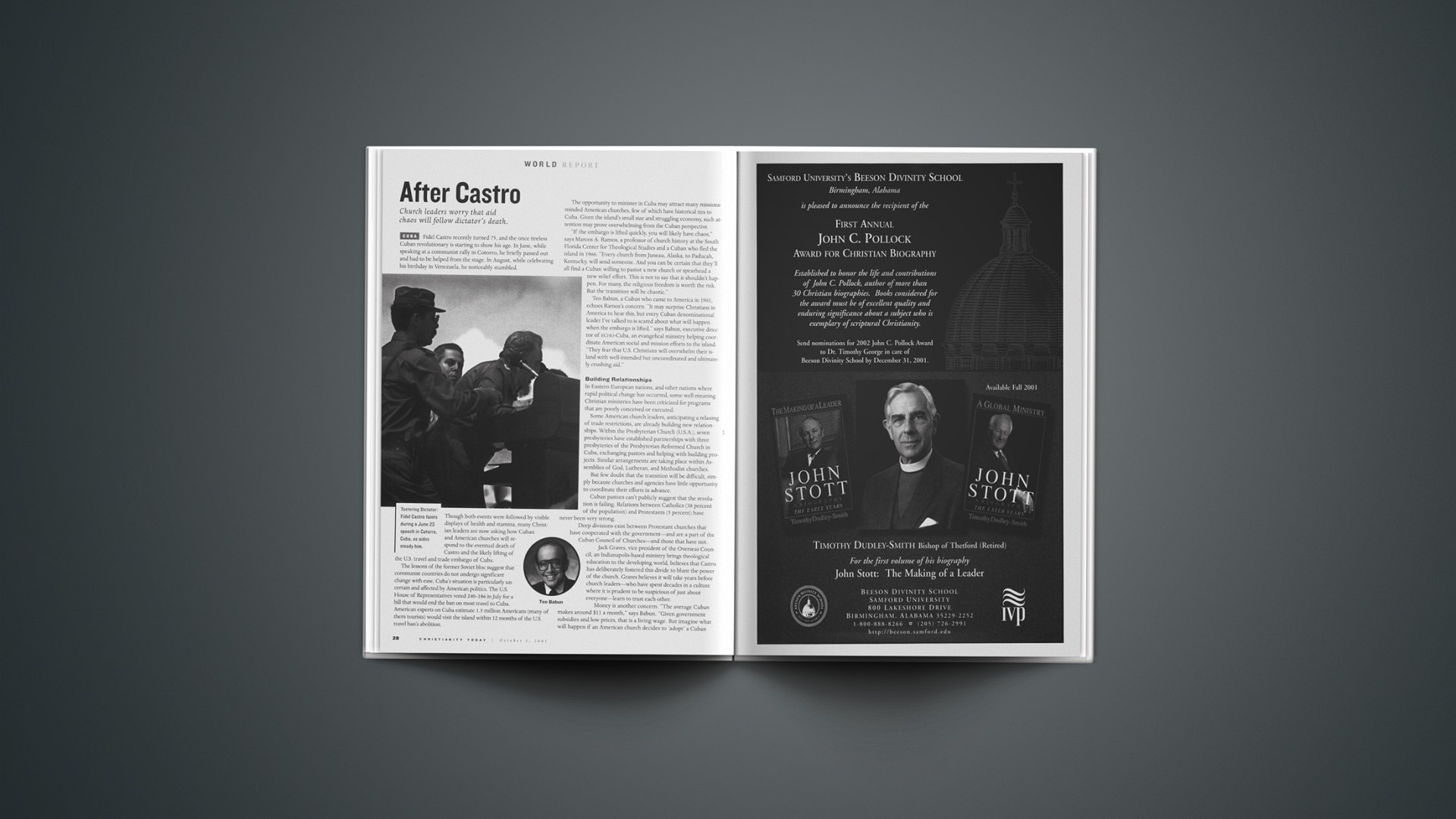

Fidel Castro recently turned 75, and the once tireless Cuban revolutionary is starting to show his age. In June, while speaking at a communist rally in Cotorro, he briefly passed out and had to be helped from the stage. In August, while celebrating his birthday in Venezuela, he noticeably stumbled.
Though both events were followed by visible displays of health and stamina, many Christian leaders are now asking how Cuban and American churches will respond to the eventual death of Castro and the likely lifting of the U.S. travel and trade embargo of Cuba.
The lessons of the former Soviet bloc suggest that communist countries do not undergo significant change with ease. Cuba's situation is particularly uncertain and affected by American politics. The U.S. House of Representatives voted 240-186 in July for a bill that would end the ban on most travel to Cuba. American experts on Cuba estimate 1.5 million Americans (many of them tourists) would visit the island within 12 months of the U.S. travel ban's abolition.
The opportunity to minister in Cuba may attract many missions-minded American churches, few of which have historical ties to Cuba. Given the island's small size and struggling economy, such attention may prove overwhelming from the Cuban perspective
"If the embargo is lifted quickly, you will likely have chaos," says Marcos A. Ramos, a professor of church history at the South Florida Center for Theological Studies and a Cuban who fled the island in 1966. "Every church from Juneau, Alaska, to Paducah, Kentucky, will send someone. And you can be certain that they'll all find a Cuban willing to pastor a new church or spearhead a new relief effort. This is not to say that it shouldn't happen. For many, the religious freedom is worth the risk. But the transition will be chaotic."
Teo Babun, a Cuban who came to America in 1961, echoes Ramos's concern. "It may surprise Christians in America to hear this, but every Cuban denominational leader I've talked to is scared about what will happen when the embargo is lifted," says Babun, executive director of echo-Cuba, an evangelical ministry helping coordinate American social and mission efforts to the island. "They fear that U.S. Christians will overwhelm their island with well-intended but uncoordinated and ultimately crushing aid."
Building Relationships
In Eastern European nations, and other nations where rapid political change has occurred, some well-meaning Christian ministries have been criticized for programs that are poorly conceived or executed.
Some American church leaders, anticipating a relaxing of trade restrictions, are already building new relationships. Within the Presbyterian Church (U.S.A.), seven presbyteries have established partnerships with three presbyteries of the Presbyterian Reformed Church in Cuba, exchanging pastors and helping with building projects. Similar arrangements are taking place within Assemblies of God, Lutheran, and Methodist churches.
But few doubt that the transition will be difficult, simply because churches and agencies have little opportunity to coordinate their efforts in advance.
Cuban pastors can't publicly suggest that the revolution is failing. Relations between Catholics (38 percent of the population) and Protestants (5 percent) have never been very strong.
Deep divisions exist between Protestant churches that have cooperated with the government—and are a part of the Cuban Council of Churches—and those that have not.
Jack Graves, vice president of the Overseas Council, an Indianapolis-based ministry brings theological education to the developing world, believes that Castro has deliberately fostered this divide to blunt the power of the church. Graves believes it will take years before church leaders—who have spent decades in a culture where it is prudent to be suspicious of just about everyone—learn to trust each other.
Money is another concern. "The average Cuban makes around $11 a month," says Babun. "Given government subsidies and low prices, that is a living wage. But imagine what will happen if an American church decides to 'adopt' a Cuban pastor and pay [him] $200 a month. That is a salary well below Western norms, but they have just made him one of the richest and most powerful men around. His fellow pastors will be understandably jealous and will eventually seek similar arrangements with different U.S. sponsors. Soon you'll have a church on every corner, each with its own programs."
Mission-Minded Cubans
Cuban leaders also fear that Americans, unaware of the strength and vitality of Christianity in Cuba, will attempt to impose American solutions on Cuban problems. Babun notes that of Cuba's 11 million people, 1 million have been in an evangelical church in the last year. According to Operation World (2001), the evangelical movement is growing at 6.5 percent annually. Meanwhile, population growth for Cuba overall is 0.7 percent annually. Many Cuban Christians worship in homes. There are an estimated 10,000 house groups with 54 denominational affiliations, Operation World reports.
Evangelicals held 19 public rallies in 1999, altogether drawing hundreds of thousands of people. "Cubans are a mission-minded people," Babun says. "They have already sent evangelistic teams into Haiti and other parts of Latin America. I doubt most American Christians know this."
Larry Rankin, a United Methodist minister in southern Florida who lived in Cuba until he was 12 and who has returned every year since 1996, agrees. "We don't have much to teach the Cuban church," he says. "They have been refined by suffering, and they are very gifted evangelists. In fact, they are doing some very effective work in the Caribbean that we would do well to learn from."
Discussions intended to guide Western involvement in Cuba are beginning. "We are all waiting to see what will happen," Babun says. "Hong Kong's date with change was set. But Cuba's is not. We must hold our breath and pray."
Copyright © 2001 Christianity Today. Click for reprint information.
Related Elsewhere:
Castro turned 75 in August.
Profiles of Fidel Castro include a CNN Newsmaker Profile and the BBC's Castro: The Great Survivor.
The Castro Speech Database contains the full text of English translations of speeches, interviews, and press conferences by Fidel Castro.
In July, the BBC reported that after 42 years in power, "Castro is constantly faced with the challenge of keeping his revolution alive and relevant to the Cuban people."
Media coverage of the decision to lift travel bans to Cuba included:
Senator: Lift Cuba Travel Ban — Fox News (Aug. 16, 2001)
End in sight for Cuba travel ban — Financial Times (July 27, 2001)
House votes to end ban on U.S. citizens traveling to Cuba — Associated Press (July 26, 2001)
The Human Rights Watch World Report 2001 for Cuba highlights human rights developments in the nation.
For more on Cuba, see Yahoo full coverage.
Our earlier coverage of Fidel Castro and evangelism in Cuba includes:
The War for Elián | Miami churches protest NCC efforts to return Elián González to Cuba (Feb. 25, 2000)
Cuba's Next Revolution | How Christians are reshaping Castro's communist stronghold (cover story, Jan. 12, 1998)
Cuban Catholics Make Gains, but Protestant Rights Limited (Feb. 8, 1999)
Cuba's Evangelicals Come Up for Air (June 14, 1999)