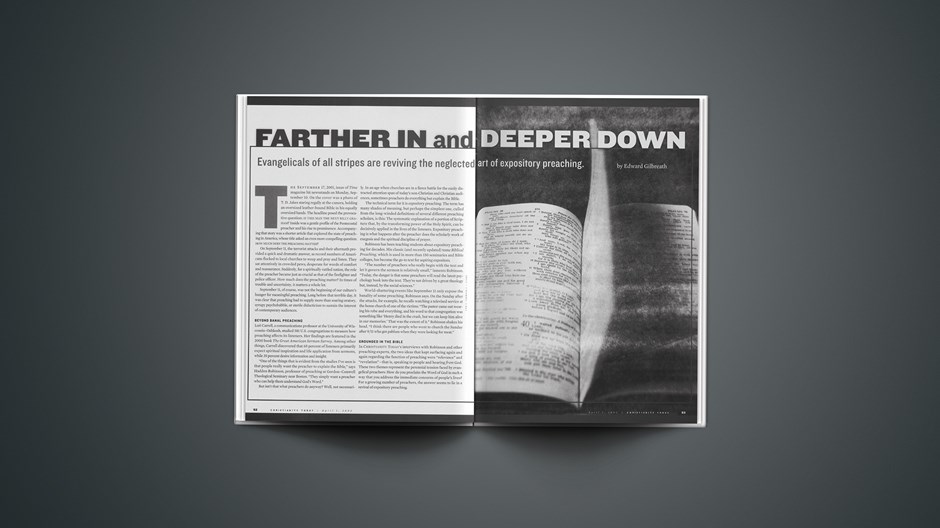
The September 17, 2001, issue of Time magazine hit newsstands on Monday, September 10. On the cover was a photo of T. D. Jakes staring regally at the camera, holding an oversized leather-bound Bible in his equally oversized hands. The headline posed the provocative question: IS THIS MAN THE NEXT BILLY GRAHAM? Inside was a gentle profile of the Pentecostal preacher and his rise to prominence. Accompanying that story was a shorter article that explored the state of preaching in America, whose title asked an even more compelling question: HOW MUCH DOES THE PREACHING MATTER?
On September 11, the terrorist attacks and their aftermath provided a quick and dramatic answer, as record numbers of Americans flocked to local churches to weep and pray and listen. They sat attentively in crowded pews, desperate for words of comfort and reassurance. Suddenly, for a spiritually rattled nation, the role of the preacher became just as crucial as that of the firefighter and police officer. How much does the preaching matter? In times of trouble and uncertainty, it matters a whole lot.
September 11, of course, was not the beginning of our culture's hunger for meaningful preaching. Long before that terrible day, it was clear that preaching had to supply more than soaring oratory, syrupy psychobabble, or sterile didacticism to sustain the interest of contemporary audiences.
Beyond Banal Preaching
Lori Carrell, a communications professor at the University of Wisconsin-Oshkosh, studied 581 U.S. congregations to measure how preaching affects its listeners. Her findings are featured in the 2000 book The Great American Sermon Survey. Among other things, Carrell discovered that 65 percent of listeners primarily expect spiritual inspiration and life application from sermons, while 35 percent desire information and insight.
"One of the things that is evident from the studies I've seen is that people really want the preacher to explain the Bible," says Haddon Robinson, professor of preaching at Gordon-Conwell Theological Seminary near Boston. "They simply want a preacher who can help them understand God's Word."
But isn't that what preachers do anyway? Well, not necessarily. In an age when churches are in a fierce battle for the easily distracted attention span of today's non-Christian and Christian audiences, sometimes preachers do everything but explain the Bible.
The technical term for it is expository preaching. The term has many shades of meaning, but perhaps the simplest one, culled from the long-winded definitions of several different preaching scholars, is this: The systematic explanation of a portion of Scripture that, by the transforming power of the Holy Spirit, can be decisively applied in the lives of the listeners. Expository preaching is what happens after the preacher does the scholarly work of exegesis and the spiritual discipline of prayer.
Robinson has been teaching students about expository preaching for decades. His classic (and recently updated) tome Biblical Preaching, which is used in more than 150 seminaries and Bible colleges, has become the go-to text for aspiring expositors.
"The number of preachers who really begin with the text and let it govern the sermon is relatively small," laments Robinson. "Today, the danger is that some preachers will read the latest psychology book into the text. They're not driven by a great theology but, instead, by the social sciences."
World-shattering events like September 11 only expose the banality of some preaching, Robinson says. On the Sunday after the attacks, for example, he recalls watching a televised service at the home church of one of the victims: "The pastor came out wearing his robe and everything, and his word to that congregation was something like 'Henry died in the crash, but we can keep him alive in our memories.' That was the extent of it." Robinson shakes his head. "I think there are people who went to church the Sunday after 9/11 who got pablum when they were looking for meat."
Grounded in the Bible
In Christianity Today's interviews with Robinson and other preaching experts, the two ideas that kept surfacing again and again regarding the function of preaching were "relevance" and "revelation"—that is, speaking to people and hearing from God. These two themes represent the perennial tension faced by evangelical preachers: How do you proclaim the Word of God in such a way that you address the immediate concerns of people's lives? For a growing number of preachers, the answer seems to lie in a revival of expository preaching.
There have been many theories and debates about what makes good biblical preaching. In recent years, the issue has manifested itself as a clash between different homiletical approaches. Fundamentalists and many Reformed Christians decry the experience-centered, topical style of some mainstream evangelicals and exhort us to "preach the Bible" only. Gen-X or postmodern churches sing the praise of narrative and story. Leaders from large seeker churches remind us that today's unchurched people approach everything with a consumerist mentality and that we must "market" our message accordingly.
Article continues below
These disagreements in opinion and approach are old news. What's refreshing is how a diverse movement of preachers and churches is laying aside their superficial differences and committing themselves to a philosophy of preaching that, while unquestionably grounded in the Bible, is free to take on many shapes and forms in its practice and execution.
"I think there is an increasing emphasis on biblical preaching," says Brian Larson, editor of the Preaching Today audio series and PreachingToday.com (both produced by Christianity Today International). "I think it's spreading to groups in the church that would not have been very sensitive to it before."
It can be seen, says Larson, in the ministries of megachurch pastors like Rick Warren of Saddleback Valley Community Church in Southern California and John Ortberg at Willow Creek in Chicago. "I see them maturing in their use of how-to preaching and seeker-driven preaching and moving toward a willingness to do expository series in tandem with the topical stuff."
The shift can also be seen in the top preaching books of the day. Australian pastor Graham Johnston's Preaching to a Postmodern World (Baker), for example, has won acclaim (including Preaching magazine's 2001 Book of the Year honor) for its clear treatise on delivering Bible-centered sermons to audiences enchanted by relativistic thinking.
Larson says this new focus on expository preaching was not an overnight phenomenon. "It's spreading now because we've had strong leaders who have argued for it for a long time—guys like Haddon Robinson, Warren Wiersbe, and John MacArthur."
Another important name to add to that list is E. K. Bailey. Bailey, 56, is the senior pastor of Concord Missionary Baptist Church, a large African American congregation on the southern edge of Dallas. A large and well-liked man who is currently recovering from nasal cancer, Bailey became a national name in the late 1980s after he founded E. K. Bailey Ministries, which helps black pastors and lay leaders revitalize their churches through conferences and seminars.
In 1995, after years of reading preaching books by authors like Robinson and Wiersbe and putting their principles into practice in his own ministry, Bailey became convinced that the African American church needed to learn about expository preaching. "Some preachers open a book of the Bible to read a text and use the pulpit as a launching pad to catapult themselves into a planned discussion, without the slightest intent of ever returning to the text," Bailey says. He was determined to counter that tendency.
Article continues below
Preaching in Black and White
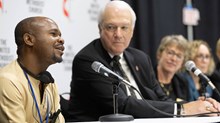
Bailey dreamed of bringing together a stellar lineup of both black and white preachers who could model the principles of expository preaching through sermons and workshops. The first E. K. Bailey Expository Preaching Conference took place in July 1996. Mostly through word of mouth, more than 850 preachers from all over the country gathered in downtown Dallas to hear black preachers like James Earl Massey and A. Louis Patterson, and white preachers like Wiersbe and Stephen Olford. "This conference is about cross-pollination," Bailey says, "because when God was passing out genius, he didn't discriminate by race."
Since that first year, the conference has become an annual ritual for hundreds of pastors and lay people from all races and church backgrounds. Timothy George, dean of Beeson Divinity School at Samford University, regularly attends the event. He calls it "the intersection of the best preaching from the black and white traditions."
Robert Smith, a professor of preaching at Beeson who has spoken at the conference from its beginning days, says the event models both racial and homiletical reconciliation in the church. "I have contended for many years that the black preacher is not complete without the white preacher and vice versa. And of course, I'd say the same about Hispanic and Asian and Native American styles, but I'm focusing on the two major preaching traditions in America. White preaching tends to be strong in the area of information, while black preaching is full of inspiration. Substantive preaching needs both."
It really is an electrifying experience to sit in on the conference. Last year, on five sticky days in July, about 1,100 preachers were out in force for the event. The energy and emotion were palpable as preacher after preacher took the stage to go, in Robert Smith's phrase, "farther in and deeper down" into the Word of God.
For a preacher, there is probably no more attentive audience than a roomful of other preachers: they always bring their Bibles, they don't need to be prodded into shouting Amen, and they know intuitively that when the speaker says he's almost finished, it means that he's just getting warmed up.
During a rousing sermon by local son Tony Evans, the preachers listen with intensity. "Jesus Christ is not just building a preacher; he's building a church," Evans shouts.
Article continues below
The preachers, who fill the giant meeting room at the Fairmont Hotel, erupt in agreement.
"We need a generation of expositors today who believe that the Word of God is so powerful, it can be applied to open the power of heaven."
The preachers applaud. They sit in their chairs, rocking back and forth. They suddenly rise to their feet and point vigorously at the speaker—"You tell it, Pastor!" Some of them stand still with their arms folded, tears welling up in their eyes.
Jim Dennison, the white senior pastor of Park Cities Baptist Church in Dallas, offers another impassioned challenge: "God save us from people who preach only because it's Sunday," he says to affirmative shouts. "Our world's not looking for a ministry or sermons; it's looking for a message."
At times, the event feels like a massive marathon of preaching, with speaker after speaker showcasing his homiletical chops. Even the workshop sessions ultimately become miniature sermons wrapped up in PowerPoint presentations.
Bailey is well aware of the possibility for competition at his conference, but he says the Spirit of God and a clear commitment to making the event both an educational and worshipful experience reduce that likelihood. "The best preacher is the one God is preaching through at any given moment," he says.
The most intriguing aspect of the conference, however, is how naturally the black and white styles blend together. The white preachers preach in their usual, low-key fashion, and the black preachers are not reluctant to get swept up in the frenzied "whooping" that signals the climax of some forms of African American preaching. Says Bailey, "Once we have the illumination on the revelation, then it's time for the celebration." Yet each sermon—black and white—is equally dynamic and powerful. Bailey believes it's because the preachers share a common commitment to the ideal of expository preaching.
Robert Smith agrees. "For me, the word expository is a principle, not a style," he says. "You cannot say this is the only way to do expository preaching, because in its essence it is about exposing what is in the biblical text rather than reading into it. And that can be done in many forms."
And in many colors.
Counting the Expository Cost
The Stephen Olford Center for Biblical Preaching is located on 20 acres of scenic real estate in southeast Memphis, Tennessee. Throughout the year, hundreds of pastors and laity descend on the center for weeklong seminars on expository preaching and pastoral ministry.
Article continues below
Olford, 84, is a diminutive, white-haired dynamo with a blazing British accent and a passion for expounding the Word of God. A former pastor, who led such renowned congregations as Duke Street Baptist in Richmond, Surrey, England, and Calvary Baptist in New York City, Olford now devotes his twilight years to equipping and encouraging evangelical preachers. He and his son David, also a scholar of preaching, founded the Institute for Biblical Preaching in 1980 as a resource for both seasoned and aspiring preachers. Olford believes today's preachers are in danger of compromising the pure proclamation of the gospel message.
"The apostle Paul predicted this current state of affairs," Olford says. "Paul said, 'Preach the Word in season and out of season, for the time will come when they'—that is, church people—'will not endure sound doctrine.' And quite frankly, the shallowness (as John Stott calls it) of preaching today is due to the fact that preachers are not prepared to pay the cost of preaching the great absolutes that come out of the exposition of God's Word."
Olford is not alone in his assessment. Many preaching experts believe the Christian minister will be challenged like at no other time in history as the surrounding culture becomes increasingly pluralistic—especially after the landmark events of September 11.
"I think most Christian preachers have felt the weight of the new religion of religious pluralism in America, where every god is as good as any other god," says Bryan Chapell, president of Covenant Seminary in St. Louis and author of Christ-Centered Preaching: Redeeming the Expository Sermon (Baker). "There has been a real tension between trying to express respect and compassion toward other faiths while at the same time articulating the uniqueness of the Christian faith."
The saving grace in this treacherous new territory for preachers is that Christianity has a message like no other religion—one that emphasizes a personal, loving God who made a very accessible provision for humanity's sin and spiritual bankruptcy. It's a message that people are looking for, whether they realize it or not, says Chapell. "Preachers often feel they need more and more experiential relevance for people to listen to the message. But when you survey people, they more often say that what they want is the truth of the Scriptures."
And September 11 should only reinforce that yearning, Chapell adds. "When our experience and sense of certainty erodes, we begin to look for more solid foundations, and I think that pushes people back to the biblical text."
Article continues below
And back to expository preaching.
Edward Gilbreath is an associate editor of Christianity Today.
This biography of Haddon Robinson includes links to all schools he has attended and ministries and boards he is associated with. Robinson did an interview with CT's sister magazine, Leadership, on how to keep errors from creeping into Scripture application.















 While we pray for peace, we need moral clarity about this war.
 We’ve got little information on Jesus’ appearance and personality. But that’s the way God designed it.españolFrançais
 The plan would organize UMC churches in four global regions, with each given more leeway around same-sex marriage and other theological issues.






