


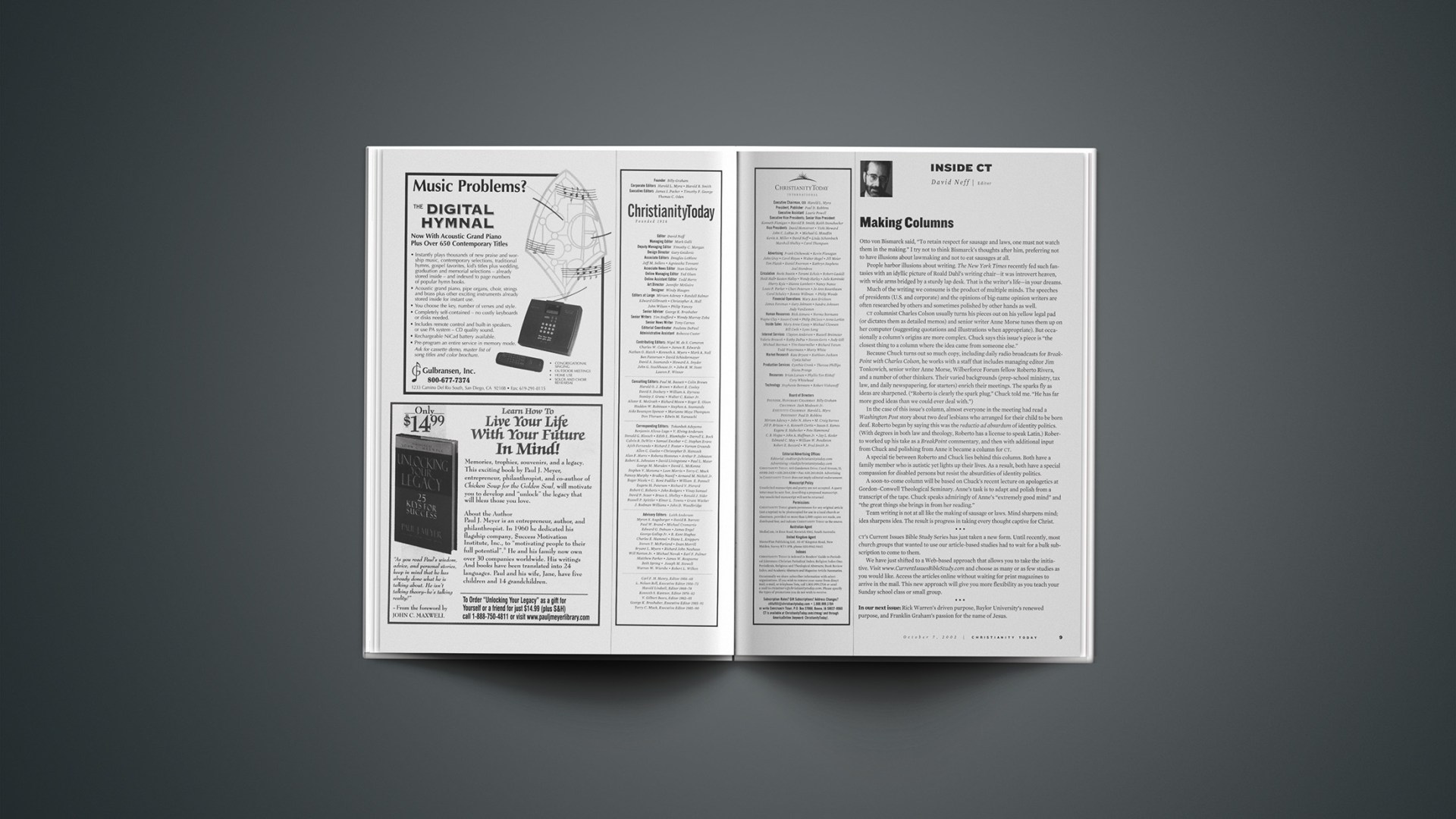

Otto von Bismarck said, “To retain respect for sausage and laws, one must not watch them in the making.” I try not to think Bismarck’s thoughts after him, preferring not to have illusions about lawmaking and not to eat sausages at all.
People harbor illusions about writing. The New York Times recently fed such fantasies with an idyllic picture of Roald Dahl’s writing chair—it was introvert heaven, with wide arms bridged by a sturdy lap desk. That is the writer’s life—in your dreams.
Much of the writing we consume is the product of multiple minds. The speeches of presidents (U.S. and corporate) and the opinions of big-name opinion writers are often researched by others and sometimes polished by other hands as well.
CT columnist Charles Colson usually turns his pieces out on his yellow legal pad (or dictates them as detailed memos) and senior writer Anne Morse tunes them up on her computer (suggesting quotations and illustrations when appropriate). But occasionally a column’s origins are more complex. Chuck says this issue’s piece is “the closest thing to a column where the idea came from someone else.”
Because Chuck turns out so much copy, including daily radio broadcasts for BreakPoint with Charles Colson, he works with a staff that includes managing editor Jim Tonkowich, senior writer Anne Morse, Wilberforce Forum fellow Roberto Rivera, and a number of other thinkers. Their varied backgrounds (prep-school ministry, tax law, and daily newspapering, for starters) enrich their meetings. The sparks fly as ideas are sharpened. (“Roberto is clearly the spark plug,” Chuck told me. “He has far more good ideas than we could ever deal with.”)
In the case of this issue’s column, almost everyone in the meeting had read a Washington Post story about two deaf lesbians who arranged for their child to be born deaf. Roberto began by saying this was the reductio ad absurdum of identity politics. (With degrees in both law and theology, Roberto has a license to speak Latin.) Roberto worked up his take as a BreakPoint commentary, and then with additional input from Chuck and polishing from Anne it became a column for CT.
A special tie between Roberto and Chuck lies behind this column. Both have a family member who is autistic yet lights up their lives. As a result, both have a special compassion for disabled persons but resist the absurdities of identity politics.
A soon-to-come column will be based on Chuck’s recent lecture on apologetics at Gordon-Conwell Theological Seminary. Anne’s task is to adapt and polish from a transcript of the tape. Chuck speaks admiringly of Anne’s “extremely good mind” and “the great things she brings in from her reading.”
Team writing is not at all like the making of sausage or laws. Mind sharpens mind; idea sharpens idea. The result is progress in taking every thought captive for Christ.
***
CT‘s Current Issues Bible Study Series has just taken a new form. Until recently, most church groups that wanted to use our article-based studies had to wait for a bulk subscription to come to them.
We have just shifted to a Web-based approach that allows you to take the initiative. Visit www.CurrentIssuesBibleStudy.com and choose as many or as few studies as you would like. Access the articles online without waiting for print magazines to arrive in the mail. This new approach will give you more flexibility as you teach your Sunday school class or small group.
***
In our next issue: Rick Warren’s driven purpose, Baylor University’s renewed purpose, and Franklin Graham’s passion for the name of Jesus.
Copyright © 2002 Christianity Today. Click for reprint information.
Related Elsewhere
Also appearing on our site today:
A Clan of One’s OwnHacking through the jungle of identity politics.
Other related articles include:
Who Writes Charles Colson’s Columns?The Los Angeles Times was wrong when it said Colson just signs off on staffwriting, says CT’s editor. (March 27, 2002)
The Legacy of Prisoner 23226Twenty-six years after leaving prison, Charles Colson has become one of America’s most significant social reformers. (June 29, 2001)
Recent Charles Colson columns for Christianity Today include:
The Wages of SecularismNew laws won’t prevent another Enron. (June 4, 2002)
More Doctrine, Not LessWe need to proclaim truth to a truth-impaired generation. (April 15, 2001)
Post-Truth SocietyThe recent trend of lying is no accident. (March 4, 2002)
Drawing the Battle LinesWe need to be informed and discerning about the Islamic worldview. (Jan. 9, 2002)
Wake-up CallIf September 11 was a divine warning, it’s God’s people who are being warned. (Nov. 5, 2001)
The New TyrannyBiotechnology threatens to turn humanity into raw material. (Oct. 5, 2001)