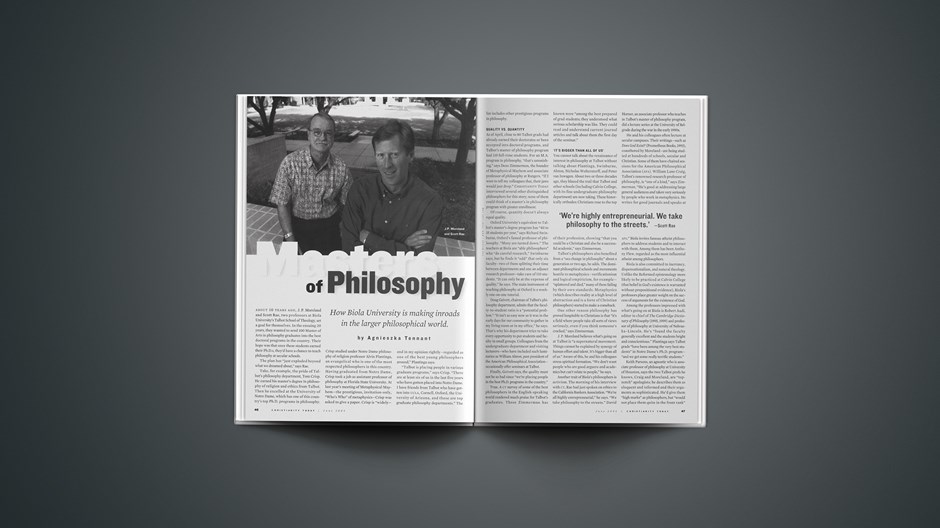
About 10 years ago, J. P. Moreland and Scott Rae, two professors at Biola University's Talbot School of Theology, set a goal for themselves. In the ensuing 20 years, they wanted to send 100 Master of Arts in philosophy graduates into the best doctoral programs in the country. Their hope was that once these students earned their Ph.D.s, they'd have a chance to teach philosophy at secular schools.
The plan has "just exploded beyond what we dreamed about," says Rae.
Take, for example, the pride of Talbot's philosophy department, Tom Crisp. He earned his master's degree in philosophy of religion and ethics from Talbot. Then he excelled at the University of Notre Dame, which has one of this country's top Ph.D. programs in philosophy. Crisp studied under Notre Dame philosophy of religion professor Alvin Plantinga, an evangelical who is one of the most respected philosophers in this country. Having graduated from Notre Dame, Crisp took a job as assistant professor of philosophy at Florida State University. At last year's meeting of Metaphysical Mayhem—the prestigious, invitation-only, "Who's Who" of metaphysics—Crisp was asked to give a paper. Crisp is "widely—and in my opinion rightly—regarded as one of the best young philosophers around," Plantinga says.
"Talbot is placing people in various graduate programs," says Crisp. "There are at least six of us in the last five years who have gotten placed into Notre Dame. I have friends from Talbot who have gotten into UCLA, Cornell, Oxford, the University of Arizona, and these are top graduate philosophy departments." The list includes other prestigious programs in philosophy.
Quality vs. Quantity
As of April, close to 80 Talbot grads had already earned their doctorates or been accepted into doctoral programs, and Talbot's master of philosophy program had 110 full-time students. For an M.A. program in philosophy, "that's astonishing," says Dean Zimmerman, the founder of Metaphysical Mayhem and associate professor of philosophy at Rutgers. "If I were to tell my colleagues that, their jaws would just drop." Christianity Today interviewed several other distinguished philosophers for this story; none of them could think of a master's in philosophy program with greater enrollment.
Of course, quantity doesn't always equal quality.
Oxford University's equivalent to Talbot's master's degree program has "40 to 35 students per year," says Richard Swinburne, Oxford's famed professor of philosophy. "Many are turned down." The teachers at Biola are "able philosophers" who "do careful research," Swinburne says, but he finds it "odd" that only six faculty—two of them splitting their time between departments and one an adjunct research professor—take care of 110 students. "It can only be at the expense of quality," he says. The main instrument of teaching philosophy at Oxford is a weekly one-on-one tutorial.
Doug Geivett, chairman of Talbot's philosophy department, admits that the faculty-to-student ratio is a "potential problem." "It isn't as easy now as it was in the early days for our community to gather in my living room or in my office," he says. That's why his department tries to take every opportunity to put students and faculty in small groups. Colleagues from the undergraduate department and visiting lecturers—who have included such luminaries as William Alston, past president of the American Philosophical Association—occasionally offer seminars at Talbot.
Finally, Geivett says, the quality must not be so bad since "we're placing people in the best Ph.D. programs in the country."
True. A CT survey of some of the best philosophers in the English-speaking world rendered much praise for Talbot's graduates. Those Zimmerman has known were "among the best prepared of grad students; they understood what serious scholarship was like. They could read and understand current journal articles and talk about them the first day of the seminar."
'It's bigger than all of us'
You cannot talk about the renaissance of interest in philosophy at Talbot without talking about Plantinga, Swinburne, Alston, Nicholas Wolterstorff, and Peter van Inwagen. About two or three decades ago, they blazed the trail that Talbot and other schools (including Calvin College, with its fine undergraduate philosophy department) are now taking. These historically orthodox Christians rose to the top of their profession, showing "that you could be a Christian and also be a successful academic," says Zimmerman.
Talbot's philosophers also benefited from a "sea change in philosophy" about a generation or two ago, he adds. The dominant philosophical schools and movements hostile to metaphysics—verificationism and logical empiricism, for example—"splattered and died," many of them failing by their own standards. Metaphysics (which describes reality at a high level of abstraction and is a forte of Christian philosophers) started to make a comeback.
One other reason philosophy has proved hospitable to Christians is that "it's a field where people take all sorts of views seriously, even if you think someone's cracked," says Zimmerman.
Article continues below
J. P. Moreland believes what's going on at Talbot is "a supernatural movement. Things cannot be explained by synergy of human effort and talent. It's bigger than all of us." Aware of this, he and his colleagues stress spiritual formation. "We don't want people who are good arguers and academics but can't relate to people," he says.
Another trait of Biola's philosophers is activism. The morning of his interview with CT, Rae had just spoken on ethics to the California Bankers Association. "We're all highly entrepreneurial," he says. "We take philosophy to the streets." David Horner, an associate professor who teaches in Talbot's master of philosophy program, did a lecture series at the University of Belgrade during the war in the early 1990s.
He and his colleagues often lecture at secular campuses. Their writings—such as Does God Exist? (Prometheus Books, 1993), coauthored by Moreland—are being studied at hundreds of schools, secular and Christian. Some of them have chaired sessions for the American Philosophical Association (APA). William Lane Craig, Talbot's renowned research professor of philosophy, is "one of a kind," says Zimmerman. "He's good at addressing large general audiences and taken very seriously by people who work in metaphysics. He writes for good journals and speaks at APA." Biola invites famous atheist philosophers to address students and to interact with them. Among them has been Anthony Flew, regarded as the most influential atheist among philosophers.
Biola is also committed to inerrancy, dispensationalism, and natural theology. Unlike the Reformed epistemology more likely to be practiced at Calvin College (that belief in God's existence is warranted without propositional evidence), Biola's professors place greater weight on the success of arguments for the existence of God.
Among the professors impressed with what's going on at Biola is Robert Audi, editor in chief of The Cambridge Dictionary of Philosophy (1995, 1999) and professor of philosophy at University of Nebraska—Lincoln. He's "found the faculty generally excellent and the students bright and conscientious." Plantinga says Talbot grads "have been among the very best students" in Notre Dame's Ph.D. program—"and we get some really terrific students."
Keith Parsons, an atheist who is associate professor of philosophy at University of Houston, says the two Talbot profs he knows, Craig and Moreland, are "top-notch" apologists; he describes them as eloquent and informed and their arguments as sophisticated. He'd give them "high marks" as philosophers, but "would not place them quite in the front rank" with such theistic philosophers as Plantinga, Swinburne, Alston, and van Inwagen. The reason? "Their arguments for the existence of God seem to me to contain a number of logical gaps," he says. When he has pointed them out to Craig and Moreland, "their responses have occasionally struck me as intemperate in tone." But, he adds, he has greatly enjoyed and learned a lot from these encounters.
Article continues below
"Talbot has a number of very strong faculty," says agnostic philosopher Paul Draper of Florida International University. "They have very good analytic skills and understanding of issues, and they approach them with a passion because of the relevance of the issues to their personal lives." Draper has one worry. "They tend to look for arguments that always justify their faith. … Inevitably, it's going to bias your investigation."
But Talbot's Horner says, "It's not biased to look for evidence and arguments to support a position that you have good reason to believe is true, especially if it is under attack—as long as you're honestly dealing with counter-evidence and objections to your position. That's the kind of approach I see at Talbot."
Wait, there's more
Several years ago, Geivett and Moreland recognized that some M.A. students did not want Ph.D.s. They wanted to learn to think with philosophical rigor about issues they were likely to encounter in their jobs as teachers, newspaper columnists, engineers, or radio hosts.
So Biola developed an additional program—an M.A. in apologetics, since much of apologetics is applied philosophy. Craig Hazen started it in the fall of 1997 with 20 students. Now there are 122.
As a subsidiary of this program, Hazen started a graduate certificate program in apologetics. It requires one year of study for laypeople who already have advanced degrees and don't intend to change careers. There are 369 of them this semester. "We have stockbrokers, engineers, English teachers," says Hazen.
The certificate program requires students to attend the Defending the Faith lecture series, during which Biola's philosophers and apologists publicly demonstrate their skills. The lectures, held in large churches and other spacious venues, are open to the public and Orange County residents show up in the thousands. Some of them move toward God (see "Forced by Logic" below).
Article continues below
Philosophia Christi, the biannual journal of the Evangelical Philosophical Society, is edited by Hazen and sponsored and put together (mostly) by Biola's vigorous movement. Since its overhaul four years ago, it's been "establishing itself as a first-rate periodical in philosophy of religion, though it is not limited to that," says the University of Nebraska's Audi. Its circulation is now at 1,625, high for a journal on the philosophy of religion.
The contributors include atheist Keith Parsons. Among the journal's subscribers are some of the more prominent non-Christian philosophers. One of them is agnostic Paul Draper. He's "impressed with the sort of quality people they're getting to publish articles there in the short time they've been in existence. I can't imagine that they could have done better than they're doing."
Not bad for the first decade of Biola's 20-year goal.
Agnieszka Tennant is an associate editor of Christianity Today.















 While we pray for peace, we need moral clarity about this war.
 As my doubts about his teachings grew, so did a secret fascination with Jesus.
 Beyoncé’s right. Whether listening to Cowboy Carter or reading theology, diversity is a good thing.






