Christian History Corner: Learning From the Other 9/11
"It's getting uncommonly easy to kill people in large numbers," wrote the Christian scholar, novelist, and lay theologian Dorothy L. Sayers in her novel Gaudy Night. "And the first thing a principle does—if it really is a principle—is to kill somebody."
I write this as midnight approaches and the calendar flips to the new Day of Infamy. I am thinking, as are many others, of where I was and what I felt on September 11, 2001, when I first heard that airplanes had struck the World Trade Center's towers.
I was in the basement of the Duke Divinity School's library, attending to my duties as copy editor of Church History, the journal of the American Society for Church History. Adam Zele, the book review editor, hung up the telephone, his face pale. Someone had just called to tell him: Two planes had hit the towers. Another was headed for the Pentagon.
At first I did not believe Adam's news. Surely his informant was wrong—or pulling a sick prank.
But soon I was sitting wordlessly in a darkened film theater at Duke's Bryan student center, with hundreds of other stunned students. In a matter of minutes, we found ourselves bonded into a single disbelieving community of horror.
We watched the footage replayed again and again. We heard the confused reports. Gradually these moved to a consensus: This was the work of terrorists. And terrorists who were not political radicals only, but Holy Warriors. These were men whose hatred of America had boiled up into a blind conviction that God willed their heinous acts.
In those first hours of shock, when all of my insides felt like they had sunk irretrievably to the bottom of my gut, the event seemed a freak—a deed with no parallel.
In the weeks and months after, journalists, professors, and other would-be authorities poured out a flood of words—trying to understand what had happened, grappling with motives, searching for logic, peering into the mind of Islamic fundamentalism's lunatic fringe.
Even in all of that flood, and even in the two years of analysis that ensued, it was not until this week that I heard of another event on American soil, nearly a century and half old, that shared not only the date of this tragedy, but its potent mix of political and religious motivation.
On September 11, 1857, 120 "gentiles" were slaughtered by Mormon malcontents in an impoverished, remote section of Utah. The Mountain Meadows massacre has been called "one of the worst mass murders in American history."
Though details of the event are vague and no eyewitness wholly trustworthy, the consensus of recent historicalstudy and dramatic treatment supports the outline of the story as Mark Twain told it in his Roughing It:
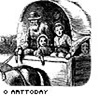
A large party of Mormons, painted and tricked out as Indians, overtook the train of emigrant wagons some three hundred miles south of Salt Lake City, and made an attack. But the emigrants threw up earthworks, made fortresses of their wagons, and defended themselves gallantly and successfully for five days!…At the end of the five days the Mormons tried military strategy. They retired to the upper end of the "Meadows," resumed civilized apparel, washed off their paint, and then, heavily armed, drove down in wagons to the beleaguered emigrants, bearing a flag of truce! When the emigrants saw white men coming they threw down their guns and welcomed them with cheer after cheer. …
. . . and were promptly slaughtered en masse, excepting only a few of the many children—those under the age of seven, deemed too young to "tell tales."
Although the establishment of the Church of Jesus Christ of Latter-day Saints still wishes to deny the complicity of Brigham Young and other key Mormon leaders in the events of that day, there seems no doubt that rank-and-file Mormons had every reason to despise such settlers as the Mountain Meadows party. Latter-day Saints had been mistreated—and some killed—by the "gentiles" from the surrounding area for years before the massacre. It seems clear that this had created a thirst for vengeance.
On October 5, 2002, Bagley spoke to an audience at the 8th Annual Ex-Mormon Conference in Salt Lake City, Utah. Echoing Sayers's sentiment quoted at the head of this article, Bagley said,
I'm astonished that I still have people who I would consider friends who argue that this was done because these people basically behaved badly, and made people in southern Utah mad at them, so they just went out and killed them all.
Never in the entire fury and blood of the Civil War did members of one side or another kill children of seven years old. It never happened. These were not crimes of anger. These were crimes of ideology.
But was Brigham Young himself responsible for the Mountain Meadow massacre? Bagley reveals chilling details, including quotations from Young, of the "blood atonement revivals of 1856," during which Mormon leaders taught the doctrine "that the Saints had a right to kill a sinner to save him, when he commits those crimes that can only be atoned for by the shedding of blood."
Article continues below
Of course, this still does not mean that Young directly ordered the murders. In February 2002, a lead sheet was discovered, inscribed with what appeared to be a confession from John D. Lee, the one Mormon executed for leading the killers. In the confession, Lee writes that he acted on Brigham Young's explicit orders. Since that time, however, forensic experts have formally declared the scroll a fake, suggesting that it was the work of notorious anti-Mormon forger and convicted murderer Mark Hofmann.
Does that exonerate Young? Hardly.
When religious groups-even those connecting themselves to the name of Jesus-find themselves beleaguered, words can become heated and ideas violent-even on the lips of those who have no intention of shedding blood. So it was with the radical theological idea of "blood atonement" that apparently helped motivate the Mountain Meadows massacre. And so it is today with other radical teachings of fundamentalist group.
It is the responsibility of those doing the teaching-whether in Iraq or in America, whether Muslim or Christian-to understand that there will always be the John D. Lees and the Paul Hills who will put action to words in the most horrific ways.
In such cases—and we have not seen the last of them in our country—God's verdict is clear: "Whoever causes one of these little ones who believe in Me to sin, it would be better for him if a millstone were hung around his neck, and he were drowned in the depth of the sea" (Matthew 18:6, NKJV).
Chris Armstrong is managing editor of Christian History magazine. More Christian History, including a list of events that occurred this week in the church's past, is available at ChristianHistory.net. Subscriptions to the quarterly print magazine are also available.
A Peacemaker in Provo | How one Pentecostal pastor taught his congregation to love Mormons. (Feb. 9, 2000)
Mere Mormonism | Journalist Richard Ostling explores LDS culture, theology, and fans of 'crypto-Mormon' C.S. Lewis. (Feb. 9, 2000)
Mormons, Evangelicals Tangle Over Web Site | A publishing unit of the Church of Jesus Christ of Latter-day Saints will continue a copyright lawsuit against an evangelical ministry that counters Mormon teaching and history. (Feb. 9, 2000)
Mormons on the Rise | Southern Baptists Take Up the Mormon Challenge. (June 15, 1998)
Francis J. Beckwith, coauthor of The Mormon Concept of God: A Philosophical Analysis, reviewed How Wide the Divide? for Christianity Today. The review, "With a Grain of Salt," appeared in the November 17, 1997 of our print issue.
The Ten Commandments, How Deep Our Debt | The words of the Decalogue run like a river through not only the church but also English and American history. (August 22, 2003)
Muscular Christianity's Prodigal Son, College Sports | In the wake of a basketball scandal at a prominent Christian university, we take time to remember the Christian roots of college athletics. (August 15, 2003)
Liberia's Troubled Past—and Present | The nation's history explains why the current conflict succumbs to, yet simultaneously transcends, the stereotype of African tribal wars. (August 1, 2003)
The African Lion Roars in the Western Church | Anglican liberals are fretting, conservatives rejoicing, and all are scrambling to their history books: whence this new evangelical force on the world scene? (June 27, 2003)
How John Wesley Changed America | His 300th birthday should be a red-letter day on this side of the ocean. After all, we're all Wesleyans now. (June 20, 2003)











 While we pray for peace, we need moral clarity about this war.
 Alcoholism among women is rising. Can the church help?
 Drake and Kendrick Lamar’s rivalry reveals our craving for controversy—and what’s lost when community is based on shared hatred, not love.





