Putnam, it turned out, was in the right place at the right time. Across the ideological spectrum, Americans have become increasingly troubled by a decline in community. The remedy? "Social capital," referring to the cumulative clout of "social networks, norms of reciprocity, mutual assistance, and trustworthiness." It is the glue that helps people achieve concrete goals while at the same time benefiting others who may not be directly involved. For example, crime tends to be lower where there are strong neighborhood associations, benefiting residents who are not active in community organizing as well as those who are.
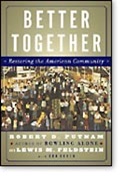
Hence Putnam's latest project, Better Together, a collaboration with Lewis Feldstein, president of the New Hampshire Charitable Foundation, and Don Cohen, "who did much of the field research and most of the actual writing of the case studies" that make up the book.
These 12 case studies range widely across the United States, offering examples of very different enterprises, from the Harvard Union of Clerical and Technical Workers to Rick Warren's Saddleback Church in Lake Forest, California; from branch libraries in Chicago to a far-sighted strategy for local business growth in Tupelo, Mississippi. Each example is intended to show in a practical way what is involved in "creating social capital: developing networks of relationships that weave individuals into groups and communities."
Taken together, they "suggest that social capital is usually developed in pursuit of a particular goal or set of goals and not for its own sake"—an important point that helps to explain the failure of initiatives with a strong utopian bent, such as those that seek "community" because, well, community is good.
Why should evangelicals read this book? First and most obviously, "Christians must actively work for the well-being of the larger societies in which we have been providentially placed." The words are from Fuller Theological Seminary president Richard Mouw's book, He Shines in All That's Fair: Culture and Common Grace. As citizens, we may learn a good deal from the studies assembled here.
Furthermore, this book is part of an ongoing public conversation—sometimes a debate, sometimes a shouting match—concerning the role of religion in general and evangelical Christianity in particular in American civil society. Is it even possible to be a card-carrying evangelical and a good citizen in a "liberal democracy"? Many people say no. Some claim that evangelicals are all theocrats at heart, forever scheming for a grand coup d'état; others, notably disciples of theologian Stanley Hauerwas, claim that evangelicals have been co-opted by the imperial state, giving up their distinctive Christian identity. Some are merely skeptical that religion makes much difference one way or another. (Two useful recent books bearing on these questions are Religion as Social Capital: Producing the Common Good, edited by Corwin Smidt, and A Public Faith: Evangelicals and Civic Engagement, edited by Michael Cromartie.)
Putnam himself has been an important voice in this conversation—important because of his immense influence, not because he is particularly knowledgeable about religion. In Bowling Alone he claimed that religious participation has declined markedly over the past three or four decades while conceding that, "measured by the yardstick of private beliefs, Americans' religious commitment has been reasonably stable over the last century" [italics added]. Many scholars of American religion would dispute the force of Putnam's distinction, but it does help to account for his confused treatment of conservative Protestants in that book.
One moment he acknowledges that even as religious participation in general has been sharply declining, fundamentalists and evangelicals have experienced growth. But before you can turn around, he refers us to a footnote in which sociologist Robert Wuthnow says that evangelicals are primarily interested in individual piety and thus support the "bowling alone" megatrend. (Dutifully following up on that footnote, we discover that Wuthnow was referring to "the first half of the twentieth century." Whoops!) Several chapters later, lo and behold, "evangelical and fundamentalist churches (along with their counterparts in Judaism and other religious traditions) constitute one of the most notable exceptions to the general decline in social capital that I have traced in this book." Go figure.
So it is all the more noteworthy, given the animus many people feel at the very word evangelical and the confusing treatment of conservative Protestants in Bowling Alone, that Better Together includes Saddleback Church as one of the case studies. Don Cohen, who visited Saddleback in May 2002 and interviewed Rick Warren, members of the staff, and church members, gives a very positive view of the "Purpose-Driven" program, with special emphasis on small groups. The unmistakable conclusion is that evangelicals can be trusted at the civic table; Cohen observes correctly that "evangelism is, finally, the engine that drives" Saddleback, but there's not a hint of paranoia in his account.
Article continues below
As we have noted, not all Christians believe that we should strive to have a place at the civic table. But we do have a precedent—a man who dined with tax collectors and all kinds of riffraff.















 While we pray for peace, we need moral clarity about this war.
 We’ve got little information on Jesus’ appearance and personality. But that’s the way God designed it.españolFrançais
 Beyoncé’s right. Whether listening to Cowboy Carter or reading theology, diversity is a good thing.






