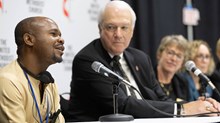
Over the years, comedic icon Bill Cosby has taken on some humorous characters —Fat Albert and Dr. Cliff Huxtable come to mind—and shaped American culture for the better. But in his latest role, Cosby the prophet is excoriating young black culture, urging African Americans to take responsibility for their lives and to stop blaming the "white man."
"For me, there is a time," Cosby told a Rainbow/PUSH gathering in Chicago recently, "when we have to turn the mirror around."
In that meeting and in an earlier appearance before black leaders, Cosby, 66, spoke bluntly. Answering accusations that he was airing his people's dirty laundry in public, Cosby snapped, "Let me tell you something. Your dirty laundry gets out of school at 2:30 every day. It's cursing and calling each other 'nigger' as they're walking up and down the street. They think 'they hip.' Can't read, can't write, 50 percent of them."
Cosby's tough-love message reminds me of Shelby Steele's groundbreaking book, The Content of Our Character. Steele noted:
The barriers to black progress in America today are clearly as much psychological as they are social or economic. We have suffered as much as any group in human history, and if this suffering has ennobled us, it has also wounded us and pushed us into defensive strategies that are often self-defeating. But we haven't fully admitted this to ourselves. The psychological realm is murky, frightening, and just plain embarrassing. And a risk is involved in exploring it: the risk of discovering the ways in which we contribute to, if not create, the reality in which we live. Denial, avoidance, and repression intervene to save us from this risk. But, of course, they only energize what is repressed with more and more negative power, so that we are victimized as much by our own buried fears as by racism.
Forty years after passage of the Civil Rights Act and fifty after the Brown vs. Board of Education decision by the Supreme Court, Cosby is saying things no white person could get away with. But he needs to say them. Of course, as a white male, I'm taking a risk to comment on these matters. I've never felt the sting of racial discrimination.
But I too have grown up with a permanent and visible physical difference. My disability—moderate cerebral palsy—is the first thing many people notice about me. It defines me in the minds of some, and it (like the color of one's skin) is inescapable. I think I understand a little of what Steele called "a lifelong voice of doubt," reinforced by decades of uncomfortable silences, patronizing treatment, and exclusion. Blacks are not the only people tempted to self-loathing, blaming others, and making excuses.
We also must acknowledge that blacks have no monopoly on social pathologies. Other groups, including whites, have members who make self-destructive choices. Unfortunately, some of what passes for black culture these days is highly dysfunctional. The first step in dealing with a pathology, either personal or social, is acknowledging its existence. Cosby, who has used his wealth to support education for blacks, did not present a dry academic treatise. Nor did he highlight the significant progress many blacks have made in educational participation, literacy, rising incomes, business, and entertainment. Yet even Jesse Jackson defended Cosby. "Bill is saying, 'Let's fight the right fight; let's level the playing field,'" Jackson said. "Drunk people can't do that. Illiterate people can't do that."
With a doctorate in education, Cosby, like a good professor, has set high standards. But I fear that he has overlooked the spiritual dimensions of this crisis. In so doing, he has missed the best hope for solving it—God's people working together in the power of the Spirit.
Speaking the Truth in Love Among the pathologies Cosby decried:
1. Poor Educational Achievement. "I can't even talk the way these people talk, 'Why you ain't,' 'Where you is,'" Cosby said. "I blamed the kid until I heard the mother talk—and then I heard the father talk. Everybody knows it's important to speak English except these knuckleheads. You can't be a doctor with that kind of crap coming out of your mouth." Cosby said many young blacks have "very, very thin" book bags and are "going nowhere."
According to the Education Trust, only 12 percent of African American fourth-graders reach proficient or advanced levels in reading, while 61 percent are below basic achievement levels. In math, just 7 percent of black eighth-graders reach proficient or advanced levels. Gains in reading and math during the 1970s and 1980s began to be reversed in the 1990s. Today, by the end of high school, the reading and math skills of African Americans are at the level of white students in the eighth grade. And while black college enrollment rates virtually match those of whites, only 41 percent of black students graduate in six years, compared with 61 percent of white students. More than 28 percent of whites aged 25 and older have four or more years of college. Only 16 percent of blacks do. While the gap is gradually narrowing and black incomes on average are rising, there is still a long way to go.
Article continues below
2. Sexual Irresponsibility. Cosby blamed music, movies, and television for encouraging young blacks toward sexual irresponsibility. "These young girls have no business having sex," Cosby said. "We've got too many young girls who don't know how to parent, turning themselves into parents. Ladies and gentlemen, our little 8-year-old boys, 9-year-old boys [are] having erections and only acting out what they see and hear on some CD. … It's time to stop!"
The illegitimacy rate among blacks in 1940 was only 19 percent. Unfortunately, the rate among African Americans has reached crisis proportions—more than 68 percent. In others words, two in every three blacks are being born into homes without a married father present.
3. Lack of Parental Control. Cosby, calling for "parent power," railed against black parents who do not discipline their children. "You [are] going to tell me that you are going to drop out of school?" Cosby said. "You are going to tell me that you are going to steal from a store? These things need to be taken care of in the home."
Unfortunately, as the above illegitimacy figures show, although some African American families may model the Huxtables, too many are simply staging areas for mayhem and despair. Boys from fatherless homes are more likely to be out of school and jobless. Girls are more likely to get pregnant and give birth outside of marriage. Boys whose fathers are absent from the home are twice as likely to end up incarcerated. Indeed, according to oft-quoted estimates, approximately 40 percent of black men in their 20s are incarcerated, on parole, or on probation. While blacks constitute about 12 percent of the U.S. population, they make up nearly 44 percent of the state and federal prison population. And it's worth noting that two-thirds of 600,000 inmates to be released this year will commit another crime that gets them arrested again in the next three years.
To change this, blacks must ignore the same tired siren songs of liberals. Speaking to an audience of black voters in Columbus, Ohio, last month, presidential candidate John Kerry commented on the high incarceration rate of blacks, saying, "It's not their fault." While it's true that many factors have produced this sad reality, the fact is that black community leaders must take primary responsibility to change it.
Article continues below
4. Lack of Respect. Cosby said many young African Americans have little or no respect for the sacrifices their parents and grandparents made to gain their civil rights. "Understand, your children have to know where you came from," he said. "Dogs, water hoses that tear the bark off trees, Emmett Till [a black in Mississippi who was tortured to death in 1955 after being accused of whistling at a white woman]. And you're going to tell me you're going to drop out? You're going to tell me you're going to steal from a store?"
Cosby is particularly incensed that blacks use the hated N-word among themselves. "This is an accepted word. You are so hip with 'nigger,' but you can't even spell it," Cosby said. Turning again to Steele, one could view this development as a way for blacks to insulate themselves from the demands of competing with higher-achieving whites by emphasizing their own "blackness." Steele said a black student told him he wasn't sure he should master standard English, because he "wouldn't be black no more."
5. Lack of Personal Responsibility. Black men need to take responsibility and stop blaming others, Cosby said. "Young men and old men, you've gotta stop beating up your women because you didn't find a job, because you didn't want to get an education, and now you are [earning] minimum wage," he said. "You should have thought more of yourself in high school." Also: "The housing project was set up for you to move in, move up, and move out."
Blacks are disproportionately represented on the welfare rolls. While the nation's official poverty rate is about 12 percent, the African American rate is double that. Welfare reform—by instituting time limits and work requirements—has helped, removing thousands from welfare and slashing teen birthrates. Much more needs to be done.
Helping Blacks Help Themselves Lost in this discussion of depressingly familiar statistics is the role churches and other faith-based organizations can play in helping African Americans to help themselves. In the battle to both prevent and eliminate black degradation, the key word is not independence (as Cosby seems to imply), but interdependence. We need one another.
A moral message—but bereft of spiritual power—has a certain appeal, but it is not the gospel. For decades, Muslim evangelists have found many American blacks to be receptive to a message of reform and submission. (For example, see Ed Gilbreath's interview with Christian apologist Carl Ellis.) Bill Cosby has once again shown the black community the law. It is up to Christians to demonstrate God's grace.
Article continues below
Of course, blacks are no strangers to God's Word. According to pollster George Barna, African Americans are significantly more likely than their white counterparts to pray, to read their Bibles, to attend church, to call themselves "born again Christians," and to feel responsible to tell others about their faith. We need to take advantage of these realities. Thankfully, many black churches already are.
Pastor James Meeks of Chicago's poor Roseland neighborhood has rolled up his sleeves. Meeks's Salem Baptist Church runs a daycare facility, a counseling center for drug abusers, a soup kitchen, a financial management ministry, and a 500-student private school, Salem Christian Academy. Meeks, a state senator, is also fighting to close down all the liquor stores and bars in Roseland.
While interdependence is important, dependence (on God) is even more vital. Cosby says too few blacks are motivated to improve their lives, saying they "have no picture that is large enough to take you out of where you [are] going." Christianity provides that picture and is one of the greatest springboards to self-improvement known in world history. Faith in Christ is often just the first step in a process of transformation—spiritual, personal, and social. It's no accident that people rightly related to God vertically often improve their relationships with others horizontally. Evangelism and social uplift go hand in hand.
In the State of the Union message earlier this year, President Bush noted, "We know from long experience that if [ex-cons] can't find work, or a home, or help, they are much more likely to commit more crimes and return to prison." That's why projects such as Operation Starting Line are so promising. An initiative of hundreds of community ministries and thousands of local churches, OSL provides in-prison and post-release training in acquiring life skills, spiritual training, and mentoring to 500,000 inmates of all races.
While Bill Cosby's gospel of the bootstrap has a strong element of truth, Christians—of whatever race—must never forget the Lord's call to help "the least of these," and, in so doing, become the neighbors that black America so desperately needs.
Stan Guthrie is associate news editor of Christianity Today.
News elsewhere on Bill Cosby's message to the black community includes:
Bill Cosby refrains from criticism in latest speech after controversy | Comedian Bill Cosby avoided his recent criticism of some segments of the black community, sticking instead to humour and praise for parents during a charity event for at-risk children. (Associated Press, July 19, 2004)
Bill Cosby's Controversial Comments | He lambasted their language, decried their decorum and panned their parenting. No wonder Bill's Cosby's remarks about African Americans have created a stir. Were his words a welcome wake-up call? Or a misguided attack? Bill Cosby joins NPR's Lynn Neary to discuss his controversial comments. (NPR, Talk of the Nation, July 7, 2004)
Bill Cosby has more harsh words for black community | Bill Cosby went off on another tirade against the black community Thursday, telling a room full of activists that black children are running around not knowing how to read or write and "going nowhere." (Associated Press, July 2, 2004)












 While we pray for peace, we need moral clarity about this war.
 As my doubts about his teachings grew, so did a secret fascination with Jesus.
 The plan would organize UMC churches in four global regions, with each given more leeway around same-sex marriage and other theological issues.





