From inner-city gardens, to fine-art exhibitions, to political activism, street-smart churches are changing the culture of America's largest and most dynamic city.
Acting on a tip, FBI agents in early October began digging up a vacant, swampy lot in Queens with a backhoe, searching for bodies of Mafia victims. One person the agents were seeking disappeared 24 years ago after he accidentally killed the 12-year-old son of John Gotti, the late "Teflon Don" mobster.
I knew exactly where they were digging. I had been on that lonely dead end on Easter. For the past two years, I have been searching hundreds of streets and alleyways to discover the civilizing effect of Christ on New York City. I could have told them where to find the unusual slab of concrete I had noticed. There were no churches nearby, but there were a few toy Easter bunnies around. In this neighborhood that some call "Mafiaville," no civilizing effect was to be found.
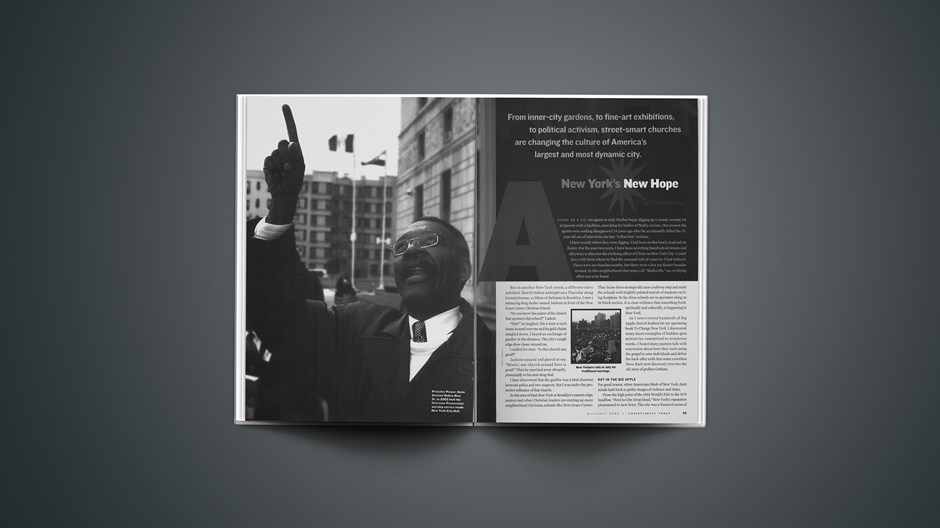
But on another New York street, a different story unfolded. Shortly before midnight on a Thursday along Livonia Avenue, a ribbon of darkness in Brooklyn, I met a menacing drug dealer named Jackson in front of the New Grace Center Christian School.
"Do you know the pastor of the church that sponsors this school?" I asked.
"Hah!" he laughed. His 6-foot-4-inch frame loomed over me and his gold chains dangled down. I heard an exchange of gunfire in the distance. The city's rough edge drew closer around me.
I stalled for time. "Is this church any good?"
Jackson paused and glared at me. "Mister, any church around here is good!" Then he marched away abruptly, presumably to his next drug deal.
I later discovered that the gunfire was a fatal shootout between police and two suspects. But I was under the protective influence of that church.
In this area of East New York at Brooklyn's eastern edge, pastors and other Christian leaders are starting up many neighborhood Christian schools like New Grace Center. They locate them strategically near a subway stop and mark the schools with brightly painted murals of students reciting Scripture. So far, three schools are in operation along an 18-block section. It is clear evidence that something fresh, spiritually and culturally, is happening in New York.
As I interviewed hundreds of Big Apple church leaders for my upcoming book To Change New York, I discovered many more examples of hidden-gem ministries committed to wondrous works. I heard many pastors talk with conviction about how they were using the gospel to save individuals and defeat the back-alley evils that snare countless lives. Each new discovery rewrites the old story of godless Gotham.
Rot in the Big Apple
For good reason, when Americans think of New York, their minds hark back to gothic images of violence and chaos.
From the high point of the 1964 World's Fair to the 1975 headline, "Ford to City: Drop Dead," New York's reputation plummeted to new lows. The city was a frenzied scene of screaming fire trucks, grafters, murder victims, and looting. The 1977 blackout and resulting riots in Harlem shut the city down. The Son of Sam serial killer still roamed the streets. Pastors told me they kept shotguns under their pulpits because robbers were going from church to church on Sundays to loot the collection plates. In the South Bronx, 100,000 units of housing burned down and murder increased 900 percent.
Later, between 1985 and 2000, 5,386 Bronx residents were murdered, 5,000 died of drug overdoses and 12,460 of full-blown aids. One year, Morris Park High School graduated a mere 24 students out of an entering class of 1,200.
In East New York, police wore T-shirts that said "The Killing Fields" to signify that the borough had the highest-proof cocktail of violence and mayhem in the nation.
But New York City's recovery is visible, though still incomplete. When a movie company wanted to show the old New York of burnt-out buildings amid a wasteland of debris, they had to haul in their own debris and burn their own building. Much change has to do with better government. The churches have played a part that has not yet been told.
It slowly began in the 1970s with the creation of new churches and the renewal of old ones. New Grace Center got its start in 1975. At the time, immigrant churches remained isolated from the city, and growth was painfully slow. In 1977, Puerto Rican Rubén Díaz Sr., now a state senator, became pastor of Seward Avenue Church of God (Cleveland). Through this period, Manhattan's evangelicals could count on one hand the number of vital churches, such as First Christian Missionary Alliance, the charismatic One Flock, or the venerable Calvary Baptist.
Starting in the mid-1980s and 1990s, both church startups and church renewals accelerated. Church leaders discovered each other through networking, big events, Communion services, and racial reconciliation meetings. Housing construction, food kitchens, and arts ministries started. The New York Arts Group, a fellowship of Christian artists, started to take off in the 1980s.
Beginning in 1982 on a card table in front of a Chinatown bookstore, Chinese Christian Herald Crusade started its international holistic ministry. Here's Life Inner City, a key group for evangelical networking, started in 1983. In 1985, Nehemiah Corporation began to build new homes and Robert Johansson's Evangel Christian School embarked on a journey to become a full-fledged K-12 institution.
Article continues below
In 1988, Campus Crusade in New York connected a group of urban professionals with pastor Timothy Keller. They formed the core of Redeemer Presbyterian Church. It started services in 1989 and today is one of Manhattan's most vital congregations.
During the 1990s, evangelicals achieved milestone after milestone of growth. On September 22, 1991, 250,000 people gathered to hear Billy Graham in Central Park. That event was the largest single gathering of all Graham crusades in North America.
In 1996, Promise Keepers filled Shea Stadium in Queens and introduced New Yorkers to A. R. Bernard, the founder and leader of the Christian Cultural Center in Brooklyn. One year later, researchers at Columbia University found that more than 50 percent of churches had experienced growth in attendance year over year.
In September 1999, The King's College, a bankrupt evangelical school, was relaunched with 17 undergraduates on the 15th floor of the Empire State Building as a part of Campus Crusade for Christ. This fall, enrollment topped 250. Within the last five years, Nyack College's city-campus enrollment has tripled. Also in 1999, Joseph Mattera, pastor of Brooklyn's Resurrection Church, birthed the City Covenant Coalition, an advocacy and networking organization. This year, its 500 associated churches are developing a broader, pro-family agenda.
In 2001, Keller's Redeemer Presbyterian started a church-planting center that has helped create more than 100 new churches in New York and elsewhere. In 2004 Johansson created the Evangelical Christian School Movement. There are now more than 100 Christian schools and 100 Bible institutes in the city.
According to the Columbia University survey, Christians were at one point in the late 1990s opening one new church every three weeks in the South Bronx. In Brooklyn, one four-block area in the Bushwick neighborhood saw an increase from two churches to twelve churches in less than 15 years. In Manhattan, you can stumble onto a pocket-sized cathedral built by Guyanese immigrants. Nearby, six storefront churches face each other within one block. These churches are straining to keep up with the new members.
In the Ocean Hill-Brownsville area of Brooklyn, the site of a brutal struggle between Jews and blacks in 1967, pastors are rehabbing their churches to prepare for the newcomers moving into homes built by new church development corporations.
Article continues below
"We have to be prepared because the people are coming," one deacon told me as he supervised construction workers.
Rap, rock, gospel, soul, and classical music spills out into the street mixing into a grand orchestration of cultural renewal. Many churches today have recording studios, and mothers push into visitors' hands sample cds of their children's music. "Listen to this! My daughter did this one," one mother told me urgently. A visit to a ministry is an invitation to walk out with sample cds and fliers for art shows, gospel pantomime, and dance services.
There are now 7,100 evangelical, charismatic, and Pentecostal churches in New York City, according to a recent church census conducted by Columbia University for the Christian Cultural Center. The situation is reminiscent of the early 1900s when sociologist Max Weber arrived here to prepare for his 1904 book, The Protestant Ethic and the Spirit of Capitalism, and noted "the wild buzzing and whizzing of the city."
Weber said, "The buildings rose as great fires to a God above all."
Preparing for the new
Amid this diversity of energetic activity, New York's evangelical church leaders are finding new unity in transforming the city's culture. Three kinds of urbanism compete for pre-eminence in New York: secularist modernism, magical urbanism of voodoo and Eastern religions, and "glorious urbanism" of the new Christians.
These church leaders want to usher in an era in which the church makes a citywide impact through compassionate service, principled politics, and multicultural arts.
One nationally well-known example of this glorious urbanism is Redeemer Presbyterian Church. Pastor Tim Keller, formerly a seminary professor at Westminster Theological Seminary in Philadelphia, learned to be nimble in the pulpit as well as on Broadway, where his office is located. Keller has translated megachurch ideas into the urban setting, generally attracting New York's working professionals. Since 1989, Redeemer Presbyterian Church has grown to 4,200 in attendance on Sundays, meeting in three locations. The church has helped plant 100 neighborhood congregations in greater New York City. Keller's formula for reaching urbanites entails culturally aware preaching, sophisticated aesthetics, and fiercely pro-city sentiments. ("I hate the suburbs," he said in one sermon.) The church's vision statement would be considered audacious if the church weren't having such an impact: "To spread the gospel, first through ourselves and then through the city by word, deed, and community; To bring about personal changes, social healing, and cultural renewal through a movement of churches and ministries that change New York City and through it, the world."
Article continues below
A less well-known example, at least nationally, is A. R. Bernard and the 21,000 people at the Christian Cultural Center in Brooklyn's East New York. Whether he's meditating on a flower in the church's gem of a horticultural garden or riding his big bmc Chopper down the beach to pray, Bernard is restless about bringing a gospel-based cultural revolution to the city.
He has traveled from being a rebellious Muslim teen to being chair of the June 2005 Billy Graham Crusade. Born in Panama, Bernard's white Spanish father rejected him. He and his mother immigrated to Brooklyn. Growing up, he felt different, outside the mainstream. At first he threw himself into the dreams of the encyclopedia: wondrous Egypt, great classical Greece, and the incredible origins of the alphabet from the Phoenicians.
As a teenager he followed the teachings of Elijah Muhammad and the Nation of Islam. They provided order and gave dignity. But they did not hold on to him for long. Bernard came to Christ through Teen Challenge's Nicky Cruz. In 1978 Bernard started his pastoral career out of a storefront as Household of Faith Ministries.
After significant growth, the ministry was able to build its current facility in 2000, and three years ago, the 52-year-old pastor changed the name of his church from Christian Life Center to Christian Cultural Center to embody a new vision. He says Christian leaders must become "transformers of culture."
During one of our in-depth conversations, he told me, "We live in two kingdoms: the one here in which we live out our faith and the one to come in heaven.
"We should never be satisfied with the one here. We should always be changing our world in view of what is to come."
The Christian Cultural Center does that with the usual array of church ministries to men, women, youth, prisoners, children (running a preparatory school, for example), and so on. Some of these are having wide-ranging impact. The New York Post's local gossip column, "Page Six," recently announced, "The Christian Cultural Center in Brooklyn hosts an invitation-only celebrity Bible study, which draws the likes of N.Y. Jets running back Curtis Martin, Star Jones, Angela Bassett, Courtney Vance, and celebrity publicist Marvet Britto." It complained that Bernard keeps it private and under the wraps.
Article continues below
Some Christian Cultural Center ministries are fresh and reach a completely different part of the city. Take the church's motorcycle ministry. Bernard is a biking enthusiast. "Riding a motorcycle is spiritual. You are sitting on a motor with power. There is a rush, certain sensations riding the cycle. You are moving forward but with the wind hitting you too."
Every August, the church sponsors a Blessing of the Bikes. Thousands of tattooed, heavy-booted cyclists come out. Among cycle gangs this has become an event not to miss. One observed, "I heard this was a good thing to be at. So, I came to see if I could benefit." Some, like leaders of the dreaded Vaughn Rangers, have become believers. There are now enough converts that the church has founded its own cycle club, Gye Nyame, a Ghanian name that means "omnipotence of God."
From greed to grace
In many instances, new immigrants are creating what it means to be a 21st-century New Yorker.
Robert Nisbet, the great Columbia University sociologist, said that social change rarely comes from the inside. "It is always the result of the intrusion of something that shakes things up and demands a new way." It's a new social movement of urban Christians that is taking New Yorkers on a journey from greed to grace.
In the 1960-1970s, the white native-born evangelical churches were shrinking. Like most long-established organizations, these churches were not innovative. They were on the defensive and blind to their surroundings. For example, Calvary Baptist Church's constitution prohibited illegal immigrants from becoming members.
But New York City has never had more foreign-born residents in its history. Of the 8 million people in New York City, 36 percent were born in another nation. Those 2.88 million foreign-born New Yorkers exceed the city's entire population in 1890, according to U.S. Census data.
From a population low point of 7 million in 1980, New York has added more than 1 million souls to the city census, and since 2000, 104,000 new foreigners have made New York their home each year.
That influx has led to a plethora of new churches, suggesting that the city is not a melting pot so much as a cornucopia. For example, new Russian immigrants have founded eight Messianic Jewish churches, including a cultural center on the main street of Brighton Beach.
Some of the fastest-growing churches are Asian. Church of Grace to Fujianese, founded in 1988, is 65 percent new Christians with 800 members and five spin-offs in five years.
Article continues below
One megachurch, Overseas Chinese Mission, is the tallest church building in New York, reaching nine stories high. The almost all-immigrant New York Presbyterian Korean Church has 6,000 members. New Life Fellowship was founded in 1987 by Pete and Geri Scazzero from New Jersey via Costa Rica. The Salvation Army's newest church, founded in 1999, already has an 800-member Spanish-speaking congregation.
A group of immigrants from Nigeria founded Christ the Rock in the East New York area in 1996. They are ambitious for God and certainly energetic. There are now more than 100 new African churches in the city since 1993.
The 1990s were also the era of Seinfeld, Friends, and Sex and the City. Hundreds of thousands of young professionals came for the boom in financial services, culture, and urban lifestyle epitomized by these programs. Several thousand of these mostly white and Asian American migrants ended up at churches like Redeemer. And Southern Baptists have planted three successful "postmodern" congregations, The Journey, Mosaic, and 411. More are on the drawing boards.
Hugo Moreno represents both these worlds—immigrant and professional. Moreno came to New York from Peru to work in a professional career. But the stresses of immigration, marital discord, and a sense of a meaningless life threw him into alcoholism. "I went to a psychiatrist to beat the habit but couldn't." Two years ago, he was desperate and wandered into Christ the Rock. "I immediately felt the power of God! I could feel my chains breaking off." Moreno and his nephew were saved and now they volunteer to transport elderly people who can't easily get back to their homes, especially after dark. I caught up with them about midnight as they were locking up the vans. Moreno told me, "The power of God to heal continues with us to this day. You see my nephew? He is safe now."
City Hall to city streets
This renewal isn't just isolated, unrelated developments. It's a full-blown, infectious network of newcomers branching out across New York City's five boroughs. Recently, Bernard from Brooklyn conferred with Hispanic Christian leaders in the Bronx. Hispanic Christians are now well-entrenched within the Bronx power structure. A Protestant pastor serves as president of the borough, another pastor as a state representative, and Rubén Díaz Sr. is widely known as "the reverend senator." He also runs a service network from his church that cares for 5,000 elderly New Yorkers.
Article continues below
Any alliance between blacks and Hispanics in New York poses difficulties for both groups due to long-standing tensions over jobs, schools, and housing.
Opposition to gay marriage is the one issue that has brought blacks and Hispanics together in big numbers. In July, the Bronx Hispanic Christians organized the largest rally against gay marriage in America up to that time. About 8,000 people turned out. Joseph Mattera's City Covenant Coalition picketed City Hall with gospel songs many times.
Such breakthroughs are gaining notice. Rudy Giuliani, former New York mayor, told me in an interview, "The evangelical and Pentecostal churches will play an increasingly important role in city politics."
Still, the church's impact is probably felt most pervasively at the lower levels of power. A recent study found that in New York, the most common slogan among homeless women is: "Without my faith I wouldn't have made it." This finding from research by Kimberly Kennard at City University of New York suggests that the civilizing effect of Christ is permeating the bottom rung of society.
The second-most-common slogan? "God's presence is everywhere."
A woman named Grace told Kennard: "The best gift I have ever received is the gift of Jesus."
This spiritual hope is reflected in the creative work of Christians throughout the city.
In 1987, artist Mako Fujimura became a Christian and immigrated to New York. He discovered a city "full of isolated individuals who are enormously gifted and yet they have no hope."
With the help of Redeemer Presbyterian, Fujimura started IAM artist fellowship with the idea of bringing a living, practical love to the city. "As I live and breathe the culture of New York, as I am called to live to seek the shalom and prosperity of the city, I must work incarnationally and get my hands dirty." Fujimura's work has been widely exhibited.
For Fujimura the perfect symbol of the transformation going on in New York City is the white columbine flower. It is "an early Christian symbol for the Holy Spirit but which has a more recent association of tragedy and suffering," he told me.
Fujimura muses that life in the city can turn tragic but beauty and grace can come out of tragedy. "In the sun the wild columbine's petals turn purple, but in the shade they are almost transparent white. There is hope. There is purpose to suffering."
Fujimura and his colleagues put on a show after 9/11 to indicate that belief in "a place where the weight and reality of our darkness and at the same time our dreams can be seen."
Article continues below
Foreign-born Philip Foster came from the South American country of Guyana in the 1980s. He saw much tragedy of city life in his tough Ocean Hill-Brownsville neighborhood. Yet, even while the fires burned and people were murdered routinely, he believed that Christ could bring new redemption.
At one of Brooklyn's bleakest moments, Foster started "The Garden of Gethsemane" in the middle of the burnt-out district.
The garden encompasses its entire lot and has a grape arbor out front. At the entrance, a sign proclaims: "God's riches at Christ's expense."
Foster provides widows and poverty-stricken neighbors with free long green beans (grown with special seeds from Guyana), three types of eggplant, lettuce, cabbage, yellow and red tomatoes, grapes, and other vegetables. The Brooklyn borough president has declared Foster "a precious resource of Brooklyn and its best green gardener."
Bernard also symbolizes the city's cultural transformation with flowers and a garden. His church sanctuary is festooned with Chinese, Indian, South American, and European artists' renditions of the rose of Sharon. He grows roses all around his home. He muses, "You have to go through the thorns to get to the rose. It is also the name of Christ."
With legendary African American horticulturalist Amos Taylor, Bernard built a jewel-like horticultural garden on the church grounds. Its waterfalls, flowers, and sweet smells are invitations to a different kind of life in the city.
"See how the purple flowers creep through the fence onto the sidewalk around the church," Bernard enthuses.
"Our flowers are going out to the community offering a different world: safe, secure, inviting."
Based in New York City, Tony Carnes is codirector of the Research Institute for New Americans and a senior news writer for Christianity Today.
Christian Cultural Center says, "With its classically styled Worship Center, Museum, Mall, Restaurants, Book Store, Prayer Center, Pavilion Garden and Community Services, CCC is a Celebration of the Christian Life and its colorful and world-changing history."
City Covenant Coalition has more information about its work to "come together in covenant to transform cities and impact the nations with the 'gospel of the Kingdom of God'."
International Arts Movement is Mako Jujimura's community of artists attempting to translate the gospel through art.















 While we pray for peace, we need moral clarity about this war.
 We’ve got little information on Jesus’ appearance and personality. But that’s the way God designed it.españolFrançais
 The plan would organize UMC churches in four global regions, with each given more leeway around same-sex marriage and other theological issues.






