
In 1980 one of America's activist evangelical theologians, Ronald J. Sider, wrote that liberation theologies were "the most significant theological development of the decade." Black, feminist, and Latin American theologies of liberation, he wrote, attempt to fundamentally rethink theology from the standpoint of the oppressed. God, after all, is on their side.
Having turned the corner into the 21st century, the challenge now is to consider the relevance of these theologies for our Christian formation and our life together in churches. Two recent volumes consider the status of black theology. Both emerge out of the authors' contact with the first generation of black theologians and the issues raised in the final three decades of the 20th century. Both writers are African Americans involved deeply in their community, as well as in other circles in the United States and abroad. Both belong to the second generation of black theologians.
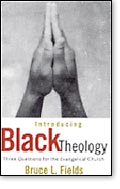
The first question Bruce L. Fields asks in Introducing Black Theology is "What is black theology?" It is theology from the perspective of an oppressed people. It seeks to interpret the gospel of Jesus Christ against the backdrop of historical and contemporary racism. The message of black theology is that the African American struggle for liberation is consistent with the gospel—every theological statement must be consistent with, and perpetuate, the goals of liberation.
Why should liberation be considered the essence of the gospel? As an evangelical, Fields clearly frames the gospel in the familiar language of personal salvation through Jesus Christ, as well as the Spirit-led witness to the surrounding culture; the message of liberation is a necessary companion. Liberation implies not only the condemnation of racism in all its forms, but also the struggle for justice, both personally and in society.
African Americans must be liberated from multiple forms of bondage—social, political, economic, and religious. This liberation involves empowerment and "also demands the right of self-definition, self-affirmation, and self-determination."
Fields, assistant professor of biblical and systematic theology at Trinity Evangelical Divinity School, relies on James H. Cone, the architect of American black theology from Union Theological Seminary, for delineating the sources of black theology—the historical and religious experience of African American people, the revelation of God at work in the black experience, the witness of Scripture, the truth in Jesus Christ, and church tradition.
Fields' second question is "What can black theology teach the evangelical church?" Plenty, he answers. He minces no words in critiquing the racism that pervades churches, as well as the systemic racism prevalent in U.S. society. Black liberation theology speaks directly to those ills. For instance, Fields asserts that grappling with black liberation theology can lead to a profound renewed study of the church's prophetic calling. Also, he notes, it could remind the evangelical church of the need for dialogue with "the theology of the Two-Thirds World."
Fields is firm and pointed in his plea for clarity and discernment. "My basic premise is that unless black theology remains within the parameters of certain biblical and traditional confessions, its power will dissipate and will be rendered ineffective as a servant to the black church in particular, and to the church in general. Some may hold that close proximity to traditional belief will lead to a blunting of black theology's liberative message and form. I must concede the fact that this is a possibility. I would insist, however, that it is not a necessity."
Fields believes that black theology remains relevant and necessary. But he notes that it must be seen in the context of the historic sweep of Christian theology. He has provided an introduction; fuller, deeper, and broader coverage awaits.
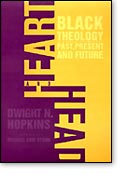
Heart and Head consists of eight essays that Dwight N. Hopkins presented "at different times and in different contexts," all related to black liberation theology. Hopkins, associate professor of theology at the University of Chicago Divinity School, has published over a dozen titles in the field.
His chapter headings are intriguing: "Black Theology of Liberation and the Impact of Womanist Theology," "The Preferential Option for the Poor and the Oppressed," "Spirituality and Transformation in Black Theology," "A New Black Heterosexual Male," "A Black American Perspective on Interfaith Dialogue in the Ecumenical Association of Third World Theologians," "The Religion of Globalization," "James H. Cone and Thoughts for a New Generation," and "A New Common Wealth."
Following the first generation of black theologians, especially Cone, Hopkins says that for the movement to evolve, black theology must always be linked with the liberation of the poor and oppressed. It should have a continuing link with the prophetic black churches and church-related institutions.
Black theology, he says, must also deliberately unite with womanist theology, cultivating "a prolonged, organized conversation and joining practice between womanists and (male) black theologians." (Womanist refers to the black feminist movement, emphasizing strong, assertive traits.) Black women must be empowered for making decisions in "business ownership, politics, education, religion, the family, and more."
Furthermore, he says, black women must be accepted as pastors, bringing new styles of church leadership.
Hopkins calls for more global interfaith dialogue that would connect multiple versions of liberation theology. Finally, he calls for developing what it means "to be a healthy heterosexual African American man." Heart and Head argues that black theology is relevant and necessary for the church today, as long as it is always joined to the actual work of liberation.
Cone, in his autobiography My Soul Looks Back, says about the future of black theology: "Its chief task is to help the church to be faithful to the task of preaching and living the liberating gospel of Jesus Christ in the world today."
Both of these volumes point readers in that challenging direction.
F. Burton Nelson is research professor of Christian Ethics at North Park Theological Seminary in Chicago, and a senior associate at Oxford University.
 |
 |
Copyright © 2004 Christianity Today. Click for reprint information.