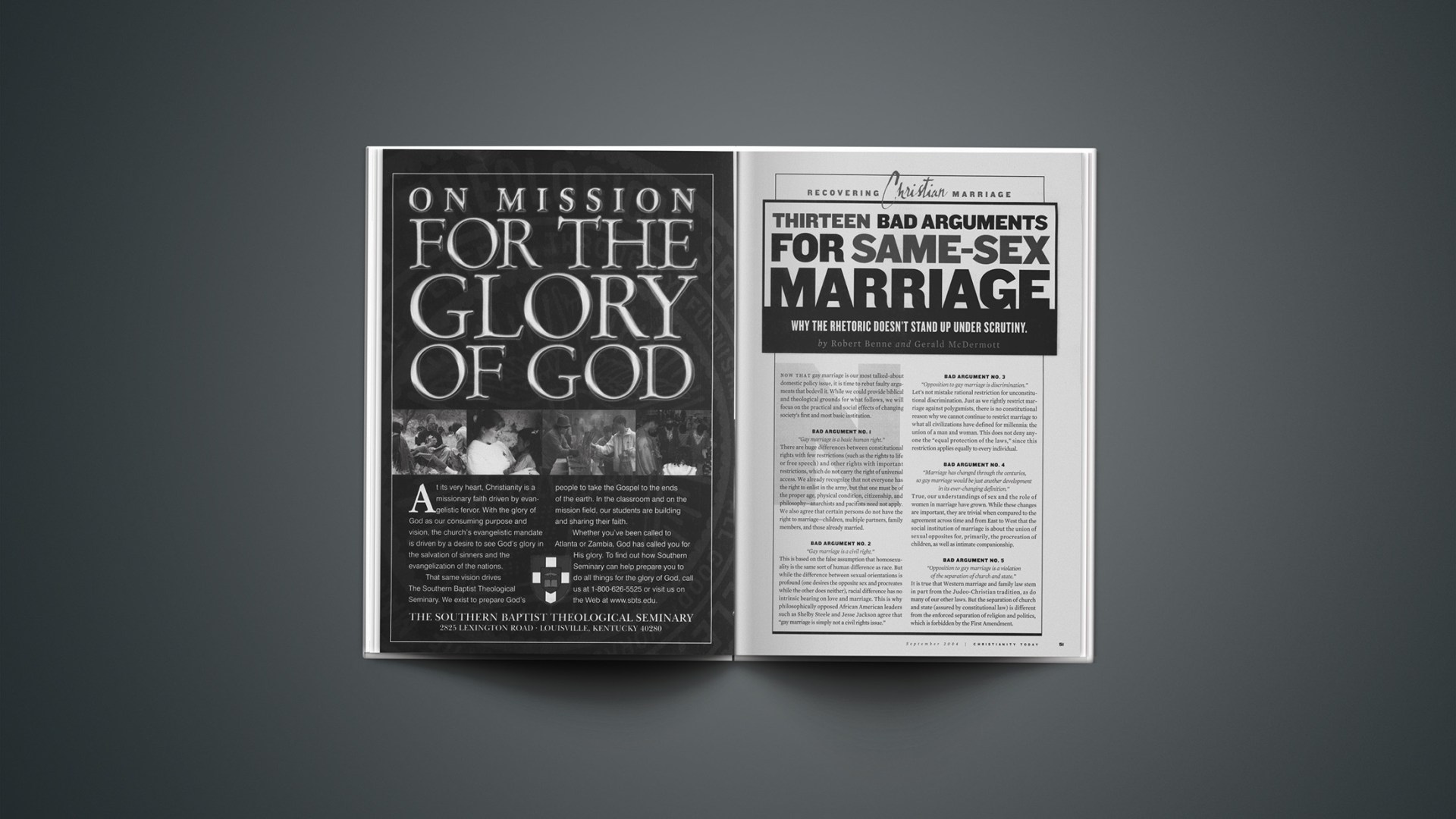

Now that gay marriage is our most talked-about domestic policy issue, it is time to rebut faulty arguments that bedevil it. While we could provide biblical and theological grounds for what follows, we will focus on the practical and social effects of changing society’s first and most basic institution.
Bad argument No. 1
“Gay marriage is a basic human right.”
There are huge differences between constitutional rights with few restrictions (such as the rights to life or free speech) and other rights with important restrictions, which do not carry the right of universal access. We already recognize that not everyone has the right to enlist in the army, but that one must be of the proper age, physical condition, citizenship, and philosophy—anarchists and pacifists need not apply. We also agree that certain persons do not have the right to marriage—children, multiple partners, family members, and those already married.
Bad argument No. 2
“Gay marriage is a civil right.”
This is based on the false assumption that homosexuality is the same sort of human difference as race. But while the difference between sexual orientations is profound (one desires the opposite sex and procreates while the other does neither), racial difference has no intrinsic bearing on love and marriage. This is why philosophically opposed African American leaders such as Shelby Steele and Jesse Jackson agree that “gay marriage is simply not a civil rights issue.”
Bad argument No. 3
“Opposition to gay marriage is discrimination.”
Let’s not mistake rational restriction for unconstitutional discrimination. Just as we rightly restrict marriage against polygamists, there is no constitutional reason why we cannot continue to restrict marriage to what all civilizations have defined for millennia: the union of a man and woman. This does not deny anyone the “equal protection of the laws,” since this restriction applies equally to every individual.
Bad argument No. 4
“Marriage has changed through the centuries, so gay marriage would be just another development in its ever-changing definition.”
True, our understandings of sex and the role of women in marriage have grown. While these changes are important, they are trivial when compared to the agreement across time and from East to West that the social institution of marriage is about the union of sexual opposites for, primarily, the procreation of children, as well as intimate companionship.
Bad argument No. 5
“Opposition to gay marriage is a violation of the separation of church and state.”
It is true that Western marriage and family law stem in part from the Judeo-Christian tradition, as do many of our other laws. But the separation of church and state (assured by constitutional law) is different from the enforced separation of religion and politics, which is forbidden by the First Amendment.
Bad argument No. 6
“Marriage is necessary for gays to gain important legal benefits.”
Homosexuals don’t need marriage to gain most significant legal benefits. For example, hospital visitation depends on the wishes of the patient. If families disagree about medical treatment, even marriage won’t solve the problem, as the Terry Schiavo case has demonstrated. The answer is medical power of attorney, which is open to anyone regardless of sexual orientation. Another example is Social Security benefits. Children’s benefits are not dependent on the marital status of their parents, and the only certain benefit is a one-time death benefit of $255. A wife can access her deceased husband’s Social Security, but if she has had her own work history, her Social Security benefit would usually be higher than the survivor’s benefit—and she must choose one or the other. Most other benefits are based on work history.
Bad argument No. 7
“There is no proof that gay marriage would change the marriages of heterosexuals.”
If marriage is all about fulfilling human desires and not parenting (as many proponents of gay marriage argue), it makes sense to dissolve marriages that don’t seem fulfilling. Recent experience in Scandinavia suggests that when a society reduces marriage to this minimalist definition, families dissolve more quickly. British demographer Kathleen Kiernan has shown that since gay marriage came to Scandinavia in the early ’90s, the out-of-wedlock birthrate has leaped significantly, and the family dissolution rate has risen. Only where the gay marriage movement had little success has the out-of-wedlock birthrate remained low. Marriage has virtually disappeared in the most gay-friendly districts of Norway, formerly the most conservative of the Nordic countries.
Bad argument No. 8
“Social science shows that gay parenting is no different from heterosexual parenting.”
Many studies have claimed this, but, according to University of Chicago’s emeritus professor of ethics and social sciences Don Browning, none of these studies was rigorous or large-scale. Stephen Nock, scholar of marriage at the University of Virginia, writes that every study on the subject of gay parenting “contained at least one fatal flaw,” and “not a single one was conducted according to generally accepted standards of scientific research.” Other studies show that children raised by homosexuals were more dissatisfied with their own gender, had homosexual experiences more frequently, and suffered a greater rate of molestation by members of their families (Adolescence, 1996; Archives of Sexual Behavior, 1986; American Sociological Review, 2001).
Bad argument No. 9
“The fact that many married couples do not have children proves that marriage is not intrinsically related to procreation.”
Yet the fact remains that most married couples either have had or will have children. The exceptions prove the rule: Being married tends to prevent a person from having a child with someone other than his or her spouse. In all cultures, even if some couples are childless, marriage as an institution is principally concerned with children and, therefore, society’s future.
Bad argument No. 10
“Heterosexuals have done a terrible job at marriage. Who are they to speak?”
It is true that half of all new heterosexual marriages end in divorce. But far more than half have succeeded, if you count marriages established before the divorce boom of the ’70s and ’80s. Yet the point is not how many are successful, but what marriage means. To accommodate gays, marriage would have to change into something it has never been: an institution for same-sex love without the biological possibility for children. It will probably not require sexual fidelity, which even the majority of unfaithful heterosexuals have conceded is the ideal. Some of the most prominent proponents of gay marriage, such as Andrew Sullivan, say the ideal needs to change, since gay understanding of fidelity includes other sexual liaisons.
Bad argument No. 11
“The resistance to gay marriage is motivated by fear and loathing for homosexuals.”
While no large group is free of hate-mongers, the vast majority resist because they strongly believe in the positive features of traditional marriage. They have experienced the benefits of the lifelong union of two persons who are complementary in many important ways—biological, psychological, temperamental, and spiritual—and who, because of this complementarity, have a unique capacity to bear and nurture children. It is appreciation for the unparalleled success of this complementarity—not fear or hatred for gays—that motivates most Americans to oppose gay marriage.
Bad argument No. 12
“Those who resist gay marriage are irrational, Neanderthal, and bigoted.”
The gay marriage movement is only a few decades old. Could it be that billions of people who for millennia upheld traditional marriage were really irrational and bigoted? On the contrary, we would argue that a common-sense understanding of life leads in the direction we have argued. Further, it seems clear that reason without religious vision misses the depth dimension of human life. It tends to dissolve basic human institutions into contracts between persons who make whatever they want of them, to the detriment of children and society.
Bad argument No. 13
“The legal issue of gay marriage ought to be left up to the states.”
Quite the opposite, we need a national definition of marriage. Without a public definition embodied in a constitutional amendment, activist judges at various levels will undo the conviction of the vast majority of Americans. Some already have, in defiance of state defense-of-marriage acts. Precedent for a national definition is ample—the federal government outlawed polygamy in the 19th century and the Supreme Court has ruled in the 20th century on many cases regarding marriage.
In sum, there are many bad reasons for supporting gay marriage. In contrast, there are many good reasons for protecting historic understandings of marriage, a public institution whose fate will determine the future of our society.
Robert Benne and Gerald McDermott both teach religion at Roanoke College in Virginia. Benne is a lay Lutheran theologian and McDermott is an Episcopal priest.
Copyright © 2004 Christianity Today. Click for reprint information.
Related Elsewhere:
Christianity Today‘s past coverage of the gay marriage debate includes:
The Man Behind the Marriage Amendment | It’s just as well that Matt Daniels loves a good fight, because he has a big one on his hands. (Aug. 25, 2004)
A Crumbling Institution | How social revolutions cracked the pillars of marriage. (Aug. 24, 2004)
What God Hath Not Joined | Why marriage was designed for male and female. (Aug. 20, 2004)
The Next Sexual Revolution | By practicing what it preaches on marriage, the church could transform society. (Aug. 27, 2003)
My Two Dads? Not in Florida | U.S. Circuit Court upholds ban on gay adoption (March 11, 2004)
Speaking Out: Why Gay Marriage Would Be Harmful | Institutionalizing homosexual marriage would be bad for marriage, bad for children, and bad for society. (Feb. 19, 2004)
Let No Law Put Asunder | A constitutional amendment defending marriage is worth the effort. (Jan. 26, 2004)
Massachusetts Court Backs Gay Marriage | Christians say gay activists will overturn marriage laws (Dec. 10, 2003)
‘AMan and a Woman’ | Activists say the Federal Marriage Amendment will be the defining issue in the next election. (Nov. 24, 2003)
The Marriage Battle Begins | Profamily and gay activists agree: Texas decision sets significant precedent. (Aug. 11, 2003)
Canada Backs Gay Marriages | Conservatives say decision could put pressure on dissenting churches. (July 16, 2003)
Marriage in the Dock | Massachusetts case on gay marriage could set off chain reaction. (April 25, 2003)
Christian Conservatives Split on Federal Marriage Amendment | Law would protect marriage from courts, but legislatures could still extend marital benefits to same-sex unions. (July 20, 2002)
Defining Marriage | Conservatives advocate amendment to preserve traditional matrimony. (October 1, 2001)
No Balm in Denver | Episcopalians defer debate over same-sex blessings for another three years. (July 17, 2001)
Marriage Laws Embroil Legislatures | New Englanders push for domestic-partner benefits. (April 26, 2001)
Presbyterians Propose Ban on Same-Sex Ceremonies | Change to church constitution, which passes by only 17 votes, now goes to presbyteries. (July 5, 2001)
Sticking With the Status Quo | United Methodists reject gay marriage, ordination. (May 15, 2000)
Presbyterians Vote Down Ban on Same-Sex Unions | Opponents say vague wording led to defeat. (March 29, 2001)
States Consider Laws on Same-Sex Unions California to vote on ‘limit on marriage’ in March (Jan. 10, 1999)
Presbyterians Support Same-Sex Unions (Dec. 10, 1999)
Pastor Suspended in Test of Same-Sex Marriage Ban (Apr. 26, 1999)
Same-Sex Rites Cause Campus Stir (Aug. 11, 1997)
State Lawmakers Scramble to Ban Same-Sex Marriages (Feb. 3, 1997)
Clinton Signs Law Backing Heterosexual Marriage (Oct. 28, 1996)