When Jesse Jackson appeared at Terri Schiavo's hospice 12 days after her feeding tube was removed, protesters cheered, "This is about civil rights!" Indeed, the Schiavo debate was framed almost entirely in the language of individual rights—and not only the inalienable right to life versus the "right to die."
Religious-freedom rights became core for lawyers and supporters of Schiavo's parents. As a devout Roman Catholic, they said, Schiavo would have wanted to comply with Vatican directives to keep the tube in place. They also argued that her religious rights—and rites— were violated when a judge ruled that she could only receive Holy Communion (a drop of wine) once after the tube removal. When Monsignor Thaddeus Malanowski returned for a second Communion, police warned him that he would be arrested.
"What court really has the authority to tell someone they can't have a religious rite?" Paul O'Donnell, one of the Franciscan friars assisting Schiavo's parents, asked The Washington Post.
Attorneys for Schiavo's parents also argued that Schiavo's right to privacy was violated—a judo move on one of the main rights invoked by Terri's husband, Michael Schiavo, in removing her tube.
Thousands of newspaper and wire service headlines declared the debate as being over the "right to die." Such language is deceptive, says columnist Thomas Sowell. "If the tragic case of Terri Schiavo shows nothing else, it shows how easily 'the right to die' can become the right to kill."
"I firmly believe in the right of individuals to make their own medical-treatment choices," Michael Schiavo's attorney. But "Terri is not making her medical choices," responded National Review's Rich Lowry. "Choices are being made for her, perhaps … on the basis of things she said a decade ago, perhaps … in the absence of any stated preference." Both Lowry and Sowell take issue with the common phrase that Schiavo was being "allowed to die." No, they say, "She is being made to die."
Actually, says Village Voice columnist Nat Hentoff, "The fundamental issue in Terri's case is disability rights—not the right to die." That was the point made by Not Dead Yet, whose Florida protest brought in another set of rights questions. Hospice officials, The Boston Globe reported, "have been aware of the need to balance the free-speech rights being exercised outside the hospice with the delicate needs of the patients and families inside."
It was like a giant Oreo stacking contest: Pile up as many rights as you can, and the one with the highest pile wins. Rights language counters rights language, with no other issues allowed to play.
The language of rights is the language of power. Thus we are tempted to claim individual rights for selfish purposes and to forget our obligations. It's disheartening to see that the majority of Christian political rhetoric is about guaranteeing our "rights" as Christians: the right to hire who we want, the right to pray where we want, the right to preach what we want, the right to sell (or not to sell) what we want. All of these are important rights to have and to fight for, but the job of politics and law is to order communal life, not to support our self-interest. As Harvard's Mary Ann Glendon wrote so eloquently in her 1991 book, Rights Talk:
Our rights talk, in its absoluteness, promotes unrealistic expectations, heightens social conflict, and inhibits dialogue. . . . In its relentless individualism, it fosters a climate that is inhospitable to society's losers, and that systematically disadvantages caretakers and dependents, young and old. In its neglect of civic society, it undermines the principal seedbeds of civic and personal virtue.
To disparage rights altogether would be to side with Esau in despising his rights as firstborn. And undervaluing rights has led to atrocities from Abu Ghraib to Auschwitz. But let's remember that we guarantee rights to guarantee our obligations. The gospel liberates individuals and repeatedly assures Christians that they're "joint heirs" with Christ, but it's not big on the rights of self-interest. We're heirs first of Christ's suffering. We're slaves of Christ, slaves of righteousness, and slaves to each other.
Biblical freedom is not the "rights" of American autonomy. Paul was rarely shy about listing off his many rights—as a Roman citizen, as a Christian, as an apostle—but he recognized that invoking them can hurt, especially when they lend themselves to selfishness. Paul was entitled to funds from the church in Corinth, but noted, "We have not made use of this right, but we endure anything rather than put an obstacle in the way of the gospel of Christ. … Though I am free from all, I have made myself a servant to all."
This is the kind of "Christian right" that needs much more attention.
More Christianity Today coverage of the Terri Schiavo case is available here.
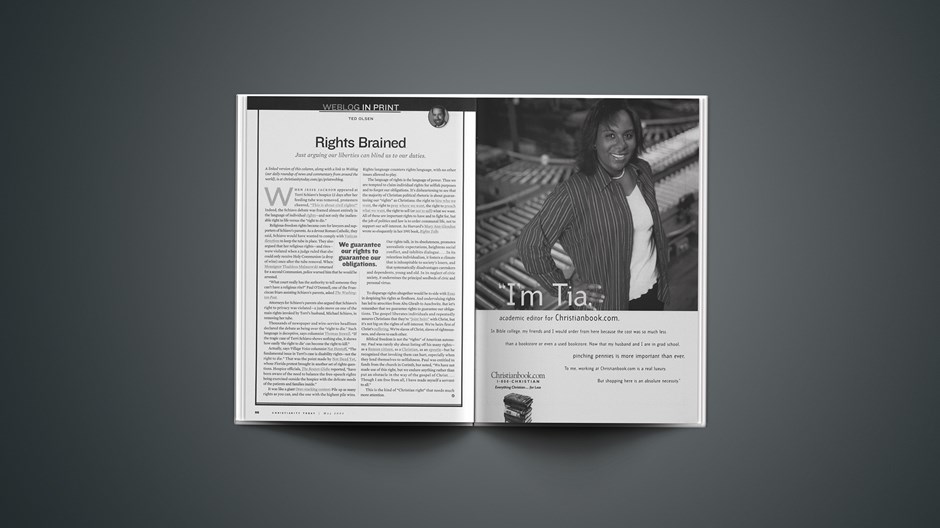
This column appeared in the magazine's May 2005 print issue as "Weblog in Print," CT's effort to duplicate on paper our popular online Weblog feature. Earlier entries include:
A Theoblogical Revolution | Billy Graham's vision goes from print to online, then back again. (Jan. 16, 2004; Weblog update: "New Kids on the Blog," Feb. 13, 2004)
Have something to add about this? See something we missed? Share your feedback here.
Ted Olsen is Christianity Today's executive editor. He wrote the magazine's Weblog—a collection of news and opinion articles from mainstream news sources around the world—from 1999 to 2006. In 2004, the magazine launched Weblog in Print, which looks for unexpected connections and trends in articles appearing in the mainstream press. The column was later renamed "Tidings" and ran until 2007.

















 While we pray for peace, we need moral clarity about this war.
 Church movements need magnetic leaders. But the best leaders need more than charm.
 Ethan Hawke has made a movie as scandalous as one of the writer’s short stories.