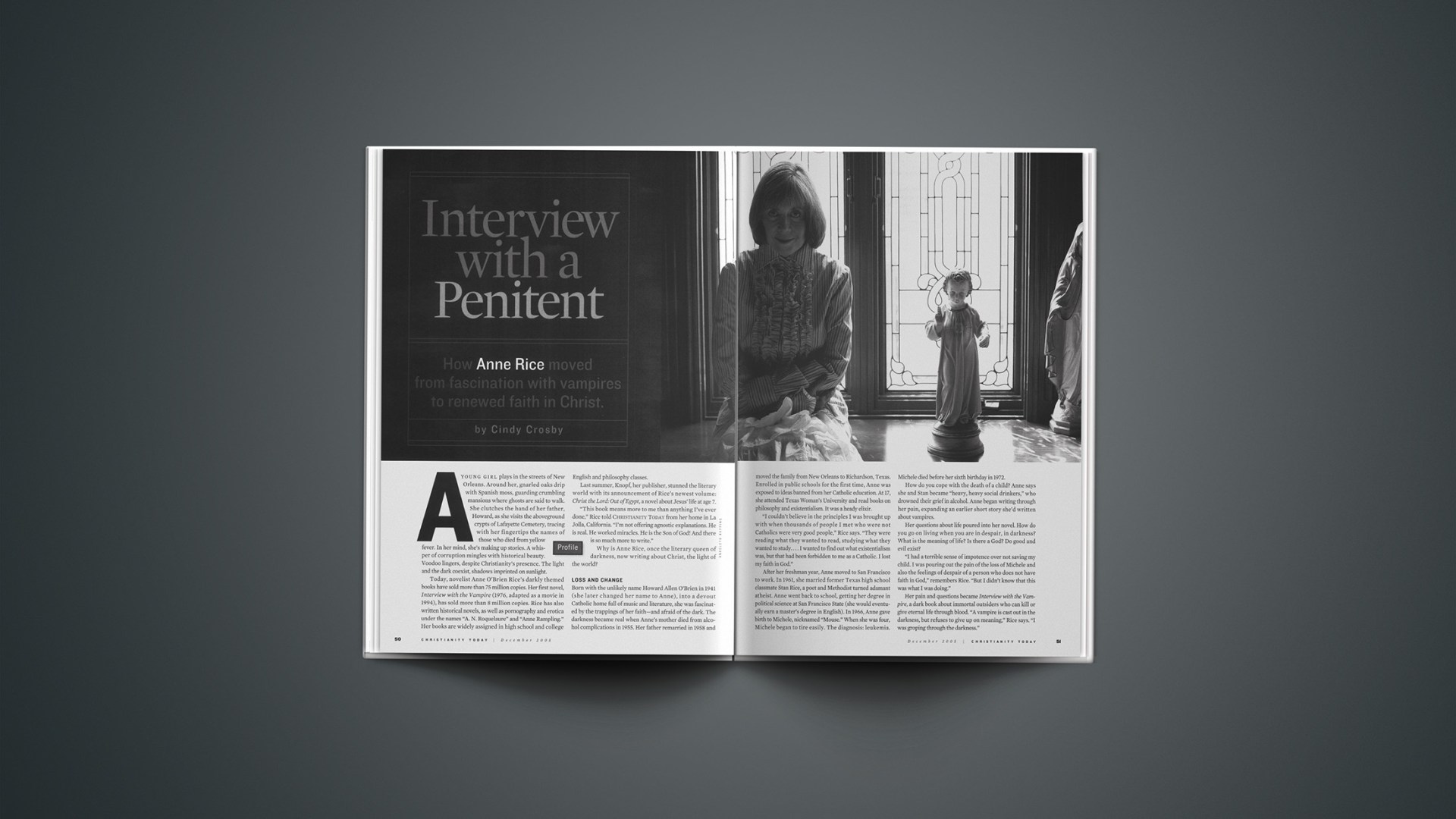
A young girl plays in the streets of New Orleans. Around her, gnarled oaks drip with Spanish moss, guarding crumbling mansions where ghosts are said to walk. She clutches the hand of her father, Howard, as she visits the aboveground crypts of Lafayette Cemetery, tracing with her fingertips the names of those who died from yellow fever. In her mind, she’s making up stories. A whisper of corruption mingles with historical beauty. Voodoo lingers, despite Christianity’s presence. The light and the dark coexist, shadows imprinted on sunlight.
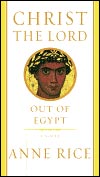 Christ the Lord:Out of Egypt by Anne Rice Knopf, 336 pp.; $25.95 |
Today, novelist Anne O’Brien Rice’s darkly themed books have sold more than 75 million copies. Her first novel, Interview with the Vampire (1976, adapted as a movie in 1994), has sold more than 8 million copies. Rice has also written historical novels, as well as pornography and erotica under the names “A. N. Roquelaure” and “Anne Rampling.” Her books are widely assigned in high school and college English and philosophy classes.
Last summer, Knopf, her publisher, stunned the literary world with its announcement of Rice’s newest volume: Christ the Lord: Out of Egypt, a novel about Jesus’ life at age 7.
“This book means more to me than anything I’ve ever done,” Rice told Christianity Today from her home in La Jolla, California. “I’m not offering agnostic explanations. He is real. He worked miracles. He is the Son of God! And there is so much more to write.”
Why is Anne Rice, once the literary queen of darkness, now writing about Christ, the light of the world?
Loss and Change
Born with the unlikely name Howard Allen O’Brien in 1941 (she later changed her name to Anne), into a devout Catholic home full of music and literature, she was fascinated by the trappings of her faith—and afraid of the dark. The darkness became real when Anne’s mother died from alcohol complications in 1955. Her father remarried in 1958 and moved the family from New Orleans to Richardson, Texas. Enrolled in public schools for the first time, Anne was exposed to ideas banned from her Catholic education. At 17, she attended Texas Woman’s University and read books on philosophy and existentialism. It was a heady elixir.
“I couldn’t believe in the principles I was brought up with when thousands of people I met who were not Catholics were very good people,” Rice says. “They were reading what they wanted to read, studying what they wanted to study. … I wanted to find out what existentialism was, but that had been forbidden to me as a Catholic. I lost my faith in God.”
After her freshman year, Anne moved to San Francisco to work. In 1961, she married former Texas high school classmate Stan Rice, a poet and Methodist turned adamant atheist. Anne went back to school, getting her degree in political science at San Francisco State (she would eventually earn a master’s degree in English). In 1966, Anne gave birth to Michele, nicknamed “Mouse.” When she was four, Michele began to tire easily. The diagnosis: leukemia. Michele died before her sixth birthday in 1972.
How do you cope with the death of a child? Anne says she and Stan became “heavy, heavy social drinkers,” who drowned their grief in alcohol. Anne began writing through her pain, expanding an earlier short story she’d written about vampires.
Her questions about life poured into her novel. How do you go on living when you are in despair, in darkness? What is the meaning of life? Is there a God? Do good and evil exist?
“I had a terrible sense of impotence over not saving my child. I was pouring out the pain of the loss of Michele and also the feelings of despair of a person who does not have faith in God,” remembers Rice. “But I didn’t know that this was what I was doing.”
Her pain and questions became Interview with the Vampire, a dark book about immortal outsiders who can kill or give eternal life through blood. “A vampire is cast out in the darkness, but refuses to give up on meaning,” Rice says. “I was groping through the darkness.”
When she read Rice’s manuscript, Victoria Wilson, then a new editor at Knopf, remembers “feeling my pulse quicken.” “Anne was writing about good and evil,” she says, “being on the outside and what that experience was like.” Wilson bought the book, which enjoyed modest success.
Rice’s next book, The Queen of the Damned (1988), brought her blockbuster status. Numerous books followed, many with themes from Rice’s past. “Even though you may not know you are writing from your own life, you make certain choices,” observes Wilson, now a vice president and senior editor at Knopf. “You can see what the writer is working out.”
“I got my fears out in my books,” Rice says.
In 1978, Anne and Stan gave birth to a son, Christopher. A year later, the couple quit drinking. In 1988, the family moved to New Orleans. Anne was now the toast of her hometown. She threw huge parties. Fans stood outside the gates of her Greek Revival townhouse waiting for autographs and pictures. Book sales soared. In a publicity stunt, Rice dressed as a bride and posed in a casket.
Now affluent, Anne added to an extensive collection of dolls and began new collections. Statues of the Catholic saints. Vestments. A library of Catholic books. Her former assistant, Amy Troxler, believes that Rice “still held a strong connection to her Catholic faith.”
Reading Her Way Back to God
Public attention had its downside, and Rice admits she can be withdrawn. To complete her novels, Rice had to escape into her room, reading, thinking, writing, and meticulously researching.
In 1993, she says, she became interested in the first century and the Jewish people. Rice recounts, “I remember thinking, ‘This doesn’t make sense—how did the Jews survive? People don’t survive these kinds of things! Their cities [were] smashed. What really happened at the beginning of Christianity?’ “
She read obsessively: John A. T. Robinson, Augustine, D. A. Carson, Jacob Neusner, Luke Timothy Johnson, Craig L. Blomberg. Slowly, the historicity of the Resurrection became hard to deny. “Christianity achieved what it did,” she says, “because Jesus rose from the dead.”
Rice had long conversations with Troxler, who had once studied to be a nun. They read passages from the Bible to each other, as did Anne and her sister Karen. Rice’s questions intensified. “The Lord came looking for me,” she remembers. “Everywhere I turned, I found images of the Lord and his love.”
Rice spent a lot of time sitting cross-legged in her room, her back to the bookcase, surrounded with books. Eventually, she says, “I read myself right back into faith.”
In 1998, she came to a crossroads. “I realized I didn’t have to find the answer to every question or know who was right on every issue. All I had to do is to love and do my best. The rest he would help me work out.”
The tipping point for Rice was a longing to take Communion. Catholics believe Christ is present in the sacraments—that they are his body and his blood. Rice called Troxler, asking, “Will they take me back?”
Troxler assured her the answer was yes. Rice went to see a priest, to whom she made her confession for two hours. She discussed her writing in depth, her personal failings, and her hopes for a better life. Although her husband Stan’s atheism had not changed, he readily agreed to be remarried in the Catholic church.
Making All Things New
Even before she returned to faith, Rice had pondered writing a novel about Jesus. In 2002, she determined to do it. “I was in church, talking to the Lord, saying, ‘I want everything I do to be for you,’ ” Rice remembers. “Then it hit me: ‘It will be for you. All of it. Every word.’ “
So Rice turned her research skills—honed from decades of writing historically based novels—to the New Testament. Rice decided to do something truly radical: treat the New Testament accounts as history. “Anyone can write a book about an off-the-wall Jesus, a magician. That’s easy,” Rice says. “But if we really believe the angel came to Mary, that there were shepherds, what was it like?
“It was more and more exciting to think about.”
Coming at the subject fresh, Rice was shocked by the bias in some quarters.
“I wasn’t prepared for the cynicism or bias against Jesus in biblical scholarship,” Rice says. “I didn’t know about the rancor in scholastic circles. People have built entire careers on tearing the gospel to pieces. I wasn’t prepared for the degree of acid and vitriol … credentialed scholars from universities saying there was no Virgin Birth or [Christ] never walked on water.
“I’ve studied a lot of history. Sound historians don’t make statements like this. But some New Testament scholars do.”
As she researched the New Testament, Rice was particularly impressed by N. T. Wright, the prolific bishop of Durham and the author of The Resurrection of the Son of God.
“I was blown away by the fact that he accommodated all the skeptics and did it with generosity,” Rice says. “He referenced their books and arguments and answered in his own brilliant, patient way and still maintained that Jesus rose from the dead. I had dreamed of this sort of scholarship.”
But just as she began work on her new novel, Stan, her husband of 41 years, was diagnosed with a brain tumor. He died in four months. Writing about the life of Christ through Stan’s illness and death sustained her, Rice says.
She now had an open-ended contract with Knopf to write anything she wanted, but she kept her topic a secret. Then, in 2004, Rice finally showed some early pages of Christ the Lord to Wilson, who admits she was “slightly apprehensive.” However, when Wilson, who describes herself as culturally Jewish, began reading, “Right away, I was amazed at how she got me to a sense of time and place.” “I loved the way she dealt with the Jewishness of her character,” Wilson says. “She was very deliberate about that.”
Christ the Lord tells the story of Jesus through first-person narrative, drawing on the Bible, the apocryphal Infancy Gospel of Thomas, and Catholic doctrine. Jesus is part of a large, warm extended family (in the novel, Joseph was previously married and widowed, so Rice’s Jesus has half-siblings). The family is returning to Nazareth after living in Egypt.
As with so many of Rice’s gothic-novel characters, Jesus is human, yet immortal, and an outsider with authority over life and death. Knopf has ordered a massive first printing of 325,000 for the novel and booked numerous media appearances. Rice plans to extend the series to three or four books and make the Christ who has captivated her “real” to readers.
Speaking about her spiritual journey from darkness to light, Rice muses, “Milton talks about the ‘fortunate fall.’ The fall is so fortunate because when we come back it is so wonderful … the mystery of it.”
It’s a big change for Rice—for some, too big to be believed. Rice says she’s hurt by critics on the internet: “Vicious attacks by those who don’t read my work … who are as angry about Christianity as they are about me.”
Rice’s own website, www.annerice.com, is a platform for everything from impassioned updates on the needs of post-hurricane New Orleans to Democratic politics and her views on controversial issues (her son, Christopher, also a novelist, is homosexual, and Anne is “an advocate for Christian and Jewish gays and their right to worship and to take the sacraments”).
To Christians who disagree with her views, Rice says, “Christians have been arguing with each other for 2,000 years. … What I hope for is that we can love one another, no matter how much we disagree; that we can embrace one another, no matter how tough the arguing becomes. … If we love, we can overcome much of what divides us as people.”
About her previous subjects, Rice says, “I would never go back, not even if they say, ‘You will be financially ruined; you’ve got to write another vampire book.’ I would say no. I have no choice. I would be a fool for all eternity to turn my back on God like that.”
At the same time, Rice doesn’t repudiate her earlier works, saying the books are a record of her journey. Readers tell her some of her early books pointed them back to faith, gave them courage, or helped them through grief. This book, Rice says, is for everyone. Rice says, “My attitude is, ‘Let me put this in your hands—please. Just take a look at it. This is about Jesus. It’s for you.’ “
As for this relatively new chapter in her life, Rice says, “I’ve had wonderful experiences as a writer. I’ve stepped out of limos in New York City to crowds wanting autographs and embracing me. There are no words for that. But this is the biggest adventure of my life. Thrilling beyond everything.”
Cindy Crosby’s reviews appear in CT’s Bookmarks. She is the author of three books, including By Willoway Brook (Paraclete, 2003), and lives in Glen Ellyn, Illinois.
Copyright © 2005 Christianity Today. Click for reprint information.
Related Elsewhere:
More about Anne Rice is available on her website.
Also posted today is:
Devil in the Details? | Horror-flick director seeks to confront postmodern culture with ultimate issues.
CT has explored the good and evil of vampires on television:
The Dick Staub Interview: TV’s Spiritual Directors, Buffy and Angel | As Angel enters the TV afterlife, the author of What Would Buffy Do? explores one of television’s more spiritual shows. (May 19, 2004)
Buffy and the Meaning of Life | Buffy the Vampire Slayer finally gets some respect. Too bad the life is slowly ebbing out of the show. (May 5, 2003)
Don’t Let Your Kids Watch Buffy the Vampire Slayer | But you can tape it and watch after they go to bed. (Sept. 18, 2002)
Other explorations of horror and good and evil include:
Are Evangelicals Fueling Teen Fascination with the Powers of Darkness? | The horror of Buffy Summers and the fantasy of Harry Potter draw from conservative religious imagery while fans feed on conservative opposition, says the author of From Angels to Aliens. (July 11, 2003)
Evangelicalism’s Dark Side and Popular Culture | Evangelicals may feel that stories of supernatural battles between good and evil belong to them, but they cannot control how these stories will be reconfigured once they enter the realm of entertainment media. (July 11, 2003)
The Devil Is Real. Therefore … | Evidence that demands a verdict. (from Books & Culture, November/December 2005)