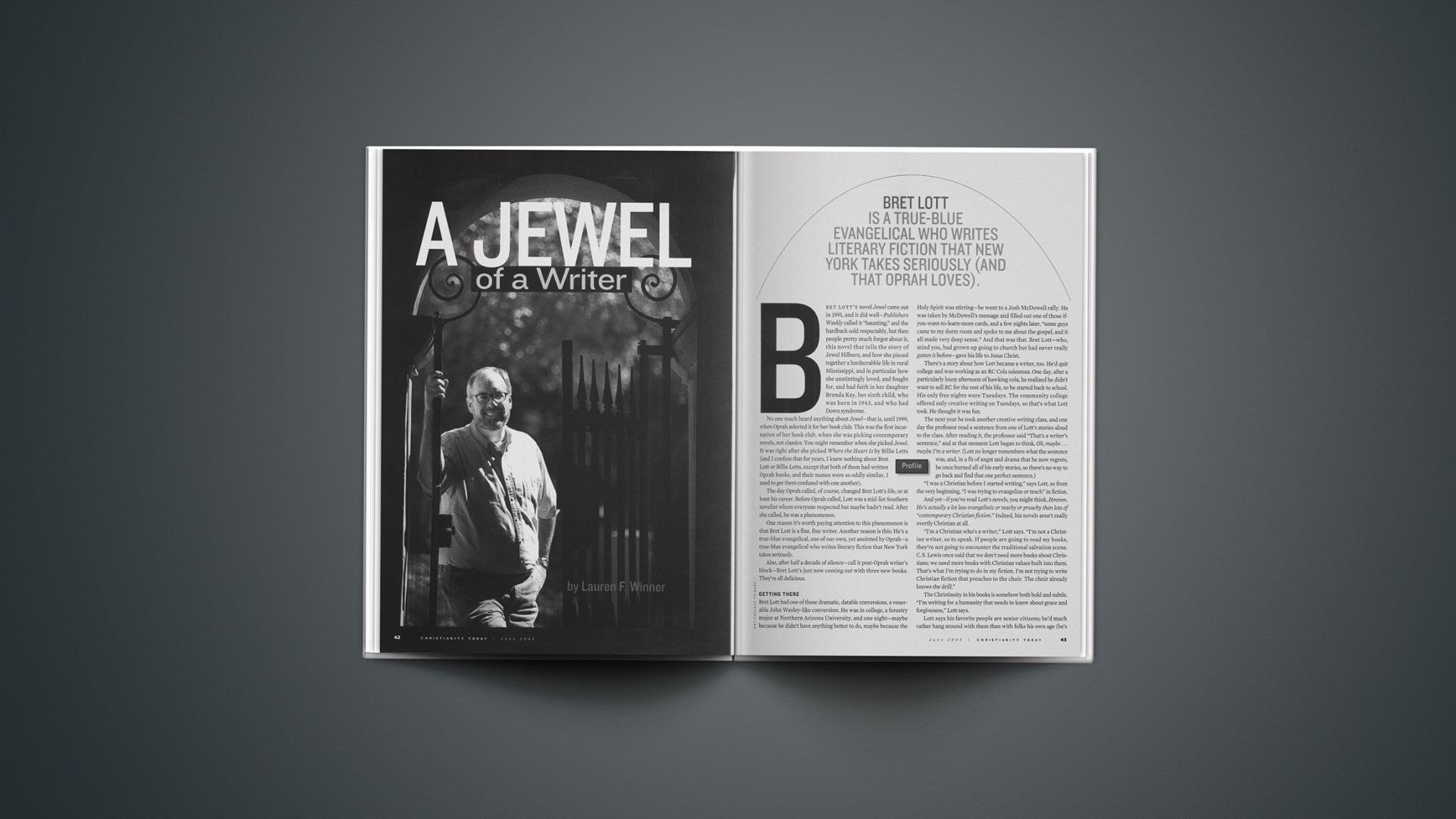

Bret lott’s novel Jewel came out in 1991, and it did well—Publishers Weekly called it “haunting,” and the hardback sold respectably, but then people pretty much forgot about it, this novel that tells the story of Jewel Hilburn, and how she pieced together a hardscrabble life in rural Mississippi, and in particular how she unstintingly loved, and fought for, and had faith in her daughter Brenda Kay, her sixth child, who was born in 1943, and who had Down syndrome.
No one much heard anything about Jewel—that is, until 1999, when Oprah selected it for her book club. This was the first incarnation of her book club, when she was picking contemporary novels, not classics. You might remember when she picked Jewel. It was right after she picked Where the Heart Is by Billie Letts (and I confess that for years, I knew nothing about Bret Lott or Billie Letts, except that both of them had written Oprah books, and their names were so oddly similar, I used to get them confused with one another).
The day Oprah called, of course, changed Bret Lott’s life, or at least his career. Before Oprah called, Lott was a mid-list Southern novelist whom everyone respected but maybe hadn’t read. After she called, he was a phenomenon.
One reason it’s worth paying attention to this phenomenon is that Bret Lott is a fine, fine writer. Another reason is this: He’s a true-blue evangelical, one of our own, yet anointed by Oprah—a true-blue evangelical who writes literary fiction that New York takes seriously.
Also, after half a decade of silence—call it post-Oprah writer’s block—Bret Lott’s just now coming out with three new books. They’re all delicious.
Getting There
Bret Lott had one of those dramatic, datable conversions, a venerable John Wesley-like conversion. He was in college, a forestry major at Northern Arizona University, and one night—maybe because he didn’t have anything better to do, maybe because the Holy Spirit was stirring—he went to a Josh McDowell rally. He was taken by McDowell’s message and filled out one of those if-you-want-to-learn-more cards, and a few nights later, “some guys came to my dorm room and spoke to me about the gospel, and it all made very deep sense.” And that was that. Bret Lott—who, mind you, had grown up going to church but had never really gotten it before—gave his life to Jesus Christ.
There’s a story about how Lott became a writer, too. He’d quit college and was working as an RC Cola salesman. One day, after a particularly lousy afternoon of hawking cola, he realized he didn’t want to sell RC for the rest of his life, so he started back to school. His only free nights were Tuesdays. The community college offered only creative writing on Tuesdays, so that’s what Lott took. He thought it was fun.
The next year he took another creative writing class, and one day the professor read a sentence from one of Lott’s stories aloud to the class. After reading it, the professor said “That’s a writer’s sentence,” and at that moment Lott began to think, Oh, maybe … maybe I’m a writer. (Lott no longer remembers what the sentence was, and, in a fit of angst and drama that he now regrets, he once burned all of his early stories, so there’s no way to go back and find that one perfect sentence.)
“I was a Christian before I started writing,” says Lott, so from the very beginning, “I was trying to evangelize or teach” in fiction.
And yet—if you’ve read Lott’s novels, you might think, Hmmm. He’s actually a lot less evangelistic or teachy or preachy than lots of “contemporary Christian fiction.” Indeed, his novels aren’t really overtly Christian at all.
“I’m a Christian who’s a writer,” Lott says. “I’m not a Christian writer, so to speak. If people are going to read my books, they’re not going to encounter the traditional salvation scene. C.S. Lewis once said that we don’t need more books about Christians; we need more books with Christian values built into them. That’s what I’m trying to do in my fiction. I’m not trying to write Christian fiction that preaches to the choir. The choir already knows the drill.”
The Christianity in his books is somehow both bold and subtle. “I’m writing for a humanity that needs to know about grace and forgiveness,” Lott says.
Lott says his favorite people are senior citizens; he’d much rather hang around with them than with folks his own age (he’s 46). “I’m intrigued by how people can live their life and have all the sorrow visited on every one of us and still live. How does that happen?”
Sometimes his subtlety has gotten Lott, who now attends a Southern Baptist church in Louisiana, into trouble. Shortly after his first novel, The Man Who Owned Vermont, came out, he got a letter from a woman in Wisconsin. She had picked up The Man Who Owned Vermont because she read a review that described it as a nice book about love and marriage (the novel tells the story of Paige and Rick Wheeler, and how their relationship is transformed by a miscarriage). The Wisconsin woman wasn’t happy. Somewhere in the first 100 pages, Lott—or, rather, one of Lott’s characters—had taken the Lord’s name in vain. “I’m praying for your soul,” the woman from Wisconsin wrote to him.
But Lott is going to keep drawing characters who take the Lord’s name in vain, and who indulge in a lot of backbiting and hard-heartedness and adultery, and other sinful behavior besides. “If we can’t portray sin,” he asks, “then how will we know it when we see it? Christ hung with the sinners. He knew what sin was. If we act like the only thing that ought to be portrayed with the written word is the ‘gee willikers’ type of bad guy, then we’re forgetting about the two robbers who died with Jesus. We’re forgetting about the adulterous woman. We’re forgetting about the tax collector.”
Unhappy Endings
And that is what you’ll find in Lott’s three new books. Before We Get Started: A Practical Memoir of the Writer’s Life grew out of Lott’s teaching at the Vermont College MFA program. It is a beautiful, humble book, the tone of which is set by this declaration: “The longer I write—and this is the one sure thing I know about writing—the harder it gets, and the more I hold close the truth that I know nothing.”
As with his novels, faith infuses, but is not explicit in, this memoir. “I didn’t want the book to be a devotional for the Christian crowd,” Lott says. “I wanted it to speak to writing at large. But if you can sniff between the lines, you see there’s something larger at stake.”
New this July is a collection of short stories, The Difference Between Women and Men. The stories are startling in their range—this is not just Lott writing about Southern women in the kitchen and at the Piggly Wiggly. This is Lott at times recalling John Cheever, and at times delving into Southern gothic.
“In these stories,” says Bruce Tracy, Lott’s editor at Random House, “Bret is flexing his stylistic muscles in a way people have not seen him do before.” Not all of the stories tie up with a neat, happy ending. “All stories shouldn’t have a happy ending,” Lott says. “Some of my books have an ending in which people must reconcile themselves to their lives. An ending is not about resolution, but reconciliation.”
Many Christian writers seem to think that in order for a novel to exemplify Christian themes, stories must end with the triumph of good over evil, salvation over damnation, and so on. But Lott’s work doesn’t wrap up so neatly. After all, we are living in a world where we have been reconciled but where not everything has been finally resolved. Here again, Lott’s stories differ from much of what you’ll find in the Christian fiction aisle of your local bookstore. Lott is subtle; he is changing our understanding of what “faith-infused fiction” looks like.
May saw the paperback release of A Song I Knew By Heart, which came out from Random House in hardcover in 2004. A modern-day retelling of the Ruth and Naomi story, this novel is a lot truer to biblical themes than many of the recent works reimagining Old Testament women in their time and place. A Song I Knew By Heart has so resonated with Christian readers that Random House brokered an unusual deal for the paperback release. Random House has brought out a paperback for the general market, while Thomas Nelson published a paperback for the Christian market.
“Our whole vision,” says Jenny Baumgartner, acquisitions editor at Thomas Nelson’s fiction imprint, WestBow, “is to partner with authors writing from a Christian worldview who are writing great fiction; Bret Lott is the poster boy for that. He’s writing great fiction, and he’s a Christian, and his worldview bleeds into his novels in a way that is not trite or formulaic.”
Thomas Nelson has chosen A Song I Knew By Heart as a Women of Faith selection, which means it will be featured at the wildly popular Women of Faith conferences and branded with the Women of Faith logo, which is something of a Good Housekeeping Seal of Approval for Christian women’s books. Baumgartner, borrowing Flannery O’Connor’s phrase, says Lott’s novels are naturally “Christ-haunted.”
“They don’t glorify any kinds of lascivious behaviors, and they recognize a God that is active in our lives. In Jewel, for example, Bret writes about the profound hopes a mother has for her daughter’s success and survival. As in all of his fiction, Bret mirrors a relationship with God, the inspiring depth of love, forgiveness, and hope.”
The characters in Lott’s fictional landscapes, says Baumgartner, overcome tremendous obstacles, larger-than-life obstacles. What distinguishes Lott’s novels from, say, many Oprah picks is how they overcome these obstacles. Secular writers create characters who overcome their problems through their own grit and determination. Lott, and his fictional protagonists, are leaning on something greater for strength and courage.
Lauren F. Winner is a CT contributing editor and author of Real Sex: The Naked Truth about Chastity (Brazos, 2005).
Copyright © 2005 Christianity Today. Click for reprint information.
Related Elsewhere:
Bret Lott is the author of the novels Jewel, A Song I Knew by Heart, Reed’s Beach, A Stranger’s House, and The Man Who Owned Vermont; the story collections The Difference Between Men and Women, How to Get Home and A Dream of Old Leaves; and the memoirs Fathers, Sons, and Brothers, Before We Get Started: A Practical Memoir of the Writer’s Life.
Oprah’s book club site has more information about Jewel and Bret Lott, including his favorite books and a letter to Oprah.
An interview with Lott is available from The Southern Scribe website.
For book lovers, see our book awards for 2005, 2004, 2003, 2002, 2001, 2000, 1999, 1998, and 1997, as well as our Books of the Twentieth Century. For other coverage or reviews, see our Books archive and the weekly Books & Culture Corner.