


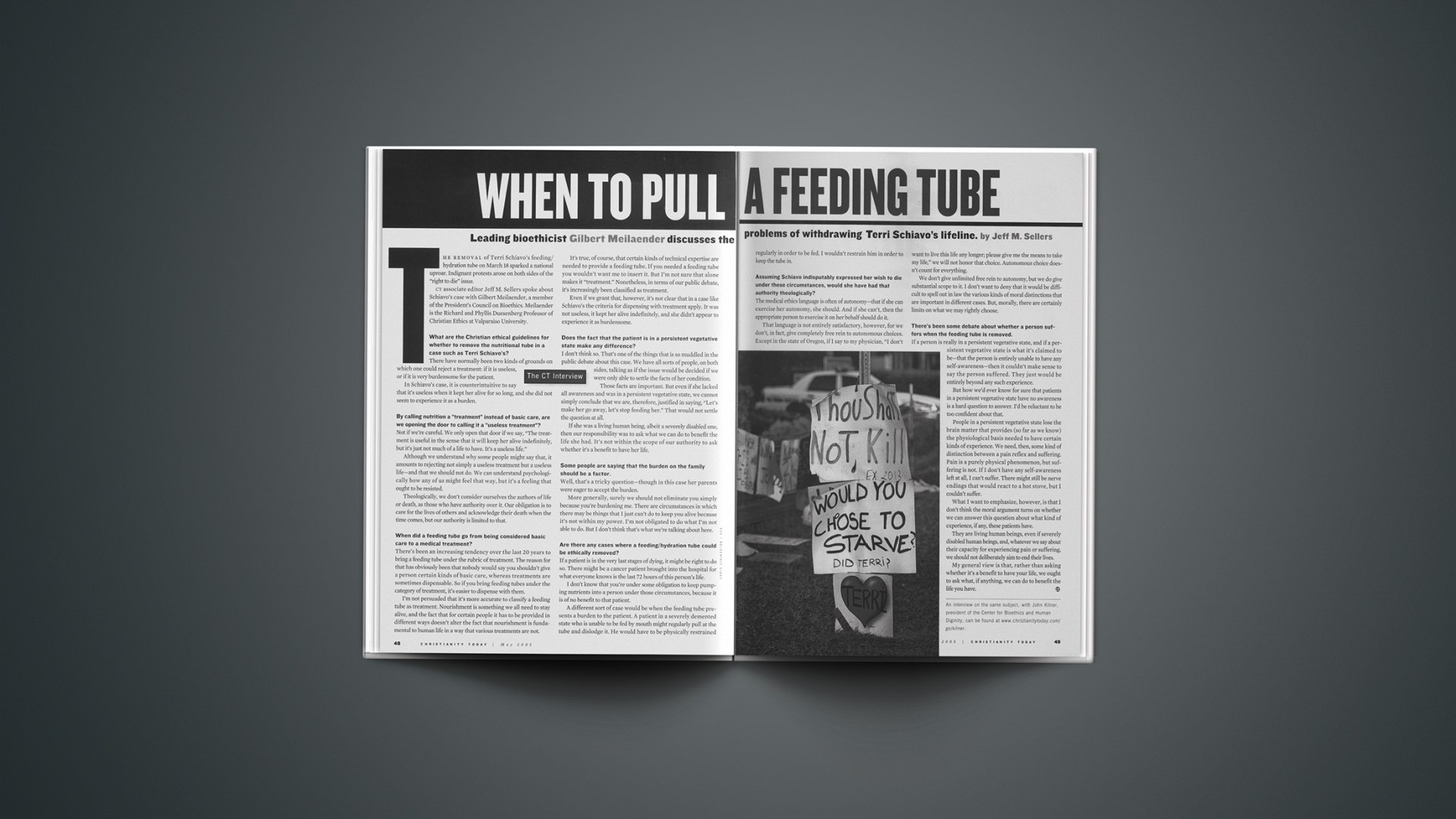
The removal of Terri Schiavo’s feeding/ hydration tube on March 18 sparked a national uproar. Indignant protests arose on both sides of the “right to die” issue.
CT associate editor Jeff M. Sellers spoke about Schiavo’s case with Gilbert Meilaender, a member of the President’s Council on Bioethics. Meilaender is the Richard and Phyllis Duesenberg Professor of Christian Ethics at Valparaiso University.
What are the Christian ethical guidelines for whether to remove the nutritional tube in a case such as Terri Schiavo’s?
There have normally been two kinds of grounds on which one could reject a treatment: if it is useless, or if it is very burdensome for the patient.
In Schiavo’s case, it is counterintuitive to say that it’s useless when it kept her alive for so long, and she did not seem to experience it as a burden.
By calling nutrition a “treatment” instead of basic care, are we opening the door to calling it a “useless treatment”?
Not if we’re careful. We only open that door if we say, “The treatment is useful in the sense that it will keep her alive indefinitely, but it’s just not much of a life to have. It’s a useless life.”
Although we understand why some people might say that, it amounts to rejecting not simply a useless treatment but a useless life—and that we should not do. We can understand psychologically how any of us might feel that way, but it’s a feeling that ought to be resisted.
Theologically, we don’t consider ourselves the authors of life or death, as those who have authority over it. Our obligation is to care for the lives of others and acknowledge their death when the time comes, but our authority is limited to that.
When did a feeding tube go from being considered basic care to a medical treatment?
There’s been an increasing tendency over the last 20 years to bring a feeding tube under the rubric of treatment. The reason for that has obviously been that nobody would say you shouldn’t give a person certain kinds of basic care, whereas treatments are sometimes dispensable. So if you bring feeding tubes under the category of treatment, it’s easier to dispense with them.
I’m not persuaded that it’s more accurate to classify a feeding tube as treatment. Nourishment is something we all need to stay alive, and the fact that for certain people it has to be provided in different ways doesn’t alter the fact that nourishment is fundamental to human life in a way that various treatments are not.
It’s true, of course, that certain kinds of technical expertise are needed to provide a feeding tube. If you needed a feeding tube you wouldn’t want me to insert it. But I’m not sure that alone makes it “treatment.” Nonetheless, in terms of our public debate, it’s increasingly been classified as treatment.
Even if we grant that, however, it’s not clear that in a case like Schiavo’s the criteria for dispensing with treatment apply. It was not useless, it kept her alive indefinitely, and she didn’t appear to experience it as burdensome.
Does the fact that the patient is in a persistent vegetative state make any difference?
I don’t think so. That’s one of the things that is so muddled in the public debate about this case. We have all sorts of people, on both sides, talking as if the issue would be decided if we were only able to settle the facts of her condition.
Those facts are important. But even if she lacked all awareness and was in a persistent vegetative state, we cannot simply conclude that we are, therefore, justified in saying, “Let’s make her go away, let’s stop feeding her.” That would not settle the question at all.
If she was a living human being, albeit a severely disabled one, then our responsibility was to ask what we can do to benefit the life she had. It’s not within the scope of our authority to ask whether it’s a benefit to have her life.
Some people are saying that the burden on the family should be a factor.
Well, that’s a tricky question—though in this case her parents were eager to accept the burden.
More generally, surely we should not eliminate you simply because you’re burdening me. There are circumstances in which there may be things that I just can’t do to keep you alive because it’s not within my power. I’m not obligated to do what I’m not able to do. But I don’t think that’s what we’re talking about here.
Are there any cases where a feeding/hydration tube could be ethically removed?
If a patient is in the very last stages of dying, it might be right to do so. There might be a cancer patient brought into the hospital for what everyone knows is the last 72 hours of this person’s life.
I don’t know that you’re under some obligation to keep pumping nutrients into a person under those circumstances, because it is of no benefit to that patient.
A different sort of case would be when the feeding tube presents a burden to the patient. A patient in a severely demented state who is unable to be fed by mouth might regularly pull at the tube and dislodge it. He would have to be physically restrained regularly in order to be fed. I wouldn’t restrain him in order to keep the tube in.
Assuming Schiavo indisputably expressed her wish to die under these circumstances, would she have had that authority theologically?
The medical ethics language is often of autonomy—that if she can exercise her autonomy, she should. And if she can’t, then the appropriate person to exercise it on her behalf should do it.
That language is not entirely satisfactory, however, for we don’t, in fact, give completely free rein to autonomous choices. Except in the state of Oregon, if I say to my physician, “I don’t want to live this life any longer; please give me the means to take my life,” we will not honor that choice. Autonomous choice doesn’t count for everything.
We don’t give unlimited free rein to autonomy, but we do give substantial scope to it. I don’t want to deny that it would be difficult to spell out in law the various kinds of moral distinctions that are important in different cases. But, morally, there are certainly limits on what we may rightly choose.
There’s been some debate about whether a person suffers when the feeding tube is removed.
If a person is really in a persistent vegetative state, and if a persistent vegetative state is what it’s claimed to be—that the person is entirely unable to have any self-awareness—then it couldn’t make sense to say the person suffered. They just would be entirely beyond any such experience.
But how we’d ever know for sure that patients in a persistent vegetative state have no awareness is a hard question to answer. I’d be reluctant to be too confident about that.
People in a persistent vegetative state lose the brain matter that provides (so far as we know) the physiological basis needed to have certain kinds of experience. We need, then, some kind of distinction between a pain reflex and suffering. Pain is a purely physical phenomenon, but suffering is not. If I don’t have any self-awareness left at all, I can’t suffer. There might still be nerve endings that would react to a hot stove, but I couldn’t suffer.
What I want to emphasize, however, is that I don’t think the moral argument turns on whether we can answer this question about what kind of experience, if any, these patients have.
They are living human beings, even if severely disabled human beings, and, whatever we say about their capacity for experiencing pain or suffering, we should not deliberately aim to end their lives.
My general view is that, rather than asking whether it’s a benefit to have your life, we ought to ask what, if anything, we can do to benefit the life you have.
Copyright © 2005 Christianity Today. Click for reprint information.